
- Published on
Prophetic Diet in Islam: What the Prophet Actually Ate
- Authors

- Name
- Ahmad
- Role
- Senior Marketing Manager, Islamic education • Deen Back
بِسْمِ اللهِ الرَّحْمٰنِ الرَّحِيْمِ
In the name of God, the Most Gracious, the Most Merciful.
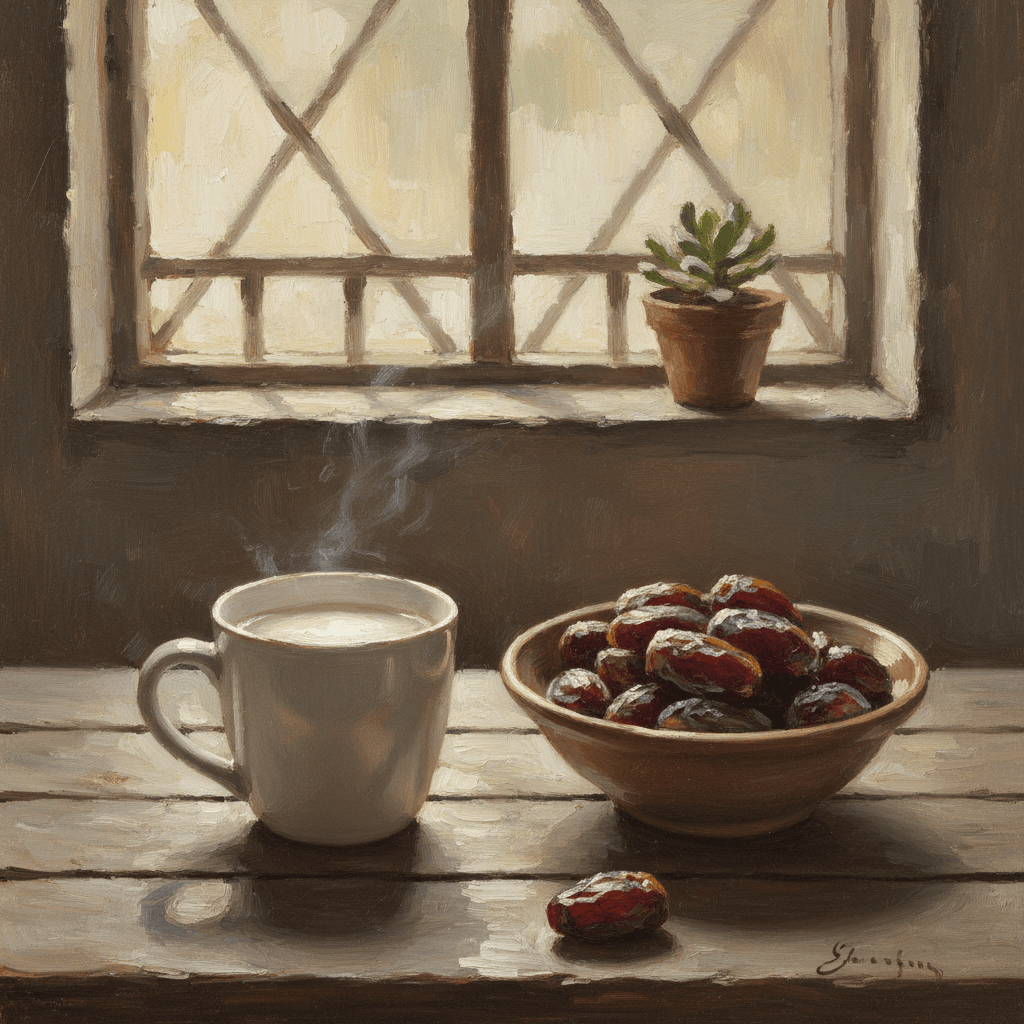
There is a gap between knowing the Prophetic sunnah about food and actually eating differently. Most Muslims can tell you the Prophet said to eat one-third and stop. Most Muslims still eat until they are full.
This is not a failure of knowledge. It is a challenge of the nafs — the lower self that says yes to the plate before the mind has a chance to say enough.
The Prophetic diet was not a meal plan. It was a demonstration of something deeper: that how you eat reflects who controls you — your appetites or your values.
What the Prophet Actually Ate
The hadith literature is rich with descriptions of the Prophet's ﷺ food habits. Piecing them together reveals not a diet in the modern marketing sense, but a way of relating to food.
Dates were the staple. The Prophet ﷺ often broke his fast with dates, ate them alone as a meal, and recommended them highly. He said: "Whoever has seven dates of Ajwa in the morning will not be harmed by poison or magic that day." (Sahih Bukhari 5445)
Bread — particularly barley bread — was a common staple in the prophetic household. Not the soft refined bread of modern bakeries, but dense, filling, and modest.
Milk was a beloved drink. The Prophet specifically recommended camel milk for its healing properties in certain conditions, and drank goat and camel milk regularly.
Honey was described by the Prophet as a cure: "There is a cure for every disease in honey." (Sahih Bukhari 5684). He ate it and recommended it.
Olive oil — the Prophet said: "Eat olive oil and anoint yourselves with it, for it comes from a blessed tree." (Tirmidhi 1851)
Dates appeared constantly — eaten alone, with water, or with butter. The Prophet said that a household with dates would never go hungry.
Meat was eaten occasionally — not avoided, but not a daily food. Lamb was preferred. The Prophet ﷺ loved pumpkin (gourd), and when it appeared at meals, he would pick it out. He also ate cucumbers with dates.
Vinegar was praised: "What an excellent condiment vinegar is." (Sahih Muslim 2052)
What he consistently did not do: eat large quantities, eat multiple courses, eat for entertainment, or eat late at night without need.
Why Modern Muslims Struggle With This
The prophetic example is clear. The gap between knowing it and living it is wide. Here is what is happening in that gap.
Modern food is engineered for overconsumption. The flavors, the textures, the convenience — all calibrated to bypass the signal that says enough. The Prophet ﷺ ate food that was simple enough that his body could actually regulate it.
Social eating has become performative. Eating in community is a sunnah — but today it often means pressure to eat more than you need, to accept second helpings, to treat food as a demonstration of hospitality rather than a practical fuel stop.
The nafs treats food as a comfort mechanism. Stress, boredom, loneliness — modern life drives people to the kitchen for reasons that have nothing to do with hunger. The Prophet's relationship with food was instrumental: it was for sustaining the body for worship, not for managing emotional states.
How to Apply the Prophetic Diet Today
Start with the one-third rule. This is the most foundational habit change. Before finishing a meal, ask: am I one-third full? Then stop eating for a moment and actually check in with your body. You do not need to hit one-third exactly — you need to stop treating fullness as the only valid stopping point.
Eat sunnah foods regularly. This is not about eliminating modern food — it is about building a habit of including the foods the Prophet recommended. Dates in the morning instead of cereal. Honey instead of processed sweeteners where possible. Olive oil for cooking. These small substitutions build a different relationship with food over time.
Observe the sunnah timing habits. The Prophet ate suhoor (predawn meal) and delayed iftar (breaking the fast). He did not eat immediately before sleep. He encouraged light eating at night. These timing patterns have significant metabolic support in modern nutrition research.
Say bismillah and eat with intention. The sunnah of saying bismillah before eating is not just a ritual — it is a psychological anchor that slows you down, creates a moment of consciousness before you begin, and situates the meal within gratitude to Allah. The Prophet also discouraged criticizing food and encouraged eating with the right hand from what is closest to you.
Practice voluntary fasting. The Prophet ﷺ fasted on Mondays and Thursdays, and the white days (13th, 14th, 15th of the lunar month). Voluntary fasting is perhaps the single most powerful tool for resetting your relationship with food. It teaches the nafs that appetite is not an emergency — that hunger can be experienced without being immediately resolved. The prophetic medicine framework sees fasting as healing precisely for this reason.
Track Your Prophetic Eating Habits
DeenBack lets you set reminders for sunnah fasting days, track your bismillah habit, and build the daily consistency that transforms how you relate to food and nafs.


Free download. Premium features available in-app.
Signs That This Approach Is Working
The Prophetic diet is not a weight loss program. But some signs that you are moving in the right direction:
You no longer feel compelled to finish what is in front of you. The plate does not command you.
You notice hunger as information rather than an emergency. A few hours without food feels manageable, not catastrophic.
Your salah after eating feels lighter. You can stand in prayer without the heaviness of a full stomach making you want to cut it short.
You find yourself genuinely less interested in food as entertainment. Simple foods satisfy more than complex ones used to.
Common Questions
Is the Prophetic diet halal in itself? Do I have to follow it?
The Prophetic diet is sunnah — following it is recommended and rewarded, but it is not fard. The obligatory rules are about halal/haram ingredients, not meal structure or quantities. However, following the sunnah approach to food brings genuine benefit and is itself an act of love for the Prophet ﷺ.
Can I still eat modern foods and follow the spirit of the Prophetic diet?
Yes. The spirit of the Prophetic diet is: eat simply, eat moderately, eat with consciousness, and do not let food rule you. You can apply that spirit to whatever food is available to you. The Prophet ate what was available in his context — simplicity and moderation were the constants, not the specific ingredients.
What about processed foods, sugar, and modern foods the Prophet never ate?
There is no ruling that makes processed food haram in itself (as long as ingredients are halal). But the Prophetic principle of avoiding excess applies directly: if a food is eaten in excess and clearly harms the body, that falls under the prohibition of harm. Islam's general rule is that harm to the body is impermissible.
Is it sunnah to fast every Monday and Thursday?
Yes. This is a well-established sunnah. The Prophet ﷺ said he liked his deeds to be presented on Monday and Thursday, and would fast on those days. See how to fast correctly for guidance on voluntary fasting.
Closing
The Prophet did not eat like a king. He ate like a servant of Allah — food was fuel for worship, not entertainment for the nafs.
The gap between his example and modern Muslim eating habits is significant. But it closes one habit at a time: starting with bismillah, pausing before the plate is empty, adding a date to the morning, fasting on Mondays.
None of this requires perfection. It requires direction.
Build Habits That Honor the Sunnah
From voluntary fasting reminders to daily sunnah tracking, DeenBack helps you apply the Prophetic lifestyle — one small daily practice at a time.
Free download. Premium features available in-app.
Frequently Asked Questions
What did the Prophet Muhammad eat most often?
The Prophet's most common foods were dates, bread (especially barley bread), water, milk, honey, olive oil, vinegar, meat (particularly lamb when available), and vegetables like pumpkin. He ate simply and rarely to excess. He often went days eating only a few dates or drinking only water or milk.
Did the Prophet eat meat every day?
No. Meat was a luxury that the Prophet ate occasionally, not daily. When it was available, he preferred lamb and goat. He did not eat predatory animals or animals not slaughtered according to Islamic rites. Modern Muslims who eat meat at every meal are far from the Prophetic example.
Is the Prophetic diet scientifically proven to be healthy?
Many elements of the Prophetic diet align with what modern nutrition science recommends: dates for natural sugar and fiber, olive oil for healthy fats, honey for antimicrobial properties, moderation in quantity, avoiding excess. It was not designed as a health program, but it reflects a disciplined, natural approach to eating that modern research increasingly validates.
What did the Prophet say about eating too much?
The Prophet said: 'The human being does not fill any container worse than his stomach. It is sufficient for the son of Adam to have a few mouthfuls that support his back. If it is unavoidable, then one third for his food, one third for his drink, and one third for his breath.' (Tirmidhi 2380). This principle of the one-third rule is perhaps the most famous Prophetic dietary guidance.