
- Published on
Dua for Tahajjud: Praying in the Night When No One Is Watching
- Authors

- Name
- Ahmad
- Role
- Senior Marketing Manager, Islamic education • Deen Back
بِسْمِ اللهِ الرَّحْمٰنِ الرَّحِيْمِ
In the name of God, the Most Gracious, the Most Merciful.
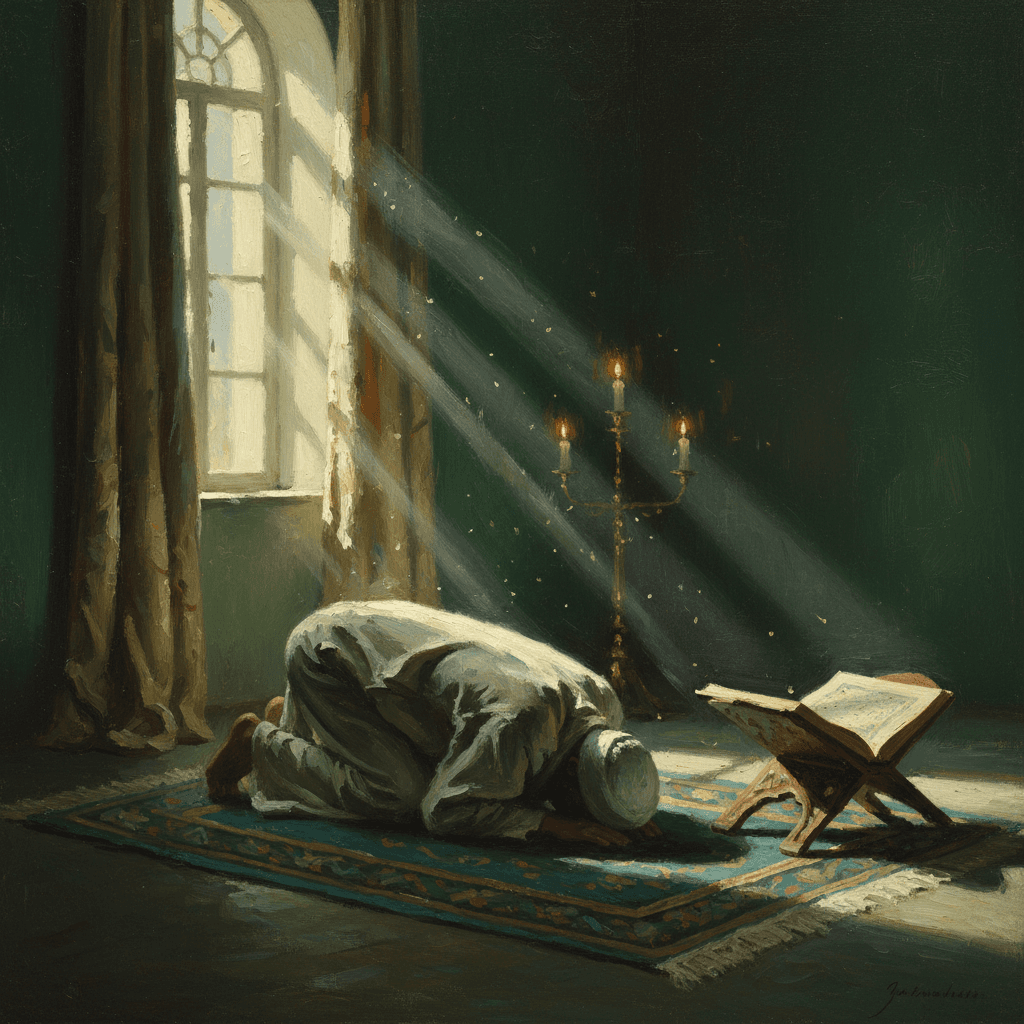
There is a version of you that nobody sees. The version that wakes in the dark, stands on a prayer mat, and asks Allah for things you would not say out loud to anyone else.
That version is built through Tahajjud.
The Prophet (peace be upon him) never abandoned the night prayer — not on a normal night, not while traveling, not even when he was unwell. His wife Aisha (may Allah be pleased with her) said he would stand so long in Tahajjud that his feet would swell. When she asked why, he replied: "Should I not be a grateful servant?" (Bukhari 4837)
Tahajjud is not just extra worship. It is the practice that builds the inner life nobody else sees — the one that holds you together when things fall apart.
The Dua for Tahajjud
The opening dua — said when rising for Tahajjud
اللَّهُمَّ لَكَ الْحَمْدُ أَنْتَ قَيُّومُ السَّمَوَاتِ وَالأَرْضِ وَمَنْ فِيهِنَّ وَلَكَ الْحَمْدُ لَكَ مُلْكُ السَّمَوَاتِ وَالأَرْضِ وَمَنْ فِيهِنَّ، وَلَكَ الْحَمْدُ أَنْتَ نُورُ السَّمَوَاتِ وَالأَرْضِ، وَلَكَ الْحَمْدُ أَنْتَ الْحَقُّ وَوَعْدُكَ الْحَقُّ وَلِقَاؤُكَ حَقٌّ وَقَوْلُكَ حَقٌّ وَالْجَنَّةُ حَقٌّ وَالنَّارُ حَقٌّ وَالنَّبِيُّونَ حَقٌّ وَمُحَمَّدٌ صلى الله عليه وسلم حَقٌّ وَالسَّاعَةُ حَقٌّ، اللَّهُمَّ لَكَ أَسْلَمْتُ وَبِكَ آمَنْتُ وَعَلَيْكَ تَوَكَّلْتُ وَإِلَيْكَ أَنَبْتُ وَبِكَ خَاصَمْتُ وَإِلَيْكَ حَاكَمْتُ فَاغْفِرْ لِي مَا قَدَّمْتُ وَمَا أَخَّرْتُ وَمَا أَسْرَرْتُ وَمَا أَعْلَنْتُ، أَنْتَ الْمُقَدِّمُ وَأَنْتَ الْمُؤَخِّرُ لَا إِلَهَ إِلاَّ أَنْتَ
Allahumma lakal hamd, anta qayyumus samawati wal-ardi wa man fihinn. Wa lakal hamd, laka mulkus samawati wal-ardi wa man fihinn. Wa lakal hamd, anta nurus samawati wal-ard. Wa lakal hamd, antal haqq, wa wa'duka al-haqq, wa liqa'uka haqq, wa qawluka haqq, wal-jannatu haqq, wan-naru haqq, wan-nabiyyuna haqq, wa Muhammadun sallallahu alayhi wa sallam haqq, was-sa'atu haqq. Allahumma laka aslamtu, wa bika amantu, wa alayka tawakkaltu, wa ilayka anabtu, wa bika khasamtu, wa ilayka hakamtu. Faghfir li ma qaddamtu wa ma akhkhartu wa ma asrartu wa ma a'lantu. Antal muqaddimu wa antal mu'akhkhiru, la ilaha illa ant.
"O Allah, all praise is for You. You are the Sustainer of the heavens and the earth and all that is in them. All praise is for You — Yours is the dominion of the heavens and earth and all that is in them. All praise is for You — You are the Light of the heavens and earth. All praise is for You — You are the Truth, Your promise is true, Your meeting is true, Your word is true, Paradise is true, the Fire is true, the Prophets are true, Muhammad (peace be upon him) is true, and the Hour is true. O Allah, to You I submit, in You I believe, in You I place my trust, to You I turn, for You I dispute, and to You I submit for judgment. Forgive me for what I have done before and what I have done later, what I have done in secret and what I have done openly. You are the One who advances and the One who delays — there is no god but You." — (Bukhari 1120)
Say this after waking and before starting the prayer, or use it as your opening supplication between the iqamah and the first Takbir of prayer.
The Story Behind It
Aisha (may Allah be pleased with her) narrated: "The Prophet (peace be upon him) used to pray eleven rakahs at night. When Fajr came, he would pray two light rakahs, then lie on his right side until the caller to prayer came to him." (Bukhari 1123)
What is remarkable about this is the consistency. The Prophet maintained his Tahajjud even when he was tired, even in difficulty, even in times of joy. He did not practice Tahajjud only in hardship when he needed something. He prayed it as a standing relationship with Allah — a nightly appointment that did not get cancelled.
There is also this narration from Abu Hurayrah (may Allah be pleased with him): The Prophet said — "Our Lord descends to the lowest heaven every night in the last third of the night and says: Who is calling upon Me, that I may answer? Who is asking of Me, that I may give? Who is seeking My forgiveness, that I may forgive?" (Bukhari 1145)
The Tahajjud prayer places you exactly in that window. You are not just praying extra — you are showing up at the time when the door is widest open.
How to Make Tahajjud a Consistent Habit
Tahajjud is the one prayer that most Muslims deeply want to pray consistently and almost none actually do. The gap between intention and action is almost always the same thing: waking up.
Here is how to close that gap.
Start with one night a week
Do not promise yourself you will pray Tahajjud every night from now on. That commitment breaks by week two, and when it breaks you feel worse than before you started. Instead, choose one night — Thursday night is a sunnah-aligned choice, as Fridays are elevated days. Set an alarm 45 minutes before Fajr. Pray two rakah. That is it.
One night a week, done consistently for a month, is worth more than seven nights a week promised and abandoned.
Use the physical trigger: feet on the floor
The hardest part of Tahajjud is getting out of bed. Not the prayer itself — that feels beautiful once you start. The battle is the moment your alarm goes off. The only counter to this is a commitment rule: when the alarm rings, feet hit the floor within 30 seconds. No negotiating, no "five more minutes." Standing is the point of no return — once you are standing, you will almost always make wudu and pray.
Keep your prayer mat out the night before
A prayer mat laid out the night before is a small environmental nudge that makes Tahajjud slightly easier. You have already set your intention visibly. When you wake, the mat is waiting. Friction matters in habit formation — reduce it wherever you can.
Make your du'a before the sunrise and the day fills in
After the rakahs of Tahajjud, sit in sujud or sit facing the qiblah and make personal du'a. This is when you say the things that are heaviest on your heart — ask for your marriage, your health, your provision, your parents, your children, whatever carries the most weight. Nobody is awake. No one is watching. It is just you and Allah in the last third of the night.
Connect Tahajjud to suhoor (in Ramadan)
In Ramadan, suhoor gives you a natural reason to be awake before Fajr. Use the time before eating for Tahajjud. This habit — Tahajjud then suhoor then Fajr — is one of the most powerful Ramadan routines and it mirrors what the Prophet's household practiced. See dua for suhoor to build the full pre-Fajr sequence.
Build Your Tahajjud Habit One Night at a Time
DeenBack helps you track your night prayer streak, store your personal duas, and build the kind of consistent worship practice that actually sticks. Start with one night a week.


Free download. Premium features available in-app.
Related Duas
Dua for sleeping: The Tahajjud habit starts the night before — with the right sleep intention and a reasonable bedtime. See the dua for sleeping for the complete prophetic bedtime routine.
Dua for waking up: Between Tahajjud and Fajr, the dua for waking up marks the transition from sleep to consciousness as its own act of worship.
Duas for Witr: Tahajjud is typically capped with Witr prayer. See duas for Witr for what to say in the Witr qunut and how to close the night prayer properly.
Dua for Laylatul Qadr: The most powerful night of the year is spent in Tahajjud. See the dua for Laylatul Qadr for the specific supplication the Prophet taught for the Night of Power.
Common Questions
What is the difference between Tahajjud and Qiyam al-Layl?
Qiyam al-Layl means "standing in the night" — it refers to any voluntary night prayer. Tahajjud specifically refers to voluntary prayer after sleeping and then waking. Technically, Tahajjud is a subset of Qiyam al-Layl. In common usage, Muslims often use the terms interchangeably. Either way, praying at night is a valuable act of worship regardless of whether you slept first.
Can I combine Tahajjud and Witr or pray them separately?
Many scholars recommend praying Witr after Tahajjud as a single closing set — meaning you pray your Tahajjud rakahs and then seal the night prayer with Witr. If you already prayed Witr after Isha and then wake for Tahajjud, you can add more rakahs but it is typically not recommended to repeat Witr in the same night unless you make it even.
Does Tahajjud have to be a specific number of rakah?
No. The minimum is two rakah. The Prophet typically prayed eight or eleven rakahs (including Witr), but he explicitly said: "The night prayer is two by two." (Bukhari 990) Two rakah sincerely prayed is Tahajjud. Do not let the perceived length of the "full" Tahajjud stop you from praying what you can.
What if I cannot wake up for Tahajjud no matter what I try?
The Prophet said: "When a person sleeps, Shaytan ties three knots at the back of his head... if he wakes and makes dhikr, one knot is untied..." (Bukhari 1142). Some practical steps: sleep earlier, make sincere intention before sleep, ask Allah to wake you, and use a second alarm in another room. If you still struggle — pray two rakah of night prayer immediately after Isha, before sleeping, and build from there.
Closing
The Prophet (peace be upon him) was asked which prayer is best after the obligatory ones. He said: "Night prayer." (Muslim 1163)
Most of us will go through life never building this habit — not because we do not want it, but because we never treat it as something that requires a plan.
Start with one night. Wake 45 minutes before Fajr. Stand on the mat. Say the opening dua. Pray two rakah. Make du'a for the thing you most need right now. Then go back to sleep or wait for Fajr.
Do that one night this week. Then again next week. That is how the habit starts — not with a grand commitment, but with one quiet night at a time.
Start Your Night Prayer Habit This Week
DeenBack helps you track your Tahajjud streak, save your personal duas, and build the night prayer habit the Prophet called the best voluntary worship — one night at a time.
Free download. Premium features available in-app.
Frequently Asked Questions
What dua did the Prophet say at the start of Tahajjud?
The Prophet (peace be upon him) would begin Tahajjud with: Allahumma lakal hamd anta qayyimus samawati wal-ard wa man fihinn... (Bukhari 1120). This opening dua is a declaration of Allah's praise and a statement of total dependence before making any personal requests.
How many rakah is Tahajjud?
There is no fixed minimum or maximum. The Prophet prayed Tahajjud in sets of two rakah, typically 8 rakah followed by Witr (1 or 3 rakah). He said: The night prayer is two by two — if you fear Fajr is approaching, pray one Witr. (Bukhari 990). You can pray as few as 2 rakah and it counts.
Can I pray Tahajjud without sleeping first?
Tahajjud specifically means prayer after sleeping at night and then waking. If you pray before sleeping, it is called Qiyam al-Layl or simply night prayer. Both are valid and rewarding forms of voluntary night worship. If you cannot sleep and wake, praying before sleep is still an excellent act.
What is the best time for Tahajjud?
The last third of the night — the final third before Fajr — is the best time. This is when Allah descends to the lowest heaven and calls out asking who is making du'a, who is asking, and who seeks forgiveness. (Bukhari 1145). Calculate this by dividing the time between Isha and Fajr into thirds and praying in the final third.
What should I ask for in Tahajjud?
Tahajjud dua is personal. After the opening dua from Bukhari 1120, ask for anything — forgiveness, healing, rizq, guidance, a specific worry you carry. The Prophet said: Our Lord descends... and says: Who is calling upon Me, that I may answer? The night prayer is one of the few times you have this kind of direct spiritual access. Use it for whatever is heaviest on your heart.