
- Published on
How to Make Tahajjud a Daily Habit
- Authors

- Name
- Ahmad
- Role
- Senior Marketing Manager, Islamic education • Deen Back
بِسْمِ اللهِ الرَّحْمٰنِ الرَّحِيْمِ
In the name of God, the Most Gracious, the Most Merciful.
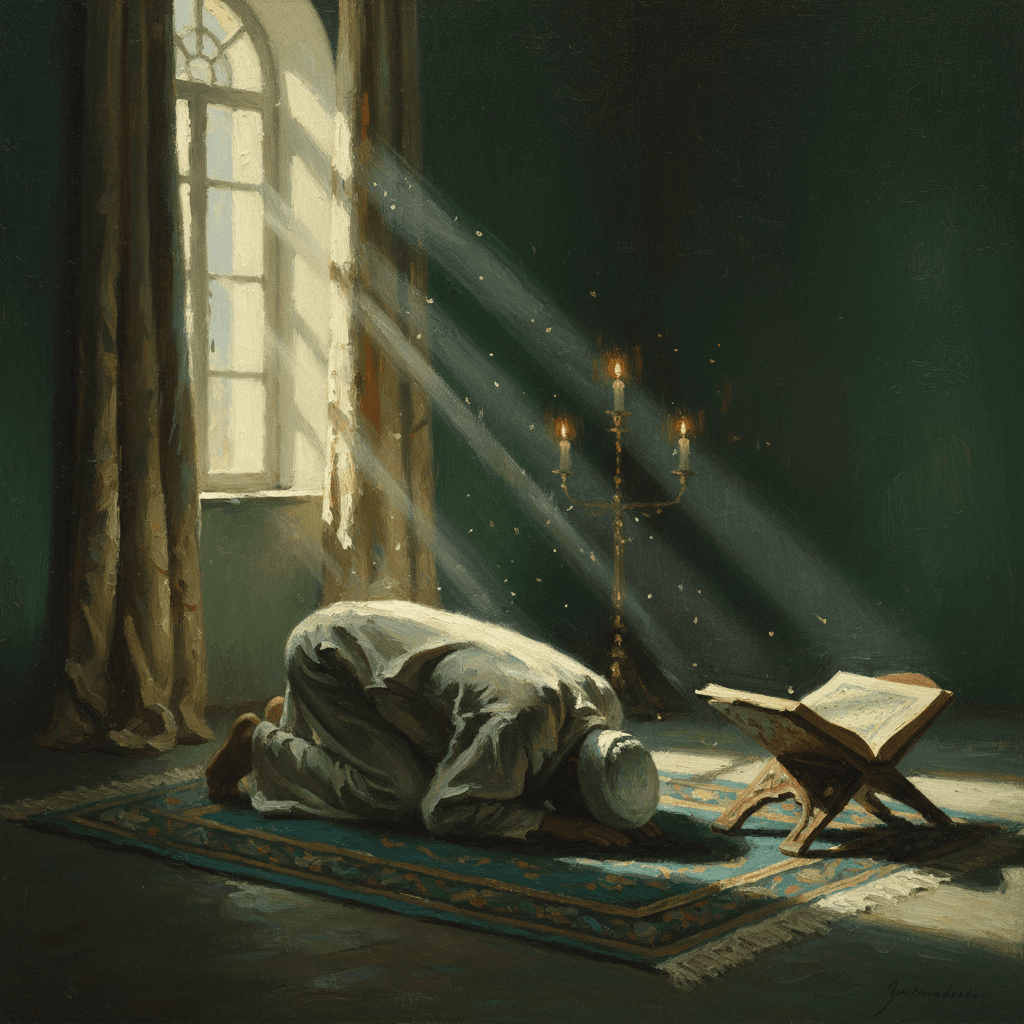
You have tried. You set the alarm. Maybe you even woke up once or twice — bleary-eyed, cold, shuffling to the bathroom — and prayed those two rakats. And it felt beautiful. Genuinely different from any prayer you had prayed before.
Then life intervened. The alarm became a snooze. The rare became non-existent. You are still hoping to make Tahajjud a regular practice, but right now "regular" means "maybe once a month when I happen to wake up anyway."
The gap between intention and consistency is exactly what this article is about.
Why Tahajjud Matters — The Islamic Foundation
Allah singles out the night prayer in the Quran:
وَمِنَ اللَّيْلِ فَتَهَجَّدْ بِهِ نَافِلَةً لَّكَ عَسَىٰ أَن يَبْعَثَكَ رَبُّكَ مَقَامًا مَّحْمُودًا
"And from part of the night, pray Tahajjud as an additional prayer for you — your Lord will raise you to a praised station."
— (Surah Al-Isra, 17:79)
The Prophet ﷺ also said: "The most virtuous prayer after the obligatory ones is the night prayer." (Sahih Muslim 1163)
And perhaps most motivatingly, Allah descends to the lowest heaven in the last third of every night asking: "Who is supplicating so that I may respond? Who is asking so that I may give? Who is seeking forgiveness so that I may forgive?" (Sahih Bukhari 1145)
This happens every single night. The question is whether you are awake to receive it.
The gap between most Muslims and consistent Tahajjud is not a gap of knowledge — you know it is virtuous. It is a gap of system, environment, and nafs management. This guide closes that gap.
Step-by-Step Guide to Making Tahajjud a Habit
Step 1: Start absurdly small
The most common mistake is starting with eight rakats, long supplications, and an ambition to pray for an hour. This fails within a week because the activation energy is too high.
Start with two rakats. That is it. Two rakats, a brief dua, and done. The bar needs to be low enough that on the hardest night — when you are exhausted, when everything feels like too much — you will still do it. Two rakats you can always do.
The Prophet ﷺ said: "The most beloved deeds to Allah are the most consistent ones, even if they are small." (Sahih Bukhari 6465) Two rakats every night is infinitely more beneficial than eight rakats once.
Step 2: Sleep earlier — non-negotiable
You cannot wake up at 3am after sleeping at 1am and expect this to be sustainable. Tahajjud is only possible if the rest of your night is managed.
One hour earlier to bed = one Tahajjud possible. Make this trade. If you are losing sleep over phone scrolling, social media, or entertainment, you are spending your Tahajjud time on something far less valuable.
Step 3: Make the niyyah (intention) before sleeping
The Prophet ﷺ said: "Whoever goes to bed intending to get up and pray during the night, but sleep overcomes him until morning, what he intended will be written for him as a complete act." (Ibn Majah 1344 — hasan)
Before you sleep, say intentionally: "O Allah, I intend to wake up for Tahajjud tonight. Help me rise." This is not just a spiritual act — it primes your mind and sets your alarm-response differently when the time comes.
Step 4: Use a strategic alarm setup
- Set your alarm 15 minutes before the target time (to give yourself a buffer to wake properly)
- Place your phone or alarm across the room — getting up to turn it off breaks the sleep inertia
- If you share a room, use a silent alarm (vibration on the wrist) or coordinate with your partner
- Set a second backup alarm five minutes later
Step 5: Make the waking-up transition easy
The hardest part of Tahajjud is not the prayer — it is getting from horizontal to standing. Make this easier:
- Go to sleep in wudu (there is a hadith recommending this, and it means you wake already purified)
- Have your prayer rug ready and facing qiblah before you sleep
- Keep a glass of water by the bed to drink immediately upon waking — hydration breaks the fog of sleep
- Use cold water to wash your face after waking — one of the proven ways to accelerate alertness
The Prophet ﷺ himself made wudu and brushed his teeth (miswak) when he woke for the night prayer (Bukhari 245). This sequence was part of the transition ritual.
Step 6: The actual prayer — what to do
Begin with the dua for waking at night:
اللَّهُمَّ لَكَ الْحَمْدُ أَنْتَ قَيُّومُ السَّمَوَاتِ وَالأَرْضِ
Allahumma lakal-hamd, anta qayyimus-samawati wal-ard
"O Allah, praise is for You. You are the Sustainer of the heavens and the earth."
— (Sahih Bukhari 1120, condensed)
Then pray your minimum: two rakats with Bismillah, Surah Al-Fatiha, and a surah. After the prayer, make your personal dua. This is the time — the last third of the night — when dua is most powerfully answered.
For more detail on the prayer itself, see how to pray tahajjud consistently.
Track Your Tahajjud Streak
DeenBack lets you track your Tahajjud nights with a streak counter — so each morning you wake up having prayed, you see the evidence of your growth building day by day.


Free download. Premium features available in-app.
Making It Stick — The Habit Science
The Prophet ﷺ said: "The most beloved deeds to Allah are the most consistent, even if they are small." This is precisely what modern habit science calls "minimum viable habit" — and it is prophetically endorsed.
Three principles from both the Sunnah and practical habit-building:
Anchor it to something already fixed. Tahajjud comes after a fixed point (sleeping) and before a fixed point (Fajr). Use these anchors. "After I wake and before Fajr" is the trigger. Add a physical anchor — when the alarm goes off, the next automatic step is feet on the floor, not snooze.
Track your consistency. Seeing a streak of seven nights makes you resist breaking it on night eight. Tracking builds motivation that willpower alone cannot sustain. Use a journal, an app, or a simple calendar mark.
Plan for failure. Decide in advance: if I miss a night, I do this. (Answer: the next night, without guilt, I start again.) People who anticipate failure and have a plan recover faster than people who expect perfection.
Common Mistakes to Avoid
Starting big. Eight rakats plus witr plus an hour of dua is an unsustainable starting point. Two rakats is the starting point. You can grow from there only after the habit is established.
No environmental preparation. Not sleeping earlier, not having the prayer mat ready, not removing barriers to waking — these make Tahajjud a willpower contest every night. Remove the friction.
Guilt-quitting. Missing three nights and then deciding "I can't do this" is a nafs trick. Every night is a new night. The Prophet ﷺ missed the night prayer on occasion due to sleep overcoming him — and he continued the practice. So should you.
Using Tahajjud as a substitute for Fajr. If waking for Tahajjud consistently means you then fall back asleep and miss Fajr, you have a sequencing problem. Your Fajr is obligatory. Tahajjud is sunnah. Protect the obligatory first, then add the voluntary.
Common Questions
How long should my Tahajjud prayer be? As long as it needs to be to keep the habit. Two rakats with short surahs is two to three minutes. That is fine. Long recitation is more virtuous but consistency is more important than length for the person trying to build the habit.
Can I pray Tahajjud if I did not sleep first? Strictly, Tahajjud requires sleeping first. If you have not slept, the night prayer is called qiyam al-layl (night standing) rather than Tahajjud specifically. The reward is similar — pray regardless.
Can I make Tahajjud part of my Witr? Some scholars say the Witr should be the last prayer of the night, which means if you plan to pray Tahajjud, delay your Witr until after Tahajjud. Others say you can pray Witr after Isha and then pray Tahajjud additional rakats without repeating Witr. Check with a scholar for your specific approach.
What if I wake up only 15 minutes before Fajr? Pray two quick rakats. The time window being short does not diminish the prayer. Even a brief Tahajjud is Tahajjud. See dua for tahajjud for what to say in this prayer.
The Night Allah Is Already Waiting
Every night, in the last third of the darkness before Fajr, Allah descends and calls out to His servants. This is not a metaphor — it is a hadith (Bukhari 1145). He is asking: who wants to be answered? Who wants to be given? Who wants to be forgiven?
You can be that person. Starting with two rakats. Starting tonight.
The alarm is set. The mat is waiting. Your Lord is already there.
For the full structure of your nightly worship, see how to do evening adhkar and how to build a daily ibadah routine.
Make the Night Prayer Your Signature Habit
DeenBack tracks your Tahajjud nights and reminds you gently — so the habit builds slowly, surely, and sustainably until the night prayer is as natural as Fajr.
Free download. Premium features available in-app.
Frequently Asked Questions
How do I make Tahajjud a habit if I always sleep through my alarm?
Start with two rakats at a time that is realistic for you, even if it is only 30 minutes before Fajr. Sleep earlier to compensate for the shorter night. Use multiple alarms, involve an accountability partner, and make a firm niyyah (intention) before sleep. Consistency at a sustainable time beats occasional full-night prayers.
What time is Tahajjud prayer?
Tahajjud is prayed after Isha and before Fajr, after you have slept. The last third of the night (roughly from 1:30am to Fajr in many time zones) is the most virtuous time. However, any time after sleeping and waking before Fajr is valid for Tahajjud.
How many rakats should I pray for Tahajjud as a beginner?
Start with 2 rakats. The Prophet ﷺ said the best prayer after the obligatory ones is the night prayer (Muslim 1163), and he also said the most beloved deeds to Allah are the most consistent ones, even if small. Two consistent rakats are better than eight occasional ones.
What dua should I say when I wake up for Tahajjud?
The Prophet ﷺ taught a specific dua upon waking for night prayer: 'Allahumma lakal-hamd, anta qayyimus-samawati wal-ard...' (Bukhari 1120). You can also simply say: 'Alhamdulillahillathi ahyana ba'da ma amatana wa ilayhin-nushur' — the sunnah dua for waking up.
Is it okay if I miss Tahajjud some nights?
Yes. Missing nights does not erase the habit you have built. The Prophet ﷺ himself sometimes slept through part of the night. The goal is a sustainable practice, not a perfect one. If you miss a night, resume the next night without guilt. Consistency over weeks and months is what matters.