
- Published on
Dua for Noor: The Prophet's Prayer for Light in Every Direction
- Authors

- Name
- Ahmad
- Role
- Senior Marketing Manager, Islamic education • Deen Back
بِسْمِ اللهِ الرَّحْمٰنِ الرَّحِيْمِ
In the name of God, the Most Gracious, the Most Merciful.
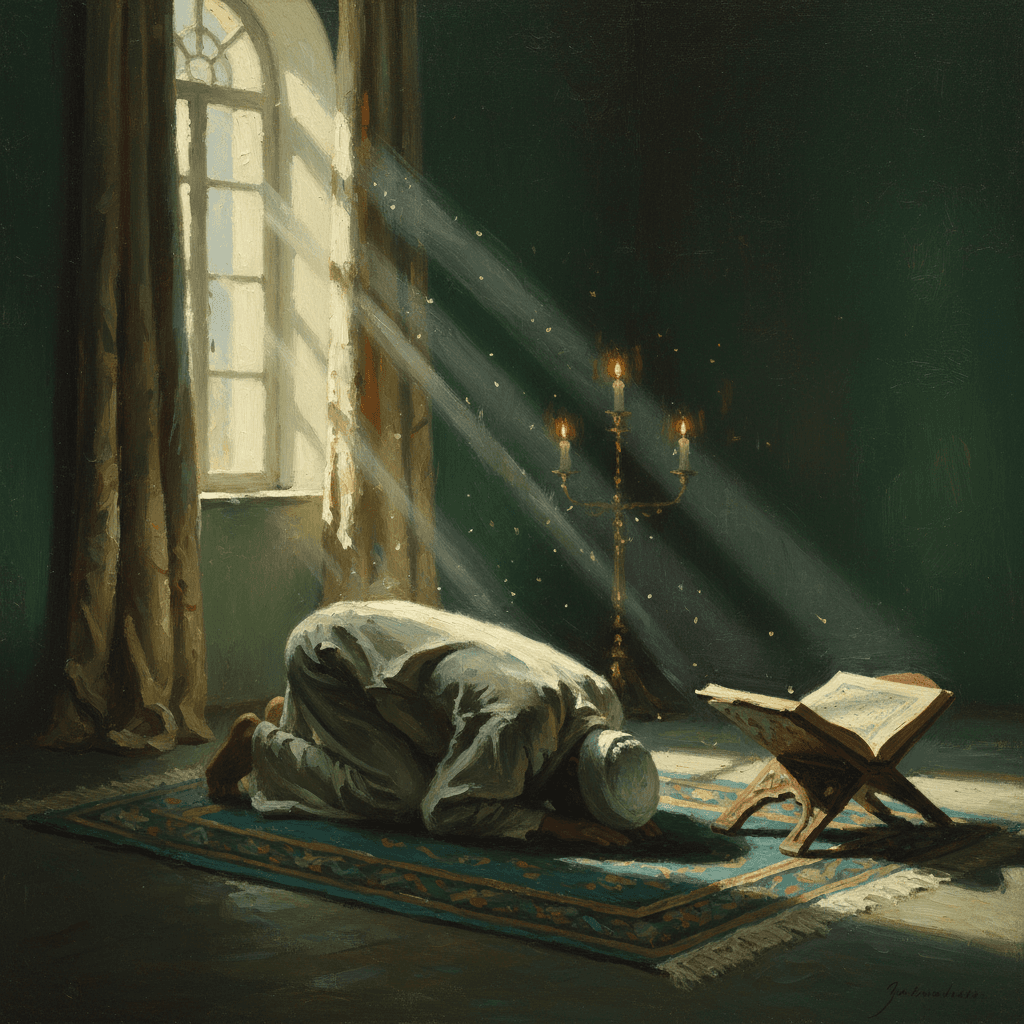
Have you ever felt spiritually dim? Not in crisis — just flat. Going through the motions of prayer without presence, reading Quran without the words landing, smiling at people while something inside feels switched off.
That feeling has a name in the Islamic tradition. It is the absence of noor — light. And the Prophet (peace be upon him) had a specific dua for exactly this moment.
This is not a dua you say once and forget. It is a request for divine light to fill every part of you — your heart, your sight, your hearing, your tongue, and every direction around you. The Prophet made it part of his routine walk to Fajr prayer. He did not wait to feel spiritually bright before asking for light. He asked for the light first, and then walked toward it.
The Dua for Noor
اللَّهُمَّ اجْعَلْ فِي قَلْبِي نُورًا، وَفِي لِسَانِي نُورًا، وَفِي سَمْعِي نُورًا، وَفِي بَصَرِي نُورًا، وَمِنْ فَوْقِي نُورًا، وَمِنْ تَحْتِي نُورًا، وَعَنْ يَمِينِي نُورًا، وَعَنْ شِمَالِي نُورًا، وَمِنْ أَمَامِي نُورًا، وَمِنْ خَلْفِي نُورًا، وَاجْعَلْ فِي نَفْسِي نُورًا، وَأَعْظِمْ لِي نُورًا
Allahumma ij'al fi qalbi nooran, wa fi lisani nooran, wa fi sam'i nooran, wa fi basari nooran, wa min fawqi nooran, wa min tahti nooran, wa 'an yameeni nooran, wa 'an shimali nooran, wa min amami nooran, wa min khalfi nooran, waj'al fi nafsi nooran, wa a'dhim li nooran.
"O Allah, place light in my heart, light in my tongue, light in my hearing, light in my sight, light above me, light below me, light to my right, light to my left, light in front of me, light behind me, place light in my soul, and make my light great."
— (Sahih Muslim 763)
When to say it: The Prophet (peace be upon him) said this dua on his way to the masjid for Fajr prayer. Incorporate it into your morning routine — before Fajr, after waking, or while walking to prayer.
Longer version: Ibn Abbas (may Allah be pleased with him) narrated a longer version of this dua that also asks for light in the nerves, flesh, blood, hair, and skin — the full version is in Sahih Muslim 763. Start with the version above; it is the most widely practiced form.
The Story Behind It
Ibn Abbas (may Allah be pleased with him) narrated that he once spent the night at the home of his aunt, Maymunah — the wife of the Prophet (peace be upon him). He wanted to observe the Prophet's night prayer.
After sleeping part of the night, the Prophet woke, performed wudu, and prayed a long Tahajjud prayer. Then, before leaving for the masjid for Fajr, he said this dua — asking Allah to fill him with light from every direction.
What is striking is the context. This was the Prophet. He already had more noor than any person who has ever lived. He received revelation. He was called siraj un munir — a radiant lamp — in the Quran (33:46). And yet he still asked Allah for more light, from above, below, in front, behind, within.
This tells us something important: noor is not a fixed quantity you either have or do not have. It is something you actively seek, every day, from its only source — Allah.
The Quran calls Allah An-Noor — the Light — in Surah An-Noor (24:35). All light, physical and spiritual, comes from Him. The dua for noor is an acknowledgment of that dependency and a request to stay connected to the source.
How to Make the Dua for Noor Part of Your Daily Life
The dua for noor works best as part of your morning routine — not as a standalone memorization project, but woven into habits you already have.
Attach it to wudu
Wudu is already a purification — physical and symbolic. When you finish wudu before Fajr, that is the natural trigger for this dua. You have just cleaned yourself outwardly; now you are asking Allah to illuminate you inwardly. The pairing makes spiritual sense and makes the habit easy to remember.
Memorize it in pieces
The dua has a repeating structure: fi qalbi nooran (in my heart, light), fi lisani nooran (in my tongue, light), and so on. That pattern is your friend when memorizing. Learn four phrases per day:
- Day 1: fi qalbi, fi lisani, fi sam'i, fi basari
- Day 2: min fawqi, min tahti, 'an yameeni, 'an shimali
- Day 3: min amami, min khalfi, fi nafsi, a'dhim li nooran
Three days of focused repetition and you have it for life.
Say it with intention, not speed
When you say fi qalbi nooran — light in my heart — pause for a breath and mean it. Think of what it would feel like to have your heart genuinely illuminated: less resentment, more clarity, more love for Allah and people. When you say fi basari nooran — light in my sight — consider what you look at and how you look at it. Presence in each phrase transforms the dua from recitation to conversation.
Use it when you feel spiritually dim
Beyond the morning routine, the dua for noor is especially powerful in those flat, disconnected moments — when prayer feels rote, when your heart feels closed, when you are going through the motions. Say it slowly. It is a request to be plugged back in to the source of all light.
Track your consistency
The Prophet (peace be upon him) said: "The most beloved deeds to Allah are the most consistent ones, even if they are small." (Bukhari 6464) A daily streak of this dua — even just one week — will change how you relate to it. It moves from something you know about to something that is part of you.
Build Your Noor Habit Daily
DeenBack helps you track your daily duas and dhikr — including the dua for noor — so you can build a consistent morning routine and watch your spiritual light grow over time.


Free download. Premium features available in-app.
Related Duas
Dua for morning: The dua for noor pairs naturally with the full morning adhkar routine. Together they cover gratitude, protection, forgiveness, and light — a complete spiritual start to the day.
Dua for waking up: The first moments after waking are an opportunity to set the frame. The dua for waking up transitions you from sleep to the morning, and the dua for noor then fills that newly awake state with intention.
Dua for studying: Noor in the heart and sight is directly connected to the ability to learn and retain knowledge. Pair this dua with the dua for studying — both are asking Allah to illuminate your mind and make knowledge accessible to you.
Dua for protection: Light in every direction is also a form of protection. If you find the dua for protection meaningful, the dua for noor complements it — one asks for a shield, the other asks for an illumination that makes you less vulnerable to begin with.
Common Questions
Is the dua for noor specifically for before Fajr?
The Prophet said it on his way to Fajr prayer, which makes that the recommended time. But the dua itself is not restricted to that window. You can say it at any time of prayer, during Tahajjud, or whenever you feel spiritually dim and in need of guidance. The morning is ideal because it sets the frame for the day — light first, then everything else.
What does it mean to have noor in your tongue?
Having noor in your tongue means that your speech is guided — that what comes out of your mouth is truthful, kind, useful, and free of harm. It means speaking with wisdom rather than impulse. The Prophet's request for light in his tongue was a request to be controlled and illuminated in what he said, not just what he saw or heard. When you say this phrase, think about the conversations you will have that day and what it would look like to speak with light.
How is the dua for noor different from Ayat An-Noor?
Ayat An-Noor — Surah An-Noor 24:35 — is a description of Allah as the Light of the heavens and earth. It is Quran, meant for recitation and reflection. The dua for noor is a supplication — a request directed to Allah, asking for a share of that light in your own life. Reading the Ayat gives you understanding; saying the dua is the asking. Both are valuable and they work well together.
What if I cannot memorize the full Arabic?
Start by memorizing just the first phrase: Allahumma ij'al fi qalbi nooran — O Allah, place light in my heart. Say that sincerely every morning. As it settles into your tongue, add the next phrase. Memorization built this way — phrase by phrase with meaning — stays longer than anything memorized all at once.
Closing
The dua for noor is not complicated. It is an honest request: I cannot generate my own light. You are the source. Fill me from every direction.
The Prophet said it walking to Fajr every morning — not because he doubted his faith, but because he understood where light comes from and never assumed he had enough. That is a lesson worth building into your routine.
Say it tomorrow morning. Slowly. One phrase at a time. Ask Allah for light in your heart before the noise of the day fills it with something else.
Track Your Daily Dua for Noor
DeenBack makes it easy to build the morning dua habit — add the noor dua to your daily dhikr list, track your streak, and let your spiritual light grow one consistent morning at a time.
Free download. Premium features available in-app.
Frequently Asked Questions
What is the dua for noor?
The most comprehensive dua for noor is from Sahih Muslim 763. The Prophet (peace be upon him) would say it on his way to Fajr prayer: Allahumma ij'al fi qalbi nooran, wa fi lisani nooran, wa fi sam'i nooran, wa fi basari nooran — asking for light in his heart, tongue, hearing, sight, and every direction around him.
When should I say the dua for noor?
The Prophet (peace be upon him) said this dua when walking to the masjid for Fajr prayer, which is the recommended time. You can also say it during your morning adhkar, before prayer, or at any time you feel spiritually heavy or disconnected.
What does noor mean in Islam?
Noor means light. In an Islamic context it refers not just to physical light but to divine guidance, spiritual illumination, and the clarity that comes from nearness to Allah. The Quran describes Allah as An-Noor — the Light — and describes the believer's heart as capable of receiving and radiating that light.
Does this dua appear in the Quran?
The specific dua for noor is from hadith, not the Quran directly. However, Surah An-Noor (24:35) contains the famous Ayat An-Noor — the Light Verse — which is the theological foundation for understanding noor in Islam. Many scholars recommend reading this verse alongside the dua.
Can I say the dua for noor at night?
Yes. While the Prophet said it on the way to Fajr, the dua itself is not time-restricted. Saying it before Tahajjud, Isha, or at any point of quiet reflection is entirely appropriate. The request for noor is relevant any time you feel you need clarity, guidance, or spiritual light.