
- Published on
Dua for Leaving the Masjid: Carry Your Worship Into the World
- Authors

- Name
- Ahmad
- Role
- Senior Marketing Manager, Islamic education • Deen Back
بِسْمِ اللهِ الرَّحْمٰنِ الرَّحِيْمِ
In the name of God, the Most Gracious, the Most Merciful.
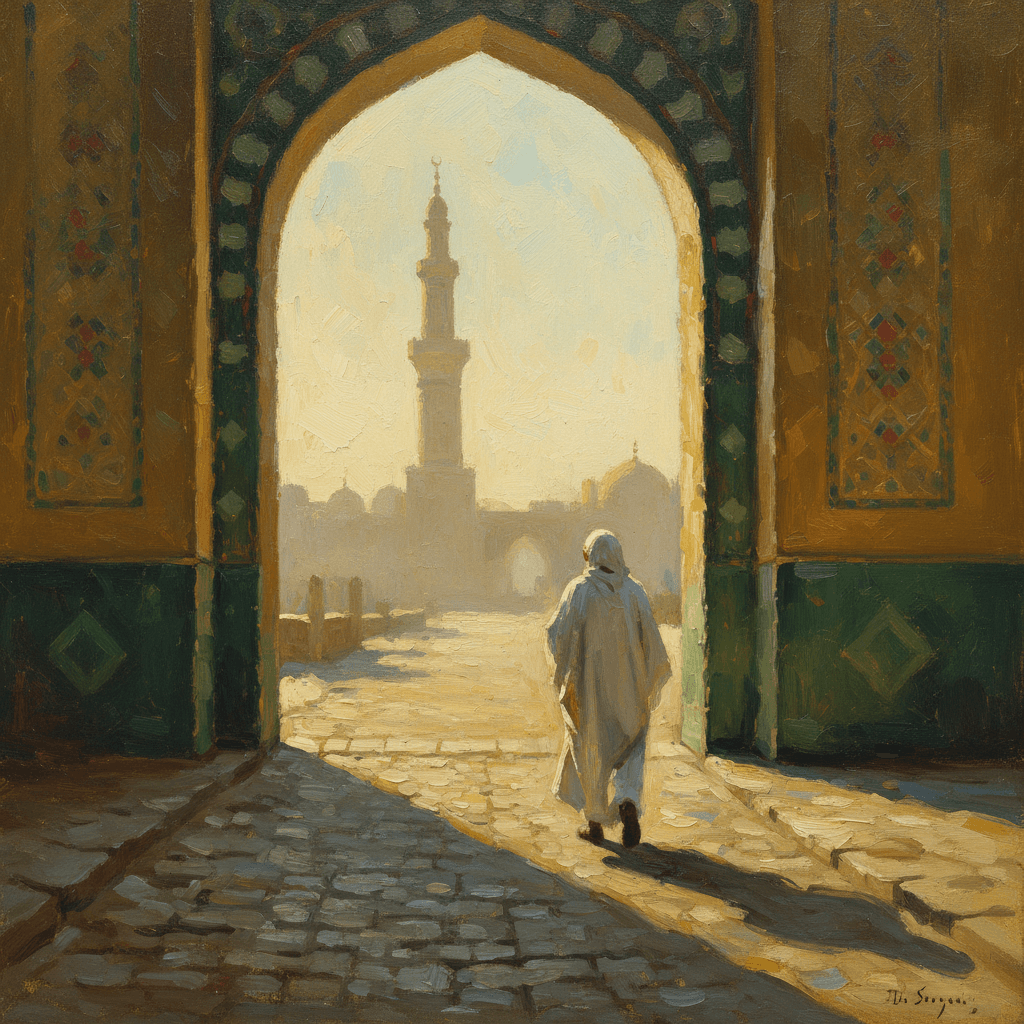
There is a moment right after prayer that most of us waste completely.
You have just stood before Allah. You bowed, you prostrated, you asked for guidance. For a few minutes, the noise of the world was behind you. And then — the salaam. The prayer ends. And within seconds, the phone comes out, the conversations start, and you are back to exactly where you were before.
The Prophet (peace be upon him) did not leave the masjid like that. He had a dua for the exact moment of stepping back into the world — a dua that bridges worship and daily life, asking Allah to bless everything you are about to do outside.
It is short. It is simple. And if you make it a habit, it changes how you carry your prayer with you.
The Dua for Leaving the Masjid
When you step out of the mosque, lead with your left foot and say:
اللَّهُمَّ إِنِّي أَسْأَلُكَ مِنْ فَضْلِكَ
Allahumma inni as'aluka min fadlika.
"O Allah, I ask You from Your bounty." — (Sahih Muslim 713)
It is also Sunnah to send salawat upon the Prophet (peace be upon him):
اللَّهُمَّ صَلِّ عَلَى مُحَمَّدٍ وَسَلِّمْ
Allahumma salli 'ala Muhammad wa sallim.
"O Allah, send blessings and peace upon Muhammad."
Some narrations also include seeking protection from Shaytan as you re-enter the outside world:
بِسْمِ اللَّهِ وَالصَّلَاةُ وَالسَّلَامُ عَلَى رَسُولِ اللَّهِ اللَّهُمَّ اعْصِمْنِي مِنَ الشَّيْطَانِ الرَّجِيمِ
Bismillah, wassalatu wassalamu 'ala Rasulillah, Allahumma a'simni minash-shaytanir-rajeem.
"In the name of Allah, and peace and blessings upon the Messenger of Allah. O Allah, protect me from the accursed Shaytan." — (Ibn Majah 773)
When to say it: Every time you leave a mosque or prayer space — after the five daily prayers, Jumu'ah, Taraweeh, or any visit.
The Story Behind It
The same hadith from Abu Usayd (may Allah be pleased with him) that teaches the entrance dua also teaches the exit dua. The Prophet (peace be upon him) said: "When one of you enters the mosque, let him say: Allahumma aftah li abwaba rahmatika (O Allah, open for me the doors of Your mercy), and when he leaves, let him say: Allahumma inni as'aluka min fadlika (O Allah, I ask You from Your bounty)" (Sahih Muslim 713).
The word choice is deliberate. Mercy (rahmah) inside — because worship requires Allah's help to be sincere and accepted. Bounty (fadl) outside — because the world requires Allah's blessings to navigate with success and integrity.
This pairing reveals something beautiful about the Islamic worldview: your time outside the mosque is not separate from your worship. It is an extension of it. When you ask Allah for His fadl as you step out, you are saying: "The prayer is done, but my need for You is not."
The Prophet (peace be upon him) also said:
"One of you is in a state of prayer as long as they are waiting for the prayer." — (Sahih al-Bukhari 647)
The space between prayers matters. The exit dua helps you carry that consciousness forward.
How to Make This Dua Part of Your Daily Life
This is one of the easiest Sunnah habits to build because the trigger is built into your day. Every time you leave a prayer space, the opportunity is right there.
Pair it with the left foot. Just as entering with the right foot triggers the entrance dua, stepping out with the left foot triggers the exit dua. Let the physical action be your cue. Left foot crosses the threshold → mouth says the dua. No thinking required once the habit is set.
Link it to the entrance dua. If you already say the entrance dua, the exit dua completes the pair. Think of them as bookends — mercy in, bounty out. Building one makes the other natural.
Do not rush out. After the salaam, sit for a moment. Say your adhkar. Then when you stand and walk toward the door, you are mentally prepared for the transition dua. Rushing kills mindfulness.
Say it with intention. When you say "I ask You from Your bounty," think about what you actually need. Your work, your family, your health, your rizq — all of that falls under Allah's fadl. Make the dua personal, even though the words are short.
Track the pair. Count both the entrance and exit duas as one unit. Did you complete the full masjid dua routine today — right foot in with dua, left foot out with dua? Tracking the pair builds the complete habit.
Complete Your Masjid Routine
Track your daily Sunnah habits — entrance dua, exit dua, adhkar after salah — and build streaks that turn one-time actions into lifelong practices with Deen Back.


Free download. Premium features available in-app.
Related Duas
Dua for entering the masjid:
اللَّهُمَّ افْتَحْ لِي أَبْوَابَ رَحْمَتِكَ
"O Allah, open for me the doors of Your mercy." — (Sahih Muslim 713)
See our full guide: Dua for Entering the Masjid.
Dua for leaving the house:
بِسْمِ اللَّهِ تَوَكَّلْتُ عَلَى اللَّهِ وَلَا حَوْلَ وَلَا قُوَّةَ إِلَّا بِاللَّهِ
"In the name of Allah, I place my trust in Allah, and there is no power nor strength except with Allah." — (Abu Dawud 5095)
For more transition duas, see dua for entering home and dua for travel.
Common Questions
Is the exit dua obligatory?
No, it is a Sunnah — recommended but not required. However, Sunnah acts are how you build closeness with the Prophet's way of life. The companions did not treat Sunnah practices as optional extras. They treated them as opportunities they did not want to miss.
What if I leave the masjid in a hurry and forget?
Say it wherever you remember. The point is training your mind to make the transition from worship to world with consciousness. If you remember ten steps outside, say it then. Over time, the habit will kick in at the right moment.
Can I combine the exit dua with personal duas?
Absolutely. The Sunnah dua is the foundation, but you can add any personal supplication. Many people use the moment of leaving as a time to ask Allah for specific blessings — success at work, healing for a family member, guidance in a decision. The door of dua is always open.
Should I teach this to my children?
Yes. Pair it with the entrance dua and make it a family routine. Children who learn to say duas at transitions — entering, leaving, eating, sleeping — grow up with a constant awareness of Allah in every part of their day. See our guide on dua for sleeping for another transition dua to teach children.
Take the Blessing With You
The masjid is a place of mercy. But the world outside is where you need Allah's bounty most — in your work, your relationships, your daily struggles against the nafs.
Six Arabic words as you step out the door. That is all it takes to say: "Ya Allah, I just worshipped You. Now help me live for You too."
Left foot first. Allahumma inni as'aluka min fadlika. And carry the prayer with you into everything that comes next.
Carry Your Prayer Into the World
Build daily Sunnah habits, track your dhikr streaks, and make every transition — into the masjid and out of it — an act of worship with Deen Back.
Free download. Premium features available in-app.
Frequently Asked Questions
What is the dua for leaving the masjid?
The dua for leaving the mosque is: Allahumma inni as'aluka min fadlika — O Allah, I ask You from Your bounty (Sahih Muslim 713). You should step out with your left foot first and send salawat upon the Prophet (peace be upon him). This dua asks Allah to bless your worldly affairs after worship.
Why do we ask for bounty when leaving but mercy when entering?
Inside the masjid, you need Allah's mercy to make your worship sincere and accepted. Outside, you need His bounty (fadl) to succeed in your daily life — work, relationships, and responsibilities. The Prophet (peace be upon him) taught this distinction to show that Islam covers both worship and worldly life.
Which foot do I leave the masjid with?
Leave the masjid with your left foot first. This is the opposite of entering, where you step in with the right foot. The Sunnah uses the right side for honorable beginnings (entering the mosque, putting on shoes) and the left for exits and less noble actions.
Can I say additional duas when leaving the masjid?
Yes. Besides the primary dua, you can make any personal dua when leaving. Some scholars also recommend saying: Bismillah, wassalatu wassalamu ala Rasulillah, Allahumma inni as'aluka min fadlika, Allahumma a'simni minash-shaytanir-rajeem — combining the name of Allah, salawat, asking for bounty, and seeking protection from Shaytan.
Does this dua apply when leaving any prayer space?
Yes. Scholars extend this to any designated prayer area — whether a formal mosque, a musalla in a workplace, or a prayer room at an airport. The principle is marking the transition from worship back to daily life with consciousness and dua.