
- Published on
Istirja Meaning — The Verse Muslims Say When Calamity Strikes
- Authors

- Name
- Ahmad
- Role
- Senior Marketing Manager, Islamic education • Deen Back
بِسْمِ اللهِ الرَّحْمٰنِ الرَّحِيْمِ
In the name of God, the Most Gracious, the Most Merciful.
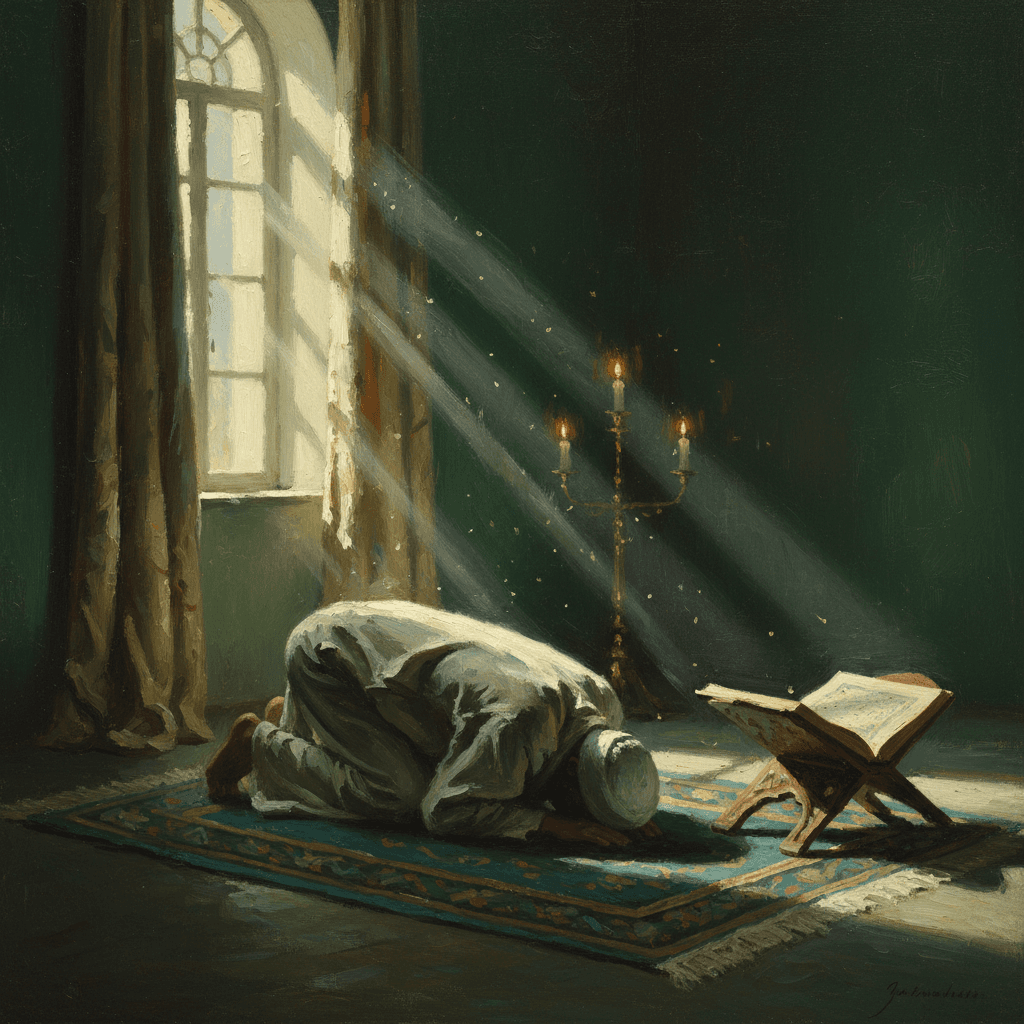
Something goes wrong. The phone rings with bad news. You lose something you cannot replace. Your body fails you in a way you did not expect. A relationship breaks.
And in that first moment — before the grief fully arrives, before the mind starts spinning — there are two responses. One is reactive: the panic, the "why me," the bargaining. The other is something the Prophet ﷺ taught that turns the moment from freefall into an act of faith.
That response is istirja (الاسترجاع) — and it is one of the most powerful tools Islam gives you for living through difficulty without being destroyed by it.
What Istirja Means — Full Meaning and Usage
Istirja literally means "returning" or "the act of returning." It refers to the Quranic phrase from Surah Al-Baqarah:
إِنَّا لِلَّهِ وَإِنَّا إِلَيْهِ رَاجِعُونَ
Inna lillahi wa inna ilayhi raji'un
"Indeed, we belong to Allah, and indeed to Him we will return."
— (Surah Al-Baqarah, 2:156)
This verse appears in the context of a divine promise:
وَبَشِّرِ الصَّابِرِينَ الَّذِينَ إِذَا أَصَابَتْهُم مُّصِيبَةٌ قَالُوا إِنَّا لِلَّهِ وَإِنَّا إِلَيْهِ رَاجِعُونَ
"And give good tidings to the patient — those who, when afflicted with calamity, say: 'Indeed we belong to Allah, and indeed to Him we will return.'"
— (Surah Al-Baqarah, 2:155-156)
The verse makes istirja an act of sabr — not passive resignation but active acknowledgment. You are not denying the pain. You are placing it in its correct context: I came from Allah, everything I have came from Allah, and it all returns to Allah. This truth does not make the grief go away. It gives grief a container.
The Full Dua — And Its Extraordinary Promise
The Quran gives us the phrase. The Prophet ﷺ taught the complete supplication that follows it. The story comes through Umm Salamah رضي الله عنها:
When her husband Abu Salamah died, she remembered the Prophet's teaching:
اللَّهُمَّ أْجُرْنِي فِي مُصِيبَتِي، وَأَخْلِفْ لِي خَيْرًا مِنْهَا
Allahumma ajirni fi musibati, wakhluf li khayran minha
"O Allah, reward me for my calamity and replace my loss with something better than it."
— (Sahih Muslim 918 — view on sunnah.com)
She wanted to say it but thought: who could be better than Abu Salamah? She forced herself to say the dua anyway. Allah replaced her loss with the Prophet ﷺ himself — she became Umm al-Mu'minin (Mother of the Believers).
This story is not just remarkable for what happened to Umm Salamah. It is a direct demonstration of the mechanism the Prophet was teaching: say the words honestly, even when you cannot imagine how they could be true, and Allah delivers on His promise in ways you did not expect.
Why Modern Muslims Struggle With This
The challenge with istirja is not knowing the words — most Muslims have heard them at funerals. The challenge is saying them from the inside rather than performing them for the outside.
In a grief context, people say Inna lillahi wa inna ilayhi raji'un as a social signal — the correct Islamic thing to say when someone dies. That use is fine, but it is the surface layer.
The Prophet's model was different. He said it internally, immediately, reflexively — when a small thing went wrong, not just tragedies. Imam Ahmad reports that the Prophet said Inna lillahi even when a lamp extinguished unexpectedly. That level of integration — where the acknowledgment of Allah's ownership happens at the smallest frustration — is what transforms istirja from a funeral phrase into a complete way of living.
The nafs resists this. The nafs wants to catastrophize, to rage, to demand an explanation. Istirja cuts that pattern short — not by suppressing emotion, but by routing it through the correct understanding immediately.
How to Make Istirja Second Nature
Learn the Full Dua, Not Just the Quranic Phrase
Most Muslims know the Quranic phrase. Fewer know the Prophet's addition:
Inna lillahi wa inna ilayhi raji'un + Allahumma ajirni fi musibati, wakhluf li khayran minha.
Memorize both parts. Write them out. Review them until they are ready to come to your tongue automatically, not as something you search for in a difficult moment.
Practice It on Small Things First
Start using istirja for minor inconveniences — a broken plate, a missed bus, a small disappointment. This builds the reflex so that when something genuinely hard happens, the response comes naturally rather than having to be constructed under pressure.
Say It Before You Process, Not After
The hadith pattern suggests istirja comes first — before the grief processing, before the analysis, before the phone calls. It is the immediate response, the first word. Train yourself to say it before doing anything else when difficulty strikes.
Build the Sabr Habits That Sustain You Through Difficulty
DeenBack helps you build the daily dhikr and dua practices that make istirja and sabr reflexive — so when difficulty comes, you are already prepared.


Free download. Premium features available in-app.
Connect It to Your Understanding of Ownership
Inna lillahi — we belong to Allah. Everything you have, everything you love, everything you are — it is on loan. Death, loss, calamity is not theft — it is the Owner reclaiming what was always His. This is not a cold theology. It is actually the most liberating way to hold the things you love: with gratitude and openness, not gripping terror.
See how to deal with grief Islamically for a deeper practical guide, and for the full text and context of this verse see Inna lillahi wa inna ilayhi raji'un meaning.
Signs of Real Growth With This Practice
- Your first response to small frustrations is Inna lillahi rather than anger or complaint
- When something genuinely hard happens, you feel anchored rather than adrift
- You can say the full dua — Quranic phrase and Prophet's addition — in your own grief without performance
- You find the sabr section of the Quran (2:155-157) personally meaningful rather than abstract
Common Questions
Should I say istirja when I make a mistake? Yes. Some scholars extend it to sins and mistakes — a recognition that your error is a calamity to your soul that Allah knows about, and that you return to Him in repentance. Inna lillahi acknowledges the loss; istighfar follows for the repair.
Is it wrong to also grieve and cry? Absolutely not. The Prophet ﷺ wept when his son Ibrahim died. He said: "The eyes shed tears and the heart grieves, but we do not say anything except what pleases our Lord." (Sahih Bukhari 1303). Crying and istirja coexist — one is human, the other is Muslim.
Can I say istirja for other people's calamities? Yes. Saying it on behalf of others is appropriate when you witness or hear of their difficulty. It expresses solidarity and the shared Muslim understanding of Allah's ownership.
Every Loss Has a Return Address
We belong to Allah, and to Him we return. This phrase does not minimize what you have lost. It locates the loss correctly — in the hands of the One who gave it, and who has authority over what comes next.
The woman who could not imagine anything better than her husband got the best. Not because she understood how — but because she said the words in trust. That is what Allah asks: say it. Mean it. Then watch what He does with the space you have opened.
For the dua for deceased loved ones, see dua for deceased and dua when someone dies.
Build Your Daily Gratitude and Sabr Practice
Use DeenBack to track your daily duas and adhkar — the consistent practice that prepares your heart for calamity before it arrives, not after.
Free download. Premium features available in-app.
Frequently Asked Questions
What is the meaning of istirja?
Istirja means 'returning' or 'returning to Allah.' It refers to the phrase 'Inna lillahi wa inna ilayhi raji'un' — 'Indeed we belong to Allah, and indeed to Him we will return.' (Surah Al-Baqarah, 2:156). It is recited when struck by any calamity, loss, or difficulty.
When should you say istirja?
Istirja is prescribed when any calamity strikes — death of a loved one, loss of wealth, physical pain, or any difficulty. Some scholars extend it to minor inconveniences as well, as the Prophet is reported to have said it even when a lamp went out.
What is the full Arabic text of istirja?
The full phrase is: 'Inna lillahi wa inna ilayhi raji'un, Allahumma ajirni fi musibati, wakhluf li khayran minha' — the first part from the Quran and the second part a dua the Prophet taught. Together they form the complete istirja.
What is the reward for saying istirja?
Umm Salamah reported that the Prophet taught her: whoever says istirja and then adds the complete dua, Allah will replace their loss with something better than it. Umm Salamah said she could not imagine what could be better than Abu Salamah — then she married the Prophet ﷺ himself.
Is istirja only for death?
No. While it is most commonly associated with death, the Quranic verse and hadith narrations make clear it applies to any calamity. The word 'musibah' (calamity/trial) in Arabic covers a wide range — from major loss to minor inconvenience. Say it whenever you are struck by difficulty.