
- Published on
Is It Haram to Force Your Child to Read Quran?
- Authors

- Name
- Ahmad
- Role
- Senior Marketing Manager, Islamic education • Deen Back
بِسْمِ اللهِ الرَّحْمٰنِ الرَّحِيْمِ
In the name of God, the Most Gracious, the Most Merciful.
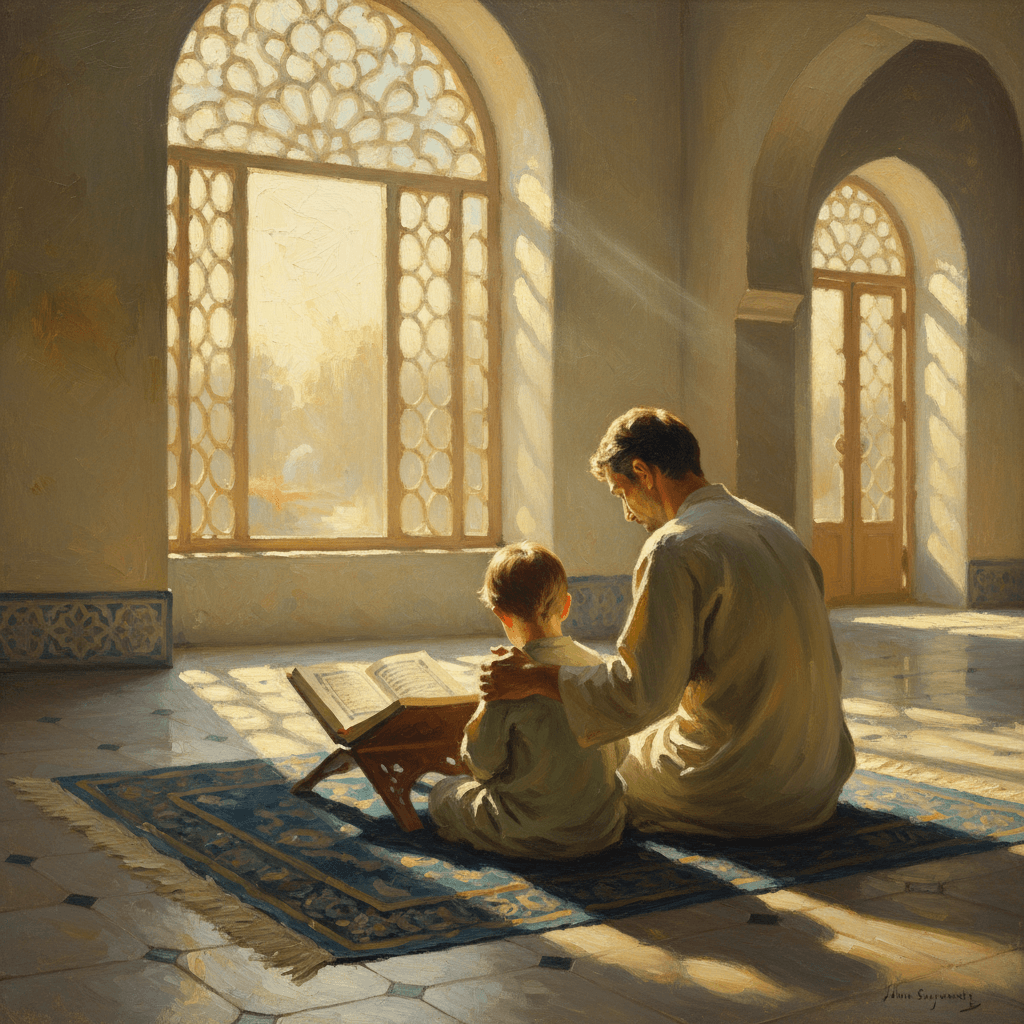
This question comes from a place of love — even if it does not always feel that way in the moment. You want your child to have the Quran. You see the distraction of screens and the pull of a culture that offers nothing spiritually. You push. They resist. And somewhere in the struggle, you start to wonder: am I doing this wrong?
The honest Islamic answer is nuanced — and far more useful than a simple yes or no.
The Short Answer
Requiring your child to learn and recite Quran is not haram — it is an obligation. But how you require it matters enormously, both Islamically and practically.
The Prophet ﷺ said:
"Command your children to pray at the age of seven, and discipline them for it at the age of ten." — (Abu Dawud 495)
This hadith establishes that parental structure in religious education is not only permitted — it is commanded. A parent who never requires anything of their child in matters of deen is not being gentle; they are abdicating a responsibility.
At the same time, the Prophet ﷺ consistently modelled gentleness in teaching:
"Make things easy, do not make them difficult. Give good news, do not drive people away." — (Sahih al-Bukhari 69)
The line between obligation and harm is crossed when force causes lasting aversion to the Quran itself — when a child grows up associating the Book of Allah with fear, pain, or humiliation rather than peace, comfort, and guidance.
What the Quran and Sunnah Say About Parenting and Tarbiyah
Allah places the responsibility of Islamic upbringing squarely on parents:
يَا أَيُّهَا الَّذِينَ آمَنُوا قُوا أَنفُسَكُمْ وَأَهْلِيكُمْ نَارًا
"O you who believe, protect yourselves and your families from a Fire." — (Surah At-Tahrim, 66:6)
This verse is one of the foundations of Islamic parenting — you are accountable for the spiritual environment of your household. Passivity is not an option.
But the Quran also establishes a principle about learning:
لَا إِكْرَاهَ فِي الدِّينِ
"There is no compulsion in religion." — (Surah Al-Baqarah, 2:256)
While this verse primarily addresses iman (faith itself), scholars use it as a broader principle: you can create conditions and expectations, but you cannot force what must come from the heart. The goal of Quran education is not just recitation — it is love and understanding. That cannot be beaten into a child.
Why This Is Actually Hard
You are navigating a real tension. On one side: your responsibility before Allah to raise children who know their deen. On the other: the reality that forced, joyless religious practice often produces adults who leave the religion entirely.
The nafs — both yours and your child's — plays a role here. Your nafs wants to see immediate results. You want your child to be reading fluently, to be memorising, to be visibly progressing. And when they resist, frustration builds.
Your child's nafs is attracted to ease. Screens, games, social media — these are engineered to be maximally engaging. Quran recitation requires attention, effort, and discipline. The competition is not fair.
The parents who succeed are not those who force hardest — they are those who create a home where the Quran is genuinely loved, where they themselves are seen sitting with the Quran daily, and where religious learning is woven into life rather than bolted on as a punishment.
What to Do — Practical Steps for Quran Education
Step 1: Examine Your Own Relationship With the Quran First
Children learn from watching their parents more than from being lectured. If your child never sees you reading Quran with genuine engagement — not just rushing through, but sitting, reflecting, and visibly at peace with it — they will not understand why they should care.
Before changing what you ask of your child, ask yourself: does my child see me love the Quran?
Step 2: Set Structure Without Severity
Structure is not abuse. A daily Quran reading time — 15-20 minutes, consistent, non-negotiable — is a reasonable household standard. The line between structure and harm is:
- Structure: "We read Quran after Maghrib every day in this house."
- Harm: Screaming, hitting, humiliating, or making Quran time the most frightening part of the child's day.
Set the expectation with warmth. Hold it consistently. Respond to resistance with patience, not punishment.
Step 3: Find the Right Teacher
A teacher who teaches with love and patience is worth far more than one with a rigorous syllabus but a harsh manner. If your child dreads Quran classes, that is a signal. Ask your child what they find hard. Watch a class if you can. A bad Quran teacher can do lasting damage to a child's relationship with Allah's book.
Step 4: Make Quran the Background of Your Home
Play recitation in the car, during meals, at home as ambient sound. When the Quran is a normal part of the soundscape of family life, children absorb it naturally. Many adult Muslims who know Quran by heart credit childhood exposure to recitation in the home, not just formal lessons. Nasheed can also play a role in building that positive association — is it haram to listen to nasheed covers the ruling and how it fits into an Islamic home environment.
Step 5: Reward Effort, Not Just Achievement
Celebrate showing up, not just results. A child who sat through a difficult reading session, even imperfectly, deserves acknowledgment. The habit of consistency — which is the foundation of all Islamic practice — is built by rewarding the process. Avoiding the all-or-nothing trap is as important in Quran education as it is in any other area of deen, as our post on is smoking haram explores through the lens of habit change.
Model the habits you want your children to have — start your own daily streak
Deen Back helps you build daily Quran, dhikr, and salah habits. When your children see you show up consistently, they learn what it means to love the deen.


Free download. Premium features available in-app.
Step 6: Make Dua for Your Children
No parenting technique replaces this. Ibrahim عليه السلام — the father of prophets — made dua for his children before they were born:
رَبِّ اجْعَلْنِي مُقِيمَ الصَّلَاةِ وَمِن ذُرِّيَّتِي رَبَّنَا وَتَقَبَّلْ دُعَاءِ
"My Lord, make me an establisher of prayer, and from my descendants. Our Lord, and accept my supplication." — (Surah Ibrahim, 14:40)
Make this dua for your children by name. Allah is the One who places love of the Quran in hearts — your job is to create the environment and ask Him for the rest.
Dua for Righteous Children
رَبِّ هَبْ لِي مِنَ الصَّالِحِينَ
"My Lord, grant me [a child] from among the righteous." — (Surah As-Saffat, 37:100)
Make this dua regularly, even for children you already have — asking Allah to make them among the righteous is a perpetual prayer.
Common Questions
My child is being physically hit at a Quran school. Is this permissible?
No. The scholars' discussions of disciplinary measures for children do not permit striking in the face, leaving marks, or causing pain beyond a mild, symbolic reminder (which many contemporary scholars also prohibit entirely). If your child is being physically abused at a Quran school, remove them immediately. This is harm, not education.
How much Quran should a child read per day?
This depends entirely on age and ability. For young children (5-8), even 10-15 minutes of focused, joyful engagement is excellent. For older children, 20-30 minutes of reading with comprehension is reasonable. Consistency matters far more than duration.
Is it haram if my child grows up not memorising the Quran?
Memorisation (hifz) is a communal obligation (fard kifayah) — enough people in the community doing it relieves the obligation from others. Your child is not individually sinful for not being a hafiz. What matters is that they have a connection with the Quran — they can read it, they understand its meaning, and they love it.
My child is autistic or has learning difficulties. How do I adapt?
Islam always accounts for individual capacity. Allah says:
لَا يُكَلِّفُ اللَّهُ نَفْسًا إِلَّا وُسْعَهَا
"Allah does not burden a soul beyond that it can bear." — (Surah Al-Baqarah, 2:286)
Adapt the method to the child. Audio recitation, visual Quran materials, shorter sessions, specialist Islamic teachers for children with learning difficulties — all of these are valid. The ruling on halal vs haram approaches always account for genuine incapacity. See also how building daily Islamic habits supports children in developing consistency over time.
The Goal Is Love, Not Just Compliance
A child who reads Quran out of fear will stop the moment they leave your house. A child who reads Quran out of love will carry it for the rest of their life.
Your job as a parent is not to produce external compliance — it is to plant seeds of love for Allah and His Book that will grow long after your authority over the child has ended. That requires structure, yes. But more than structure, it requires your own visible, genuine love for the Quran.
When was the last time your child saw you weeping over a verse? When did they hear you say, unprompted, "I love this part of the Quran"? These moments teach more than any lesson plan.
Become the Muslim parent your children need — start with your own daily habits
Deen Back helps you build the consistent Quran and dhikr habits that make you the model your children are watching. Your journey inspires theirs.
Free download. Premium features available in-app.
Frequently Asked Questions
Is it haram to force your child to read Quran?
Scholars distinguish between structure and harm. Teaching children Quran and requiring them to practice is a parental obligation — the Prophet ﷺ commanded teaching children salah at age 7. However, forcing through severe punishment, emotional abuse, or in ways that cause lasting trauma or aversion to the Quran itself crosses into harm (darar), which is impermissible. The goal is love for the Quran, not fear of it.
At what age should children start learning Quran?
The classical scholars recommended introducing Quran from very young ages (3-5) in a play-based, enjoyable way. Formal structured learning typically begins around age 5-7. The Prophet ﷺ commanded that children be taught salah at age 7 and held accountable at 10 — scholars use this as a general framework for religious education.
My child hates Quran class because of a strict teacher. What should I do?
Change the teacher or environment immediately. A child who associates the Quran with fear, pain, or humiliation will carry that association for life. The priority is protecting the child's love for the Quran, not completing a syllabus. Seek a teacher who teaches with compassion and patience.
How do I motivate my child to read Quran without forcing?
Lead by example — children who see parents genuinely love and read Quran will want to do the same. Create a positive ritual (special time, rewards for effort not just completion, family recitation). Make Quran the background of your home through audio recitation. The goal is habit and love, not just completion.
My teenager refuses to read Quran. What are my rights and limits as a parent?
You have the obligation to provide the means and environment for Islamic education, and the right to set household standards. But you cannot force belief into a teenager's heart — only Allah can. Focus on maintaining the relationship, making the home one where Quran is loved, and making dua for your child. Harsh force at this age typically produces rebellion, not devotion.