
- Published on
Dua When Stressed: Turning Overwhelm into a Moment with Allah
- Authors

- Name
- Ahmad
- Role
- Senior Marketing Manager, Islamic education • Deen Back
بِسْمِ اللهِ الرَّحْمٰنِ الرَّحِيْمِ
In the name of God, the Most Gracious, the Most Merciful.
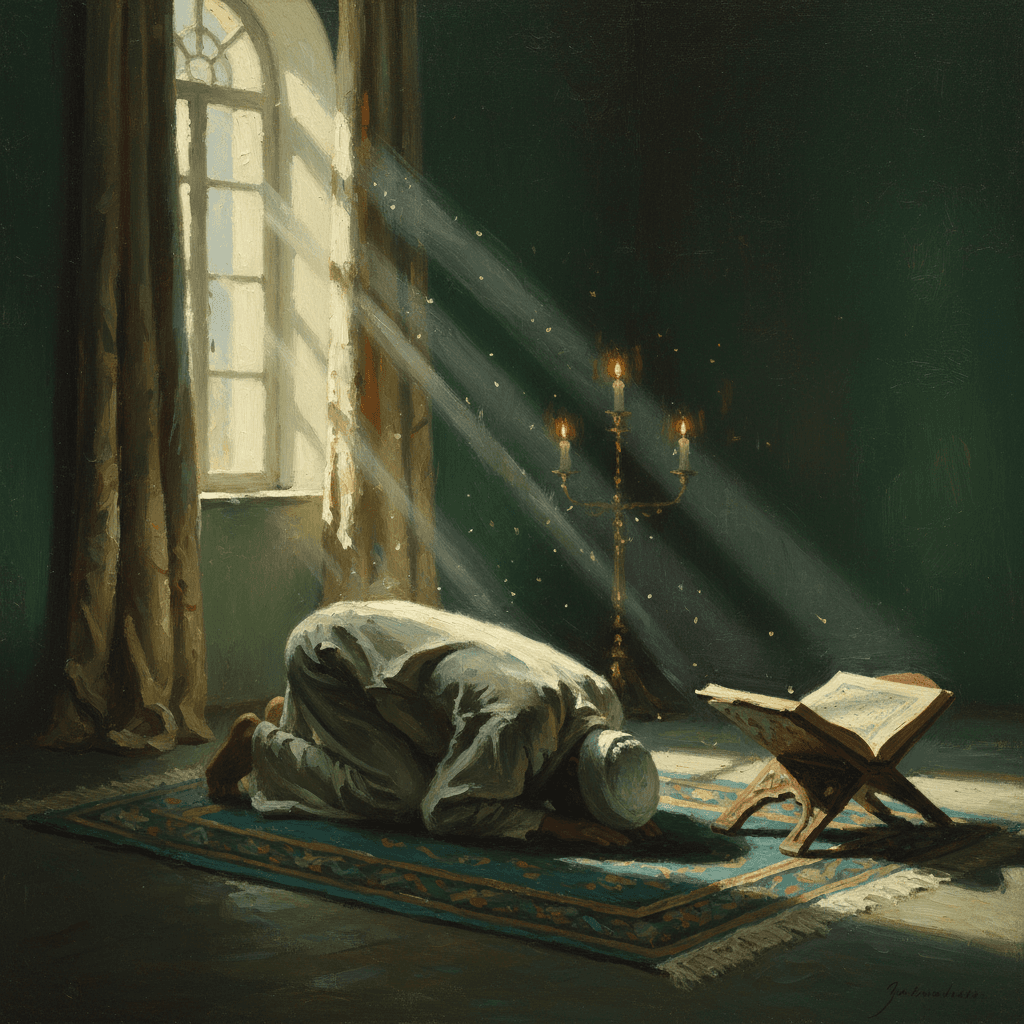
The deadline is tomorrow. The conversation you have been avoiding is unavoidable. The decisions that keep multiplying, the responsibilities that do not pause, the worry that has been sitting in your chest all day — you know the feeling.
Most people respond to this kind of stress by escaping. Scrolling. Watching something. Eating. Sleeping too much or not at all. These things do not actually reduce the stress — they relocate it temporarily while it builds pressure underneath.
The Prophet (peace be upon him) had a different response. When something distressed him, he turned to prayer. (Abu Dawud 1319) Not as an avoidance strategy — he still dealt with the problem. But as a first response, a repositioning, a returning to the only One with actual authority over the situation.
The dua when stressed is not a way to escape from difficulty. It is a way to face it with the right foundation.
The Dua When Stressed
The dua of the distressed person — taught by the Prophet:
لاَ إِلَهَ إِلاَّ اللَّهُ الْعَظِيمُ الْحَلِيمُ لاَ إِلَهَ إِلاَّ اللَّهُ رَبُْ الْعَرْشِ الْعَظِيمِ لاَ إِلَهَ إِلاَّ اللَّهُ رَبُّ السَّمَاوَاتِ وَرَبُّ الأَرْضِ وَرَبُّ الْعَرْشِ الكَرِيمِ
La ilaha illallah ul-'Adhim ul-Halim, la ilaha illallah Rabb ul-'Arsh ul-'Adhim, la ilaha illallah Rabb us-samawati wa Rabb ul-ard wa Rabb ul-'Arsh ul-Karim.
"There is no god but Allah, the Most Great, the Most Forbearing. There is no god but Allah, Lord of the Magnificent Throne. There is no god but Allah, Lord of the heavens and Lord of the earth, and Lord of the Noble Throne." — (Bukhari 6346, Muslim 2730)
Notice what this dua does: it does not ask for anything. It declares the greatness of Allah — His magnitude, His forbearance, His lordship over everything — three times, from three different angles. The act of naming Allah's power is itself the stress response. When you say this, you are placing your problem in its actual context: it exists within the dominion of the Lord of the heavens and the earth. That perspective is genuinely calming.
The dua of complete dependence on Allah:
اللَّهُمَّ رَحْمَتَكَ أَرْجُو فَلاَ تَكِلْنِي إِلَى نَفْسِي طَرْفَةَ عَيْنِ وَأَصْلِحْ لِي شَأْنِي كُلَّهُ لاَ إِلَهَ إِلاَّ أَنْتَ
Allahumma rahmataka arju, fa la takilni ila nafsi tarfata 'ayn, wa aslih li sha'ni kullahu, la ilaha illa anta.
"O Allah, it is Your mercy that I hope for, so do not leave me in charge of my affairs even for the blinking of an eye; and rectify for me all of my affairs. None has the right to be worshipped except You." — (Abu Dawud 5090)
This is the honest dua. Do not leave me in charge of my affairs. It acknowledges the root of stress: when we act as though everything depends on us, as though our management and control are the only thing standing between catastrophe and safety, we collapse under the weight. This dua releases that weight — consciously, explicitly, directly to Allah.
The Story Behind It
The Year of Grief — 'Aam al-Huzn — was the most difficult year of the Prophet's life.
In a single year, he lost Khadijah, his wife of twenty-five years, his closest companion and greatest support. He lost Abu Talib, his uncle and protector, which meant Quraysh intensified their persecution. He then traveled to Ta'if to seek a new base — and the people there drove him out with stones, leaving him bleeding.
By any measure, this was catastrophic. And yet what the Prophet did in those moments is documented: he prayed, he made dua, he asked Allah for guidance and help. He did not abandon his mission. He did not collapse into despair. He returned from Ta'if and continued.
The stress he faced was not small stress — it was existential. The lesson is not that dua removes difficulty. It is that dua provides a platform from which to face difficulty without being destroyed by it.
How to Make This Dua Part of Your Daily Life
The most effective stress response is not built in the moment of crisis — it is built beforehand, through daily habits that make turning to Allah automatic rather than effortful.
Create a "stress response protocol" and practice it before you need it. When stress hits: stop, breathe, say the dua. This three-step sequence should be practiced in low-stress moments so it is accessible in high-stress ones. The goal is to make the dua the first response to overwhelm, not something you remember after an hour of scrolling.
Make wudu as your first physical response to stress. The Prophet (peace be upon him) was seen by Companions to go perform wudu whenever something distressed him. (Abu Dawud 1319) The act of wudu is physically calming — cold water on the face reduces the physiological stress response — and spiritually reorienting. Wudu before making dua connects the physical and spiritual response.
Pray two rak'at when overwhelmed. The Prophet said: "Whenever something distressed him, he would turn to prayer." Make this your default. When the overwhelm peaks, pray two rak'at — not instead of dealing with the problem, but before. The clarity and calm that follow are real and documented in the Sunnah.
Use these duas in the morning before the stress arrives. The dua for morning includes supplications for protection from anxiety and hardship. Saying them every morning — when you are calm — builds a reservoir of trust in Allah that is there when the stress arrives.
Identify what the stress is actually about. Sometimes stress is about something real and solvable. Sometimes it is about an outcome you cannot control. The dua for tawakkul helps with the second category — see what is tawakkul in Islam for how to genuinely release what is in Allah's hands. Once you have released the outcome, the stress of trying to control it dissipates significantly.
Build the Daily Habits That Keep Stress From Taking Over
Morning adhkar, consistent salah, and daily dua build a spiritual foundation that makes you more resilient in difficult moments. DeenBack helps you build and maintain that foundation.


Free download. Premium features available in-app.
Related Duas
Dua for anxiety: Stress and anxiety are closely related. The dua for anxiety covers the supplications specifically for anxious feelings — including the famous dua from Surah Al-Inshirah and the Prophetic duas for peace of mind.
Dua for hardship: When stress is caused by a genuine difficulty — illness, financial pressure, a painful relationship — the dua for hardship addresses the situation directly.
Dua for ease: The companion dua to facing what is difficult is asking Allah to make it easier. The dua for ease covers Allahumma la sahla illa ma ja'altahu sahlan and when to use it.
Common Questions
Is chronic stress a sign that my tawakkul is weak?
Not necessarily. Chronic stress can have physiological, circumstantial, and psychological causes that are not simply resolved by stronger faith. However, chronic stress that is rooted in trying to control outcomes that belong to Allah — worry about money when you have done everything reasonable, anxiety about the future when you have no information yet — does often improve with genuine tawakkul. Both spiritual and practical interventions are valid and recommended.
What if I make dua and the stress does not go away?
Dua is not a feeling-eliminator. It is a repositioning — a conscious act of placing yourself and your situation in Allah's hands. The feeling of stress may not disappear immediately. What changes is your relationship to it: you are no longer alone with it, no longer its prisoner. If stress persists significantly over time, speaking with a counselor is entirely compatible with Islamic practice and recommended.
Should I still take practical steps to address what is stressing me?
Always. Islam does not endorse passivity. The dua and the practical action work together. Make the dua, then take the next available practical step. Dua without action is wishful thinking. Action without dua is arrogance. Together, they represent the Islamic approach to every difficulty.
Closing
Stress tells you that too much depends on you. The dua when stressed says the opposite: it depends on the Lord of the heavens and the earth, and He has never once lost control of a situation.
Say la ilaha illallah ul-'Adhim ul-Halim when the weight becomes too heavy. Let the declaration of Allah's greatness reposition the problem in its actual context. Make wudu, pray two rak'at, and return to the difficulty with a heart that has been reminded of who is actually in charge.
The situation may not change immediately. But you will.
Turn Your Stress Into a Practice of Tawakkul
Daily consistency in dua and salah is what makes you resilient when the hard moments come. DeenBack helps you build that consistency before you need it most.
Free download. Premium features available in-app.
Frequently Asked Questions
What is the dua when stressed in Islam?
The Prophet (peace be upon him) taught a specific dua of the distressed person: La ilaha illallah al-'Adhim al-Halim, la ilaha illallah Rabb al-'Arsh al-'Adhim, la ilaha illallah Rabb as-samawati wa Rabb al-ard wa Rabb al-'Arsh al-Karim — repeated remembrance of Allah's greatness over all creation. (Bukhari 6346, Muslim 2730) He also taught: Allahumma rahmataka arju, fa la takilni ila nafsi tarfata 'ayn. (Abu Dawud 5090)
Does Islam have guidance on managing stress?
Yes — extensively. The Quran says: 'Verily, with hardship comes ease.' (94:5-6, repeated twice for emphasis). The Prophet taught specific duas for distress, recommended prayer as a refuge, and modeled complete trust in Allah during the most stressful periods of his life. Islamic stress management is not suppression — it is redirection toward Allah, combined with practical action.
Why does dua help with stress?
Stress comes partly from the feeling of being alone with an unmanageable problem. Dua breaks that feeling by reconnecting you with the One who has unlimited power over your situation. The neuroscience of prayer also shows that structured prayer lowers cortisol (the stress hormone) and activates the parasympathetic nervous system. But the Islamic explanation is simpler: you are not alone, and dua reminds you of that.
What should I do immediately when I feel overwhelmed?
Stop. Take three slow breaths. Say: La ilaha illa anta, subhanaka, inni kuntu min adh-dhalimin — the dua of Yunus in the belly of the whale. (Quran 21:87). Then make wudu if possible and pray two rak'at. The Prophet said: 'Whenever something distressed him, he would turn to prayer.' (Abu Dawud 1319) This sequence takes less than ten minutes and consistently reduces the intensity of overwhelm.
Is it wrong to feel stressed as a Muslim? Does it indicate weak faith?
No. The Prophet (peace be upon him) experienced stress, grief, and anxiety — the loss of Khadijah and Abu Talib in the same year (the Year of Grief) is one example. What Islam teaches is not the absence of stress but the right response to it: turning to Allah, taking practical steps, and maintaining trust that He is in control. Stress is human; how you respond to it is where faith shows.