
- Published on
Dua After Returning from Travel: The Sunnah of Coming Home
- Authors

- Name
- Ahmad
- Role
- Senior Marketing Manager, Islamic education • Deen Back
بِسْمِ اللهِ الرَّحْمٰنِ الرَّحِيْمِ
In the name of God, the Most Gracious, the Most Merciful.
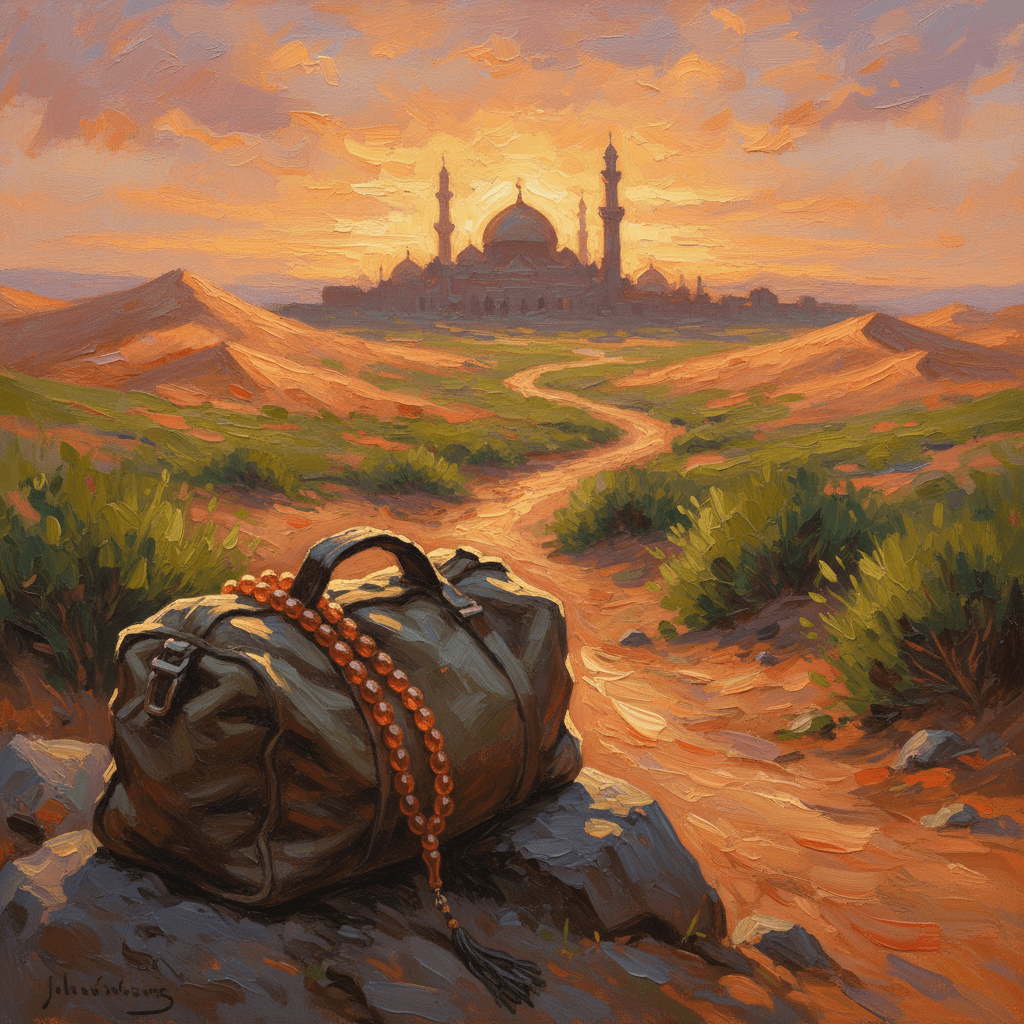
Most Muslims know there are duas for leaving the house and for starting a journey. Fewer know that there is a specific Sunnah for the moment of return — a set of words the Prophet (peace be upon him) said when he came home from travel, and a practice he taught the Companions to mark the transition from journey to home.
This is one of those forgotten Sunnahs that costs nothing and carries enormous spiritual weight. Returning from travel with the remembrance of Allah on your lips is not just etiquette — it is a declaration that every safe return is a gift, not a given.
The Dua
The Prophet (peace be upon him) would say the following when descending from elevated ground on the journey homeward, and particularly upon return:
آيِبُونَ تَائِبُونَ عَابِدُونَ لِرَبِّنَا حَامِدُونَ
Ayibuna, taibuna, abiduna, lirabbina hamidun.
"Returning, repenting, worshipping, and praising our Lord." — (Bukhari 1797, Muslim 1342)
This is traditionally said when descending from high ground. In modern travel, it is said upon landing, upon leaving the airport, or upon reaching your home city.
The Prophet also said upon reaching a high point during travel — and upon return — the full tahlil and tahmid:
لَا إِلَهَ إِلَّا اللَّهُ وَحْدَهُ لَا شَرِيكَ لَهُ، لَهُ الْمُلْكُ وَلَهُ الْحَمْدُ وَهُوَ عَلَى كُلِّ شَيْءٍ قَدِيرٌ
La ilaha illallahu wahdahu la sharika lahu, lahul-mulku wa lahul-hamdu wa huwa 'ala kulli shay'in qadir.
"There is no god but Allah alone with no partner. His is the dominion, His is the praise, and He is over all things powerful." — (Bukhari 1797)
When entering the home upon return:
اللَّهُمَّ إِنِّي أَسْأَلُكَ خَيْرَ الْمَوْلِجِ وَخَيْرَ الْمَخْرَجِ، بِسْمِ اللَّهِ وَلَجْنَا وَبِسْمِ اللَّهِ خَرَجْنَا وَعَلَى اللَّهِ رَبِّنَا تَوَكَّلْنَا
Allahumma inni as'aluka khayral-mawliji wa khayral-makhraj. Bismillahi walajna wa bismillahi kharajna wa 'ala Allahi rabbina tawakkalna.
"O Allah, I ask You for the best entry and the best exit. In the name of Allah we enter, in the name of Allah we exit, and upon Allah our Lord we rely." — (Abu Dawud 5096)
The Story Behind It
The Prophet (peace be upon him) was a man of consistent transitions — he marked the beginning and end of every significant act with remembrance of Allah. Returning home from journeys was no different.
Abdullah ibn Umar (may Allah be pleased with him) narrated that whenever the Prophet returned from a military expedition, Hajj, or Umrah, he would say the dua on high ground and then continue toward Madinah. But the practice did not stop at words. When he arrived in Madinah, he would go directly to the masjid, pray two raka'ah of voluntary prayer, and only then return to his home and family. (Bukhari 1801)
This two-raka'ah practice carries a profound message: before going back to your family, your bed, your food — you go to Allah first. The masjid receives the first gratitude of the homecoming. The family receives you after you have already thanked the One who brought you home safely.
Jabir ibn Abdillah described the scene when the Prophet returned: the streets of Madinah would fill as people came out to greet him, children running alongside. The atmosphere was celebratory — but the Prophet's first stop was always the masjid.
How to Make This Sunnah Part of Your Daily Life
You may not be returning from Hajj or a military expedition, but you return from travel regularly — business trips, family visits, weekend getaways. The Sunnah applies to all of them.
Before leaving the airport or station, say the dua. When you land or arrive in your home city, say Ayibuna, taibuna, abiduna, lirabbina hamidun. This takes five seconds and marks the transition intentionally. You can say it quietly — no one needs to know.
If you pass a masjid on the way home, stop in. This is the full Sunnah — two raka'ah before going home. It is not always practical, but when it is possible, it is deeply powerful. It tells your own soul that your priority order is correct: Allah, then family, then comfort.
Say the home-entry dua as you step inside. Bismillahi walajna wa bismillahi kharajna wa 'ala Allahi rabbina tawakkalna. This is the home-entry dua, and after a journey it carries extra weight. You are acknowledging that the home you are walking back into is itself a blessing.
Express gratitude explicitly. Alhamdulillah upon return — said with awareness, not habit. You could have been in an accident. The flight could have gone differently. The road could have been dangerous. Safe return is not normal; it is a mercy.
Make dua for the family you are returning to. Travel reveals how much you appreciate what you usually take for granted. The moment of return is one of the best times to make dua for your spouse, children, or parents — when you genuinely feel grateful for their presence.
Build a Complete Sunnah of Travel
DeenBack helps you track departure duas, journey adhkar, and return practices — so every trip becomes a spiritually intentional experience, not just logistics.


Free download. Premium features available in-app.
Related Duas
Dua for travel: The dua for travel covers the full Sunnah of departure — what to say when you leave home, what to say in the vehicle, and how the Prophet approached the beginning of every journey.
Dua for entering home: When you step back inside, use the dua for entering home — the full supplication for crossing the threshold and invoking Allah's protection and blessing in your household.
Dua for protection: Every safe journey is protected by Allah. The dua for protection covers the comprehensive morning and evening supplications that shield you from harm — before, during, and after travel.
Dua for gratitude: Return from travel is one of the clearest moments to feel genuine gratitude. The dua for thanks to Allah gives you the words to express it in a way that is grounded in the Sunnah.
Common Questions
Do I have to go to the masjid before going home?
It is Sunnah, not obligatory. The Prophet consistently did it, which makes it highly recommended — but if it is genuinely not possible (you arrive late at night, there is no masjid on the route, family urgently needs you), you are not sinning by going directly home. The intention matters. If you can do it, do it. If not, make your gratitude and dua when you arrive at home.
What if I forgot to say the dua before entering my house?
Say it now. The dua and the Sunnah practice are not lost if you forgot in the moment. The awareness is what matters — turning toward Allah in gratitude rather than collapsing on the sofa and scrolling your phone before acknowledging that you made it home safely.
Is this dua only for long journeys?
The hadith does not specify a minimum distance. Scholars generally note that it is most applicable to journeys of travel distance (typically taken as around 80-90 km, the threshold for shortening prayers). For shorter trips within a city, the home-entry dua is still appropriate, but the returning-from-travel dua is specifically for actual journeys.
What about returning from Hajj or Umrah?
The practice is the same — but the spiritual weight is even greater. The Prophet said when returning from Hajj specifically: "Ayibun, taibun" — and the entire journey was framed as a return to Allah. After Hajj, it is common for Muslims to spend extra time in dua upon arrival, as they are returning in a state of spiritual renewal that should be protected and extended.
Closing
Every safe return is a miracle you did not earn. The road could have been different. The flight could have been different. Coming home is not guaranteed — and the Sunnah of return exists precisely to prevent that truth from becoming invisible through habit.
Say the words. Stop at the masjid when you can. Enter your home with the name of Allah on your lips. These are small practices, but they are how the Prophet (peace be upon him) chose to mark every homecoming — and they transform a logistical moment into an act of worship.
Never Miss a Returning Traveller's Dua Again
DeenBack tracks your travel adhkar and daily Sunnah practices. Build the habit of Islamic intentionality at every transition — departure, journey, and return.
Free download. Premium features available in-app.
Frequently Asked Questions
What is the dua after returning from travel in Islam?
The Prophet's dua upon returning from travel was: Ayibun, taibun, abidun, lirabbina hamidun — Returning, repenting, worshipping, and praising our Lord. He said this when descending from high ground on the journey home. (Bukhari 1797, Muslim 1342)
Did the Prophet pray 2 rakah after returning from travel?
Yes. When the Prophet returned from a journey, he would go to the masjid first and pray 2 rakah before going home. (Bukhari 1801) This is a recommended Sunnah — a way of acknowledging that every safe return is from Allah.
What should I do first when I return home from a long trip?
The Sunnah is to go to the masjid upon returning and pray 2 voluntary rakah, then go home to your family. Before entering the home, say Bismillah and the home-entry dua. Express gratitude (hamdallah) for safe return throughout the process.
Is there a dua for returning safely from travel?
Upon reaching high ground or completing a leg of the journey, the Prophet said: La ilaha illallahu wahdahu la sharika lahu, lahul-mulku wa lahul-hamdu wa huwa ala kulli shay'in qadir — which is also a dua of praise and gratitude for Allah's protection during travel. (Bukhari 1797)
Why is there a special dua for coming back from travel?
Islam frames travel as a complete spiritual experience with its own set of adhkar — for departure, for the road, and for return. The dua upon returning acknowledges that safety is from Allah, not from personal effort, and that every homecoming is a mercy worth thanking Allah for explicitly.