
- Published on
Al-Qawiyy Meaning: Understanding the Name of Allah the All-Strong
- Authors

- Name
- Ahmad
- Role
- Senior Marketing Manager, Islamic education • Deen Back
بِسْمِ اللهِ الرَّحْمٰنِ الرَّحِيْمِ
In the name of God, the Most Gracious, the Most Merciful.
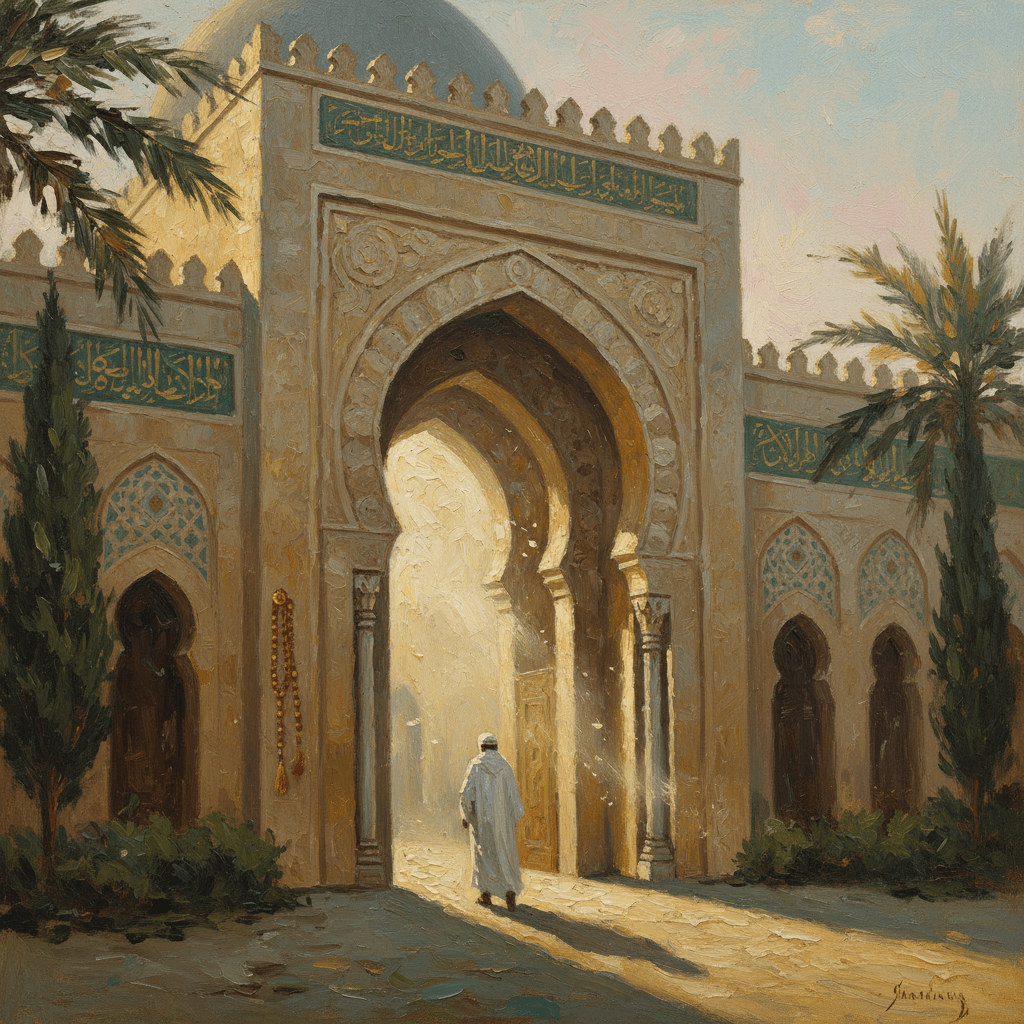
There are moments when you come up against something you cannot move. A habit you cannot break. A situation you cannot change. A heaviness in the nafs that your own willpower cannot lift. You push, and nothing shifts.
This is the moment for Al-Qawiyy.
Allah's name Al-Qawiyy — الْقَوِيُّ, The All-Strong — is not simply a description of divine power in the abstract. It is a direct confrontation with the nature of strength itself: where it comes from, who holds it, and what happens when the creature reaches for it through the Creator.
What Al-Qawiyy Means
The root of Al-Qawiyy is qaf-waw-ya (ق و ي) — the Arabic root conveying strength, vigor, and firmness. The word quwwa means power or strength. Al-Qawiyy is the intensive form: not merely strong, but utterly, completely, inherently strong.
This is strength that:
- Was never acquired and cannot be lost
- Has no source outside itself
- Does not diminish through use
- Cannot be overcome by anything created
Human strength is borrowed. It depends on health, sleep, food, circumstances. Allah's strength (Al-Qawiyy) depends on nothing. It is the quality of His being — what He is, not what He has.
Ibn al-Qayyim described Al-Qawiyy as the name that encompasses every other attribute of power: the strength behind Allah's creating, His sustaining, His judging, His knowing. Every act of divine power flows from this quality.
Al-Qawiyy in the Quran
The name appears eight times in the Quran. Look at how it is used:
With Al-Aziz — Strength and Authority Together
إِنَّ اللَّهَ لَقَوِيٌّ عَزِيزٌ
Inna Allaha la-qawiyyun 'aziz
"Indeed, Allah is All-Strong, Almighty." — (Surah Al-Hajj, 22:40)
This pairing appears repeatedly. Al-Qawiyy (strength without limit) plus Al-Aziz (dominance that cannot be overcome) is the formula the Quran uses to describe Allah's nature when power is the subject. Strength that is not sovereign is fragile. Sovereignty that is not strong is hollow. Allah is both.
In the Context of Those Who Oppose Him
كَتَبَ اللَّهُ لَأَغْلِبَنَّ أَنَا وَرُسُلِي ۚ إِنَّ اللَّهَ قَوِيٌّ عَزِيزٌ
"Allah has written: 'I will surely overcome, I and My messengers.' Indeed, Allah is All-Strong, Almighty." — (Surah Al-Mujadila, 58:21)
This verse comes in the context of those who oppose Allah and His Messenger. The conclusion: it was already written that they would not prevail. The reason: Allah is Al-Qawiyy. No force assembled against Him — whether armies, tyrants, ideologies, or the whispers of Shaytan — has ever or will ever succeed against the All-Strong.
The Strength Behind Creation
وَالسَّمَاءَ بَنَيْنَاهَا بِأَيْدٍ وَإِنَّا لَمُوسِعُونَ
"And the heaven We constructed with strength, and indeed We are expanding it." — (Surah Adh-Dhariyat, 51:47)
The word bi-aydin here — "with strength" — is from the same root. The heavens themselves are built with divine power that sustains them moment to moment. Al-Qawiyy is not an ancient action but a present reality: the universe runs on His strength, now.
Al-Qawiyy Alongside Al-Mateen
In Surah Adh-Dhariyat, Allah describes Himself as:
إِنَّ اللَّهَ هُوَ الرَّزَّاقُ ذُو الْقُوَّةِ الْمَتِينُ
Inna Allaha huwa al-razzaqu dhu al-quwwati al-mateen
"Indeed, it is Allah who is the Provider, the Possessor of Power, the Firm." — (Surah Adh-Dhariyat, 51:58)
Al-Mateen means The Firm, The Steadfast in strength — strength that does not waver. Together with Al-Qawiyy, these names describe power that is not only immense but unshakeable. Allah's strength never has a bad day. It never tires. It never runs low.
Know Your Lord — Track Your Daily Dhikr
DeenBack helps you build a consistent dhikr practice — including the names of Allah — so that knowledge becomes connection, one day at a time.


Free download. Premium features available in-app.
What Al-Qawiyy Teaches About Human Weakness
Understanding Al-Qawiyy changes how you understand your own weakness.
The nafs is weak. Allah says so directly:
وَخُلِقَ الْإِنسَانُ ضَعِيفًا
"And man was created weak." — (Surah An-Nisa, 4:28)
This is not an insult. It is a design truth. Human beings are not built to be self-sufficient in strength. The weakness in us is what makes tawakkul (reliance on Allah) possible — and necessary.
When you feel the weakness most sharply — when you cannot stop the same sin, when the grief will not lift, when your nafs is winning battles your mind knows you should be winning — the name Al-Qawiyy is the answer. Not because repeating it is a magic formula, but because genuinely recognizing that you are weak while He is Al-Qawiyy reorients the entire situation. You are not fighting alone. You are fighting with or without the All-Strong on your side.
The question then becomes: how do you access that strength?
Calling on Al-Qawiyy in Dua
The Prophet ﷺ taught a supplication for times of fear and anxiety that draws on divine power:
اللَّهُمَّ إِنِّي أَعُوذُ بِكَ مِنَ الْهَمِّ وَالْحَزَنِ، وَالْعَجْزِ وَالْكَسَلِ
Allahumma inni a'udhu bika minal-hammi wal-hazan, wal-'ajzi wal-kasal
"O Allah, I seek refuge in You from anxiety and grief, from weakness and laziness." — (Sahih al-Bukhari 6369)
The word al-'ajz — weakness, inability — is one of the things the Prophet sought refuge from. He sought refuge in Allah from weakness. That is the logic of Al-Qawiyy: you do not conquer your weakness by acquiring more of your own strength. You seek refuge in the One whose strength has no ceiling.
A direct dua calling on Al-Qawiyy:
Ya Qawiyy, anta al-qawiyy wa ana al-da'if. Qawwini biquwwatika 'ala ta'atika.
"O All-Strong, You are the Strong and I am the weak. Strengthen me with Your strength to obey You."
This is not a narrated prophetic formula — it is a personal supplication built on the name. Personal duas constructed from Allah's names are encouraged in Islamic practice and reflect the kind of relational intimacy with Allah that the Quran invites.
Al-Qawiyy and the Believer's Inner Battle
The how to strengthen iman and how to revive your iman after a setback questions ultimately come back to this: where does the strength come from?
The Prophet ﷺ said: "The strong believer is better and more beloved to Allah than the weak believer, although both are good." (Sahih Muslim 2664)
The strength referred to here is primarily strength of iman — firmness in the deen. And that firmness is not self-generated. It is built through connection to Al-Qawiyy:
- Through regular salah, which is a repeated return to His presence
- Through dhikr, which keeps the name and reality of Allah alive in the heart
- Through making dua in weakness, which is an act of recognizing where strength actually comes from
The best dhikr to say daily and the consistent practice of remembrance are what build a heart that draws on divine strength rather than relying solely on its own reserves.
Al-Qawiyy vs. Human Power — What History Shows
Every civilization that has stood against Allah's deen has eventually fallen. Pharaoh. The empire of Nimrod. The confederate tribes at the Battle of Ahzab. The Soviet Union's atheist state that sought to eliminate Islam from Central Asia. The Quran documents the pattern:
أَلَمْ تَرَ كَيْفَ فَعَلَ رَبُّكَ بِعَادٍ إِرَمَ ذَاتِ الْعِمَادِ
"Have you not considered how your Lord dealt with 'Ad — Iram of the pillars, the like of which was never created in any land?" — (Surah Al-Fajr, 89:6–8)
'Ad was a civilization described as physically powerful, mighty in construction, unmatched in their era. Allah brought them down completely. Not because of any coalition or political strategy — but because nothing created stands against Al-Qawiyy when He acts.
For the believer, this is not a historical curiosity. It is present reassurance. The things that feel immovable in your life — the circumstances you cannot change, the opposition you cannot overcome, the inner resistance that will not yield — all of it is subject to the One who is Al-Qawiyy.
Living With This Name
Three practical ways to internalize Al-Qawiyy:
1. Call on it at the moment of weakness. When you feel the pull of something haram and your willpower is flagging, say the name. Out loud, if you can. Ya Qawiyy. It is not superstition — it is reorientation in the moment. You are reminding yourself of the source of strength available to you.
2. Pair it with tawakkul. Taking the means available while relying on Allah for the outcome — this is the practical expression of recognizing Al-Qawiyy. You do not sit idle because Allah is strong. You act, then release the outcome to the One whose strength actually governs it.
3. Recite it as part of your morning dhikr. The morning adhkar practice is the daily recalibration of where you stand and Who you rely on. Including the names of Allah — Al-Qawiyy among them — is a form of active recognition that changes how you enter the day.
The Name That Changes How You See Your Own Battles
The believer who knows Al-Qawiyy does not feel the same way about their struggles.
Not because the struggles disappear. But because the frame changes. You are not a weak person fighting alone against a nafs, a world, and a Shaytan that outpower you. You are a weak person with access — through salah, through dua, through dhikr, through tawbah — to the All-Strong.
That access is not conditional on your strength. It is conditional on your reaching for it.
Build the Daily Practice That Draws on Allah's Strength
DeenBack helps you track your dhikr, duas, and salah streaks — the daily habits through which a believer connects to Al-Qawiyy and builds a life that runs on more than their own reserves.
Free download. Premium features available in-app.
Frequently Asked Questions
What does Al-Qawiyy mean?
Al-Qawiyy (الْقَوِيُّ) means The All-Strong or The Most Powerful. It refers to Allah's absolute strength — a strength that has no limit, needs no source outside itself, and never diminishes. It appears in the Quran eight times, often paired with Al-Aziz (The Almighty) to describe Allah's combined strength and dominance.
How many times does Al-Qawiyy appear in the Quran?
Al-Qawiyy appears eight times in the Quran. It is often paired with Al-Aziz — 'inna Allaha la-qawiyyun aziz' (indeed Allah is All-Strong, Almighty) — which appears in Surah Al-Hajj (22:40, 22:74), Surah Al-Mujadila (58:21), and other places. The pairing emphasizes both raw power and sovereign authority working together.
What is the difference between Al-Qawiyy and Al-Qadir?
Al-Qadir means The Able — describing Allah's capacity to do anything He wills. Al-Qawiyy means The All-Strong — describing the quality of that power as inherently strong, never weakened, never depleted. Al-Qadir speaks to what Allah can do; Al-Qawiyy speaks to the nature of how He does it: with complete, unrestricted strength.
How can I use the name Al-Qawiyy in dua?
Call on Al-Qawiyy when you feel weak — when the nafs feels overwhelming, when circumstances seem immovable, when you need strength beyond what you possess. You might say: 'Ya Qawiyy, give me strength from Your strength. You are the All-Strong; I am in need of Your power.' The name reminds you that strength is only borrowed — and that its source is available to you through dua.
Is Al-Qawiyy one of the 99 names of Allah?
Yes. Al-Qawiyy is among the Asma al-Husna (Most Beautiful Names of Allah). It appears in the Quran with direct attribution to Allah and is included in the lists of the 99 names recorded in Islamic tradition. The hadith 'Allah has ninety-nine names — whoever memorizes them enters Paradise' (Bukhari 2736) encourages learning and internalizing each name, including Al-Qawiyy.