
- Published on
Al-Jaleel: The Majestic — Meaning, Benefits, and How to Call on This Name
- Authors

- Name
- Ahmad
- Role
- Senior Marketing Manager, Islamic education • Deen Back
بِسْمِ اللهِ الرَّحْمٰنِ الرَّحِيْمِ
In the name of God, the Most Gracious, the Most Merciful.
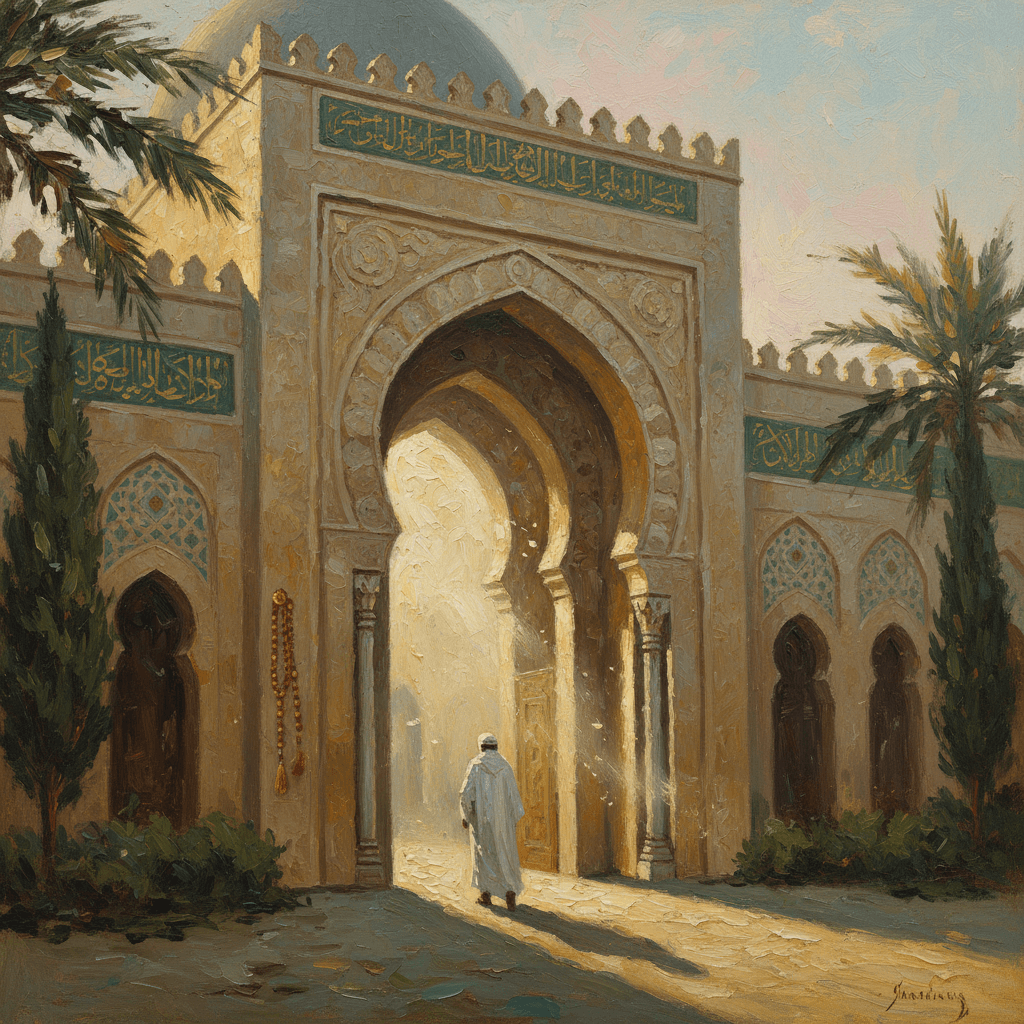
There is a feeling that the Arabic language preserved and English struggles to translate: the sensation of standing before something so magnificent, so far beyond your scale of reference, that the only appropriate response is to fall silent and lower your head.
The Arabic word for this is jalal — majesty. And Allah's name Al-Jaleel is the fullest possible expression of it.
What Al-Jaleel Actually Means
الجليل — Al-Jaleel — comes from the root j-l-l, which carries the meaning of grandeur, eminence, and a quality that elevates something far above ordinary things. It is the same root that produces jalala (majestic presence), ijlal (to honor, to revere), and the well-known phrase Dhul-Jalali wal-Ikram (the Possessor of Majesty and Honor).
Al-Jaleel describes Allah's majesty as intrinsic — not something He earned or achieved, but a quality inseparable from His divine nature. Created things can be impressive, powerful, or beautiful. Al-Jaleel is the name for a quality that is in a different category entirely.
The Quran uses the root of this name twice, at the beginning and end of Surah Ar-Rahman, in one of the most powerful expressions of Allah's identity:
تَبَارَكَ اسْمُ رَبِّكَ ذِي الْجَلَالِ وَالْإِكْرَامِ
Tabarakasmur rabbika dhil-jalali wal-ikram
"Blessed is the name of your Lord, possessor of majesty and honor."
— (Surah Ar-Rahman, 55:78)
The surah opens with Allah's name — Ar-Rahman — and closes with this: Dhul-Jalali wal-Ikram. Majesty and honor, bound together, sealing the chapter that lists Allah's infinite blessings. This is the frame that contains the entire enumeration of His gifts.
Among the 99 names of Allah, Al-Jaleel belongs to a cluster that addresses the overwhelming nature of Allah's being — names like Al-Azim (the Most Great), Al-Kabir (the Great), and Al-Mutakabbir (the Supreme in Greatness). The Asma ul-Husna together form a portrait of a Lord whose every attribute exceeds the capacity of creation to fully grasp.
Why Modern Muslims Have Lost a Sense of Jalal
There is a spiritual crisis of jalal in the modern Muslim world. Not a crisis of information — we know the names, the meanings, the translations. The crisis is in the felt experience of being in the presence of something truly majestic.
The modern world has a systematic way of deflating awe. Everything is explained. Everything is content. The universe's mysteries are Wikipedia articles. The stars are smartphone wallpapers. Even the most profound realities of existence have been made into consumable information that passes through us without settling.
The result is that many Muslims approach Allah with familiarity without reverence. They know Islam well enough to discuss it, argue about it, and share quotes from it — but the experience of standing before Al-Jaleel in prayer, genuinely awed, has become rare.
The nafs contributes to this too. Genuine jalal — authentic awe before Allah — shrinks the nafs down to its actual size. The nafs that spends its day insisting on its own importance does not enjoy encountering Al-Jaleel. It prefers a comfortable, manageable, non-awe-inspiring deity who validates rather than overwhelms.
Calling on Al-Jaleel consistently is a direct challenge to this pattern.
How to Practice This Daily
1. Call on Dhul-Jalali wal-Ikram After Each Salah
The Prophet ﷺ specifically instructed:
اسْتَكْثِرُوا مِنْ قَوْلِ يَا ذَا الْجَلَالِ وَالْإِكْرَامِ
Istakthiru min qawli: Ya Dhal-Jalali wal-Ikram
"Say frequently: O Possessor of Majesty and Honor."
— (Tirmidhi 3524)
This is a direct Prophetic recommendation. After your salah — in the moment when you are still on the prayer mat, before the phone comes back out — say this once. Then again. Let the words land.
2. Read Surah Ar-Rahman With Awareness of Jalal
Surah Ar-Rahman is structured as an extended call to acknowledge Allah's blessings — and the answer to every rhetorical question is the same: "Which of the favors of your Lord do you deny?" Reading it slowly, meditating on the blessings being listed, and arriving at the closing Dhul-Jalali wal-Ikram — this is one of the most powerful ways to feel Al-Jaleel.
3. Use Jalal in Your Personal Duas
Many Muslims address Allah with formal phrases without personalizing the invocation. Try this: when you sit in sujud for a private moment of dua, begin by calling on Al-Jaleel directly:
يَا جَلِيلُ، إِنَّكَ عَظِيمٌ وَأَنَا صَغِيرٌ، يَا كَرِيمُ اكْرِمْنِي بِرَحْمَتِكَ
Ya Jalil, innaka azimun wa ana saghir, ya Karim, akrimni bi rahmatik
"O Majestic One, You are great and I am small. O Generous One, honor me with Your mercy."
There is no rigid formula required for personal dua. The act of acknowledging Allah's jalal before making a request is itself a form of worship.
Make Dhikr of Al-Jaleel Part of Every Day
DeenBack helps you build the post-salah dhikr habit — calling on Allah by His names, including the ones the Prophet specifically recommended — so this practice becomes automatic.


Free download. Premium features available in-app.
4. Connect Jalal to Ikram — Majesty With Honor
The Quran always pairs jalal with ikram — majesty with honor. This pairing reveals something about how Allah's jalal operates. It is not a cold or distant majesty that crushes. It is a majesty that simultaneously honors those who stand before it.
When you acknowledge Al-Jaleel, you are also acknowledging that this majestic Lord chose to honor you — with creation, with Islam, with guidance, with the possibility of standing in His presence in prayer. The ikram (honor) flowing from Al-Jaleel toward you is what makes approaching His jalal safe rather than annihilating.
This is directly related to the meaning of Dhul-Jalali wal-Ikram, which explores this pairing in depth.
5. Let Jalal Relativize Your Worries
When something in life feels overwhelmingly large — a problem you cannot solve, a future you cannot control, a relationship you cannot fix — the instinctive response is to spend mental energy on it. To turn it over, analyze it, plan around it.
Al-Jaleel offers a different orientation: bring the problem into the presence of the Majestic. Not to get a quick fix, but to let the relative sizes reset. The problem that felt enormous often shrinks when brought into conscious relationship with the jalal of Allah.
This is not denial. It is correct proportion.
Signs of Progress
You know Al-Jaleel is settling in your heart when:
- You sometimes feel something in ruku and sujud that you cannot name — a sense of your smallness that is not anxiety but peace
- The worries that seemed all-consuming begin to feel manageable, not because they changed but because something larger has taken up residence in your awareness
- Post-salah dhikr stops feeling like a formality and starts feeling like something you actually want to do
- You find yourself calling on Al-Jaleel in private moments — not only in structured dhikr but spontaneously, when you feel the need for His presence
Common Questions
Is it correct to call on Al-Jaleel with just the name — "Ya Jaleel"?
Yes. The format Ya + name is established in Islamic supplication. "Ya Jaleel" is valid. If you want to use the fuller Quranic form, "Ya Dhal-Jalali wal-Ikram" is the phrase the Prophet specifically recommended.
How is jalal different from jamal in Islamic theology?
Islamic scholars describe two complementary aspects of Allah's relationship to creation: jalal (majesty, transcendence, power that inspires awe) and jamal (beauty, mercy, closeness that inspires love). Al-Jaleel is the name corresponding to jalal — the overwhelming, awesome aspect. Both are necessary for a complete relationship with Allah: love without awe becomes presumption; awe without love becomes fear without intimacy.
Does calling on Al-Jaleel require any specific time or ritual?
No. Like all names of Allah, Al-Jaleel can be invoked at any time, in any clean state, in any language. The recommended practice of the Prophet — specifically saying "Ya Dhal-Jalali wal-Ikram" frequently — does not prescribe a specific time.
Can I call on Al-Jaleel when I am feeling angry or frustrated?
Yes — and this is one of the best times. Anger often comes from a sense that something has violated what we deserve or control. Calling on Al-Jaleel resets the frame: Who actually controls? Whose jalal towers over this situation? This does not dismiss the anger but relocates it within a larger reality.
Closing — Let Majesty Change You
Al-Jaleel is not an academic concept. It is the name of the One before whom Ibrahim trembled, before whom the mountains declared their incapacity to bear the trust, and before whom every prophet lowered their head in awe.
That same jalal is what you encounter in prayer. What you approach in dua. What you are invoking every time you say "Ya Dhal-Jalali wal-Ikram."
Let it be real. Not just a phrase, but an encounter.
Explore the Al-Aziz meaning and Al-Hafiz meaning to continue building a daily practice of calling on Allah through His names and letting each one reshape how you see your life and your Lord.
Call on Al-Jaleel — The Majestic — Every Day
DeenBack tracks your daily dhikr habit so the names of Allah move from knowledge into practice — one sincere invocation at a time.
Free download. Premium features available in-app.
Frequently Asked Questions
What does Al-Jaleel mean in Islam?
Al-Jaleel (الجليل) means the Majestic, the Glorious, the One of Grandeur. It describes Allah's majesty as an intrinsic quality — not something He acquired but something inherent to His nature. His _jalal_ (majesty) encompasses the awe-inspiring, transcendent aspect of His existence that makes created beings feel small and reverent in His presence.
Is Al-Jaleel the same as Dhul-Jalali wal-Ikram?
Al-Jaleel and Dhul-Jalali wal-Ikram share the same root (j-l-l) but are distinct names. Al-Jaleel means the Majestic as an attribute of His being. Dhul-Jalali wal-Ikram means the Possessor of Majesty and Honor — emphasizing that both majesty and honor are in His ownership and under His authority. The Prophet specifically recommended calling on Dhul-Jalali wal-Ikram frequently.
Where does Al-Jaleel appear in the Quran?
Al-Jaleel as a standalone name does not appear verbatim in the Quran, but it is established through hadith and Islamic tradition. The related name Dhul-Jalali wal-Ikram appears twice in the Quran — in Surah Ar-Rahman 55:27 and 55:78. Scholars include Al-Jaleel in the 99 names based on the derivation from jalal, which is directly Quranic.
What dua uses the name Al-Jaleel or Dhul-Jalali wal-Ikram?
The Prophet said: 'Hold fast to Ya Dhal-jalali wal-ikram' — meaning say it often. (Tirmidhi 3524, Ahmad). After every salah, the Prophet also said Subhanallah 33 times, Alhamdulillah 33 times, Allahu Akbar 33 times, completing the 100 with: 'La ilaha illallahu wahdahu la sharika lah, lahul mulku wa lahul hamdu wa Huwa 'ala kulli shay'in qadir.' Calling on Al-Jaleel in personal duas adds the dimension of approaching Allah in His full majesty.
How is Al-Jaleel different from Al-Azim?
Both names address the overwhelming greatness of Allah, but from different angles. Al-Azim emphasizes immensity — the sheer magnitude of Allah's attributes. Al-Jaleel emphasizes grandeur and majesty — the quality that commands reverence and awe. Al-Azim is more about scale; Al-Jaleel is more about the quality of being majestic in a way that demands _ta'dhim_ (honoring and reverence).