
- Published on
Al-Azim: The Most Great — Meaning, Ayatul Kursi, and Daily Practice
- Authors

- Name
- Ahmad
- Role
- Senior Marketing Manager, Islamic education • Deen Back
بِسْمِ اللهِ الرَّحْمٰنِ الرَّحِيْمِ
In the name of God, the Most Gracious, the Most Merciful.
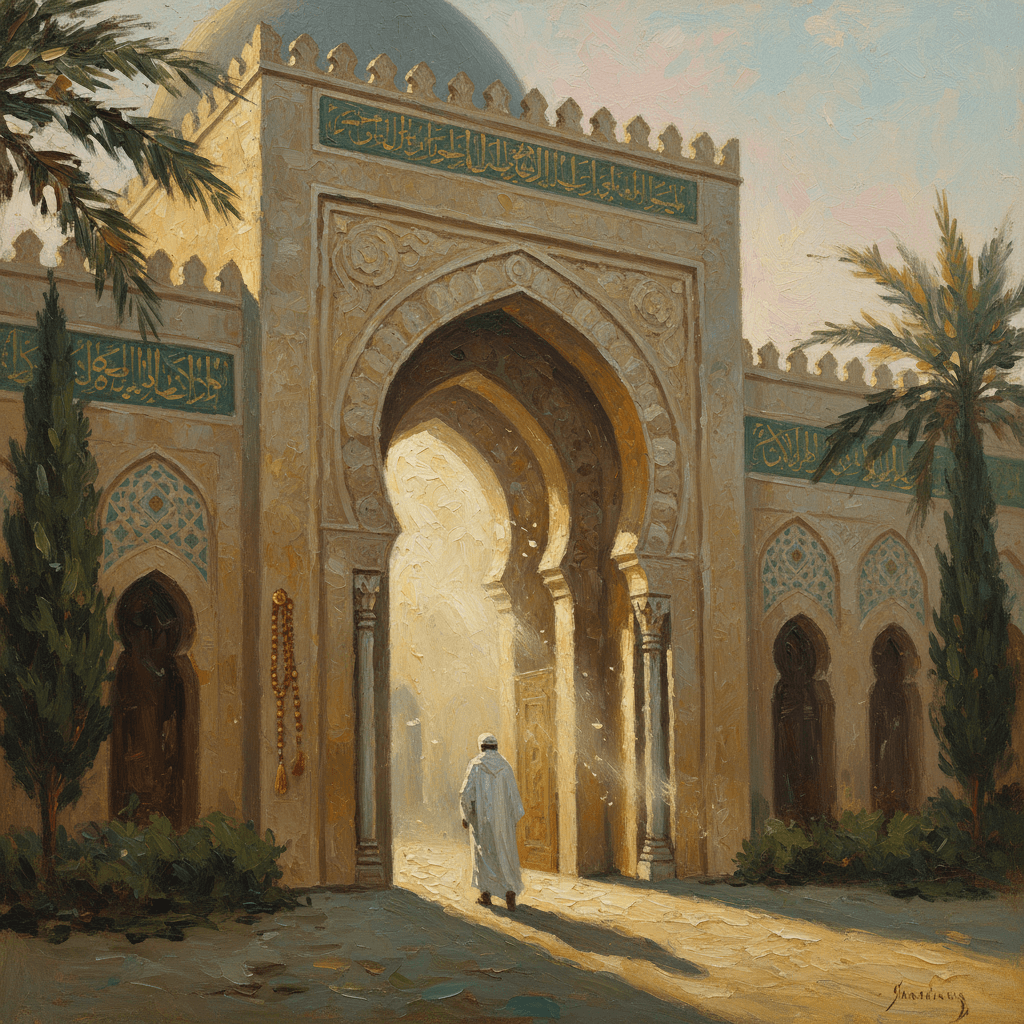
Multiple times every salah, you bow from the waist, lower your back to horizontal, and say: Subhana Rabbiyal Azim. Glory to my Lord, the Most Great. You say it at least three times in every ruku.
Most of us say these words while our minds are somewhere else. The body bows; the heart stays upright. If you actually understood what Azim means — if you felt even a fraction of the greatness the word points toward — the bowing would be different.
What Al-Azim Actually Means
العظيم — Al-Azim — comes from the Arabic root '-z-m, which carries the meaning of immensity, magnitude, and overwhelming greatness. But it is not simply "big." It describes a quality that is beyond all scale and measurement.
When you say something is great, you implicitly have a reference point — great compared to what? Al-Azim describes greatness that has no reference point because nothing exists at the same level. Allah is not great compared to other things. He is greatness itself, the very origin and definition of the concept.
This name appears in one of the most significant verses in the Quran — the closing of Ayatul Kursi:
وَهُوَ الْعَلِيُّ الْعَظِيمُ
Wa Huwal Aliyyul Azim
"And He is the Most High, the Most Great."
— (Surah Al-Baqarah, 2:255)
Ayatul Kursi is described by the Prophet ﷺ as the greatest verse in the Quran. It concludes with these two names: Al-Aliy (the Most High) and Al-Azim (the Most Great). Height without measure. Greatness without limit.
This pairing is intentional. Al-Aliy addresses the elevation of Allah above all creation. Al-Azim addresses the overwhelming magnitude of His attributes. Together, they close the verse that describes Allah's total sovereignty over the universe.
Among the 99 names of Allah, Al-Azim stands in a cluster of names that address the absolute nature of Allah's existence. The Asma ul-Husna together paint a picture of a Lord who is beyond every human attempt at comparison or comprehension.
Why Modern Muslims Have Lost a Sense of Awe
There is a spiritual problem in the modern Muslim world that rarely gets named directly: we have lost khashyah — the sense of awe and reverence before Allah.
We know the information. We recite the names. We can tell you that Al-Azim means "the Most Great." But knowing the meaning does not automatically produce the feeling. And the feeling — that authentic shiver of recognizing smallness before absolute greatness — is what the name Al-Azim is meant to evoke.
Part of this is structural. Modern life has stripped us of natural awe. When everything is instantly available, immediately explained, and entirely controllable, the experience of encountering something genuinely beyond us becomes rare. The sense of smallness that used to come from standing under a vast sky or looking at a range of mountains has been replaced by the glow of a phone screen.
The nafs also plays a role. The nafs does not like feeling small. Acknowledging that something is infinitely greater than you, that you are dependent, that you have no power except through Him — the nafs resists this at every level. It prefers to maintain a comfortable sense of independence and control.
Calling on Al-Azim directly challenges the nafs. It says: you are not Azim. He is.
How to Practice This Daily
1. Be Present in Ruku
The most direct daily application of Al-Azim is in the bowing position of prayer. When you bow and say Subhana Rabbiyal Azim, your body is in a posture of acknowledgment. The back is horizontal. The head is lowered. You are physically smaller than you were a moment ago.
Let the words match the posture. Say Subhana Rabbiyal Azim slowly. Mean each syllable. Do not rush toward the next movement. This is the moment the name was designed for — the body and tongue together acknowledging the Most Great.
2. Use the Beloved Phrase After Salah
The Prophet ﷺ said:
سُبْحَانَ اللَّهِ وَبِحَمْدِهِ سُبْحَانَ اللَّهِ الْعَظِيمِ
Subhanallahi wa bihamdihi, Subhanallahil Azim
"Glory to Allah and His praise. Glory to Allah the Most Great."
— (Bukhari 6406)
This is described as "light on the tongue, heavy on the scales, beloved to the Most Merciful." Two phrases. A few seconds. Enormous weight with Allah.
Add it to your dhikr after every salah, even just once with full consciousness.
Build a Daily Dhikr Practice Around the Names of Allah
DeenBack helps you track your daily dhikr habit — including post-salah remembrance — so the names of Allah become part of every day, not just special occasions.


Free download. Premium features available in-app.
3. Recite Ayatul Kursi With the Closing in Mind
When you read Ayatul Kursi — after each obligatory prayer, before sleep — read the last line with particular attention:
Wa Huwal Aliyyul Azim.
He is the Most High. He is the Most Great. These two attributes, given at the end of the greatest verse in the Quran, are the conclusion Allah chose for this description of His sovereignty. He wanted us to end there: with His absolute elevation and His absolute greatness.
4. Contemplate Creation to Feel the Name
The Prophet ﷺ and his Companions used to reflect on the signs of Allah in creation as a form of worship. Stand outside and look at the sky on a clear night. Consider the scale of what you are seeing. The nearest star is 4 light-years away — light traveling at 300,000 km per second for 4 years. And that is just the nearest one. The Milky Way contains hundreds of billions of stars.
Then consider: Al-Azim encompasses all of this. And infinitely more. And the existence of everything is entirely dependent on His will at every moment.
That is not information. That is khashyah.
5. Pair Al-Azim With Al-Aliy in Your Personal Duas
When you are feeling that your problems are overwhelming — large, unmanageable, beyond your control — call on Al-Azim directly:
يَا عَظِيمُ، أَنْتَ أَعْظَمُ مِنْ كُلِّ هَمٍّ
Ya Azim, anta a'zamu min kulli hamm
"O Most Great, You are greater than every worry."
Pairing this with the names explored in Al-Aleem meaning and Al-Ahad meaning builds a daily dhikr practice that moves through different facets of Allah's nature.
Signs of Progress
You know Al-Azim is working on your heart when:
- The words Subhana Rabbiyal Azim in ruku begin to carry weight — you feel something when you say them, not just hear yourself saying them
- You notice your problems becoming smaller in your estimation — not because they have changed, but because your sense of Allah's greatness has grown
- The nafs's constant reassertion of its own importance starts to feel obviously false
- You find yourself spontaneously contemplating Allah's signs — a sunset, a thunderstorm, a clear night — as reminders of Al-Azim rather than just pleasant scenery
Common Questions
Is Al-Azim the same as Allahu Akbar?
Allahu Akbar means "Allah is greater" — greater than whatever you are engaged with, whatever competes for your attention, whatever you might put before Him. It is a comparative statement. Al-Azim is a description of an absolute quality. Together they address the same reality from different angles: Allah's superiority (Akbar) and His inherent immensity (Azim).
How is Al-Azim connected to humility?
Directly. Knowing that Allah is Al-Azim makes your own self-importance seem hollow. The nafs builds its castles on the assumption that you are important, that your plans matter, that your status is real. When Al-Azim settles into your heart — even slightly — those castles lose their walls.
Should I say Al-Azim in ruku more than three times?
The minimum is three times. The Prophet sometimes prayed very long rakats with extended ruku. Saying it more — five, seven, nine times — especially in voluntary prayers, is an act of following the Prophet's practice. The more you say it with presence, the more it enters your heart.
Closing — Greatness That Exceeds All Imagination
Al-Azim is the name that puts everything else in its correct size.
Your problems, your plans, your past, your fears — all of them are measured against the Most Great, and they become what they truly are: manageable, temporary, small.
Call on this name. Let it shrink what has grown too large in your heart. Say Subhana Rabbiyal Azim the next time you bow, and mean it.
Let Al-Azim Reshape Your Daily Perspective
Build a daily dhikr habit with DeenBack — starting with the names of Allah that put your challenges in their proper place and fill the space with something real.
Free download. Premium features available in-app.
Frequently Asked Questions
What does Al-Azim mean in Islam?
Al-Azim (العظيم) means the Most Great, the Magnificent, the Immensely Grand. It describes Allah's greatness as absolute and unlimited — beyond anything that can be measured, imagined, or compared. It is not that Allah is 'great among great things'; He is the very standard by which greatness is measured.
Where does Al-Azim appear in the Quran?
Al-Azim appears in Ayatul Kursi — Surah Al-Baqarah 2:255 — paired with Al-Aliy: 'wa Huwal Aliyyul Azim' (And He is the Most High, the Most Great). It also appears in Surah Al-Waqi'ah 56:74 and 56:96, and in the dhikr of ruku: 'Subhana Rabbiyal Azim' is said while bowing, meaning 'Glory to my Lord, the Most Great.'
What is the tasbih of ruku and why does it mention Al-Azim?
In ruku (the bowing position of prayer), Muslims say 'Subhana Rabbiyal Azim' — Glory to my Lord, the Most Great. This specific dhikr in ruku was commanded by the Prophet. The position of bowing — head lowered, back horizontal — is a physical expression of acknowledging Allah's greatness. Saying Al-Azim while in that position is the tongue confirming what the body is already expressing.
What is the difference between Al-Azim and Al-Kabir?
Both names address Allah's greatness. Al-Kabir (the Great) refers to Allah's greatness in magnitude. Al-Azim goes further — it describes a greatness that is beyond all proportionality, something that cannot be contained in any scale of measurement. Al-Azim is the name used when acknowledging Allah's greatness as transcending categories entirely.
What dua uses the name Al-Azim?
The Prophet said: 'Whoever says Subhanallahu wa bihamdihi, Subhanallahil Azim — Glory to Allah and His praise, Glory to Allah the Most Great — will have a palm tree planted for them in paradise.' (Tirmidhi 3468). This is one of two phrases described as 'light on the tongue, heavy on the scales, beloved to the Most Merciful' (Bukhari 6406).