
- Published on
What Is Dua? The Most Direct Conversation You Can Have With Allah
- Authors

- Name
- Ahmad
- Role
- Senior Marketing Manager, Islamic education • Deen Back
بِسْمِ اللهِ الرَّحْمٰنِ الرَّحِيْمِ
In the name of God, the Most Gracious, the Most Merciful.
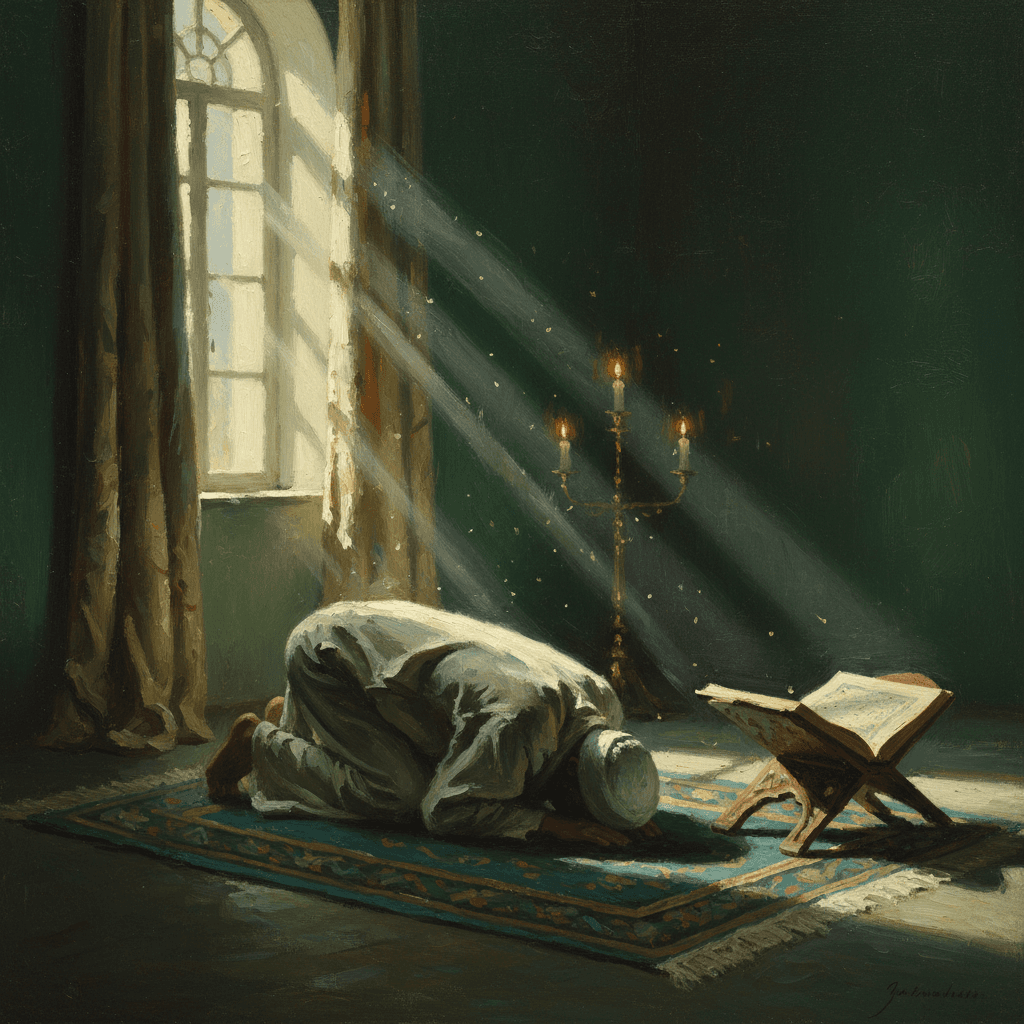
There are moments when you feel completely at the end of yourself. When the problem is too big for your hands to fix, the situation too uncertain for your plans to manage, the pain too deep for anyone around you to reach.
These moments are not gaps in Islamic practice. They are precisely the moments Islam was designed for.
Dua is the act of calling on Allah — directly, personally, in your own situation, with your own words. It is not a ceremony. It is not reserved for scholars or the spiritually advanced. It is the most basic, most direct form of communication available to every human being who was ever created.
What Dua Is
Dua (دُعَاء) comes from the Arabic root da'a — to call, to invite, to summon. When a believer makes dua, they are calling on Allah. Not through an intermediary. Not with a specific posture or location required. Just: turning toward Allah and speaking.
The Prophet ﷺ defined it directly:
الدُّعَاءُ هُوَ الْعِبَادَةُ
Ad-du'a huwal-'ibadah
"Dua is worship itself."
— (Tirmidhi 3370)
The hadith is remarkable. He did not say dua is a type of worship or a form of worship. He said it is worship. The two are synonymous. Every time you raise your hands and ask Allah for something, you are performing the core act of what it means to be a worshipper.
The Quran says:
وَقَالَ رَبُّكُمُ ادْعُونِي أَسْتَجِبْ لَكُمْ
"And your Lord said: Call on Me, and I will respond to you."
— (Quran, Surah Ghafir, 40:60)
This is a direct command followed by a direct promise. The verse continues: "Those who are too proud to worship Me will enter Hell humiliated." The opposite of dua — not asking, not calling — is kibr (arrogance). Dua is the act of acknowledging you are a creature who needs its Creator.
The Story Behind This Practice
Among the sahaba, the person most famous for the sheer volume and variety of his dua was Umar ibn al-Khattab رضي الله عنه. He used to say that Fajr prayer concerned him less than missing the opportunity for dua between adhan and iqamah.
When asked what he asked for in his dua, he said: "Everything. I ask Allah for salt for my food." This is the breadth the companions understood dua to encompass — not only the great, desperate moments, but the daily texture of life turned over to Allah's care.
The Prophet ﷺ made dua for specific, concrete things. He made dua when putting on new clothes, when entering the marketplace, when he saw the new moon, when it rained. He made dua during his most difficult moments. He made dua when things were good. His entire life was oriented through the lens of dua — a continuous acknowledgment that every circumstance was in Allah's hands.
Ibn al-Qayyim wrote that dua is the weapon of the believer. Not for attacking, but for navigating. The person who uses it consistently enters every situation with a resource that nothing in the material world can provide.
How to Build a Daily Dua Habit
The barrier most people face is not sincerity — it is structure. Without a regular time and context for dua, it happens only in emergencies. Building a daily practice changes that.
After every sujood, add a personal dua. The prostration is described in hadith as the closest position the servant is to Allah. (Sahih Muslim 482) During the sujood of any prayer — particularly in nafl prayers where there is no time pressure — pause after the obligatory phrases and add your personal dua. "Ya Allah, help me with this situation at work." "Ya Allah, I am struggling with this habit." These do not need to be eloquent.
Keep a dua list. Write down the things you are asking Allah for — specific, concrete, dated. Review it every few weeks. When an item is answered, note it and thank Allah. This practice builds real evidence in your own life that dua is answered, which in turn builds conviction.
Use the last third of the night. If you wake up at any point between 2 AM and Fajr, that window is among the most powerful for dua. The Prophet said Allah descends (in a manner befitting His majesty) and says: "Who is calling on Me that I may answer? Who is asking of Me that I may give? Who is seeking My forgiveness that I may forgive?" (Sahih Bukhari 1145) Even five minutes of dua in this window carries a weight unlike most other times.
Say it out loud when alone. Dua can be silent or spoken. Speaking it out loud — when privacy permits — tends to create more engagement and presence. It also makes it harder to be distracted.
Build Your Daily Dua Habit — Track What You Ask For
DeenBack helps you build a consistent daily dua practice — tracking your supplications, your answered duas, and your streak of turning to Allah every day.


Free download. Premium features available in-app.
Related Duas to Begin With
The dua the Prophet taught as the most comprehensive:
اللَّهُمَّ إِنِّي أَسْأَلُكَ الْعَافِيَةَ فِي الدُّنْيَا وَالْآخِرَةِ
Allahumma inni as'alukal-'afiyata fid-dunya wal-akhirah
"O Allah, I ask You for wellbeing in this world and the next." — (Ibn Majah 3851)
The companion Al-Abbas رضي الله عنه asked the Prophet: "What is the best thing I can ask Allah for?" This was the answer. Al-'afiyah — wellbeing, health, safety, ease — covers both worlds in a single phrase.
For when you do not know what to ask for:
اللَّهُمَّ أَعْطِنِي مَا يَنْفَعُنِي، وَانْفَعْنِي بِمَا أَعْطَيْتَنِي
Allahumma a'tini ma yanfa'uni, wanfa'ni bima a'taytani
"O Allah, give me what benefits me, and benefit me in what You have given me." — Say this when overwhelmed by options or unclear about what to pray for.
For the conditions that make dua more likely to be accepted, see how to make dua that gets accepted. For specific duas for guidance when facing a decision, dua for guidance is the most directly relevant. For understanding how dhikr and dua work together as a daily practice, what is dhikr is the companion to this article.
Common Questions
Does dua have to be in Arabic? No. Scholars are near-unanimous that personal dua is valid in any language. The prophetic duas preserve the best and most eloquent wording in Arabic, and learning them is a worthwhile practice — but your own words in your own language are always valid.
Can I make dua during salah? Yes, particularly in sujood and during the final tashahhud. The Prophet said the servant is closest to Allah in prostration and encouraged increasing dua there.
What if I make dua and nothing happens? The Prophet addressed this: "The dua of any one of you will be answered as long as he does not hasten and say: I made dua and it was not answered." (Sahih Bukhari 6340) Patience is part of the practice. The response comes in one of three forms — the thing asked, an equivalent aversion of harm, or reward stored for the Day of Judgment.
Does wudu increase the acceptance of dua? Being in a state of purity is recommended and shows respect. But wudu is not a condition for dua — unlike salah. You can make dua in any state of purity.
The Most Direct Line Available
You have access to the King of kings. Not through a priest, a saint, or an intermediary. Directly.
You can call on Him right now, in whatever language comes naturally, with whatever is actually on your mind. You can ask Him for the small things and the impossible things. You can complain to Him, thank Him, beg Him, and simply acknowledge that you need Him.
That access does not expire. It does not have office hours. It is not blocked by your past sins or your current state.
Make dua today. Not a perfect dua — a real one.
Your Dua Practice Starts With One Honest Conversation
DeenBack helps you build a daily habit of turning to Allah — tracking your duas, your answered prayers, and your consistency so the practice grows stronger over time.
Free download. Premium features available in-app.
Frequently Asked Questions
What is dua in Islam?
Dua (دُعَاء) is personal supplication — asking Allah directly for something. It is the act of calling on Allah with your needs, fears, hopes, and gratitude. The Prophet called it 'the core of worship' (Tirmidhi 3370). Unlike salah, dua has no formal requirements for posture or language and can be made at any time.
What is the difference between dua and salah?
Salah (the five daily prayers) is formal worship with fixed times, postures, and Arabic recitation. It is obligatory. Dua is personal conversation — flexible in time, language, posture, and content. Salah contains dua within it (particularly in sujood), but dua itself is not limited to prayer times. The Prophet described dua as worship itself.
When is dua most likely to be accepted?
The most emphasized times are: the last third of the night (when Allah descends and asks who is calling on Him), between adhan and iqamah, during sujood (prostration), after obligatory prayers, on Fridays (particularly near Asr), on the Day of Arafah, during rain, and when fasting. Dua in distress and the dua of parents for children are also specifically mentioned in hadith as among the most accepted.
Why does dua sometimes not seem to get answered?
The Prophet taught that dua is always answered in one of three ways: what was asked is given, an equivalent harm is averted, or the reward is saved for the Day of Judgment. The question is not whether dua gets answered but which form the answer takes. Sincerity, absence of haram, patience, and sustained practice all affect the experience.
Can I make dua for anything?
Yes, for any halal need — worldly or spiritual, major or minor. The Prophet made dua for specific things including his health, his family, his provisions, and victory in battles. Allah does not find the servant's needs too small or too large. Dua is appropriate for everything from finding a parking space to guidance in the most difficult decisions of a life.