
- Published on
Is Meditation Haram? The Islamic Guide to Mindfulness and Inner Peace
- Authors

- Name
- Ahmad
- Role
- Senior Marketing Manager, Islamic education • Deen Back
بِسْمِ اللهِ الرَّحْمٰنِ الرَّحِيْمِ
In the name of God, the Most Gracious, the Most Merciful.
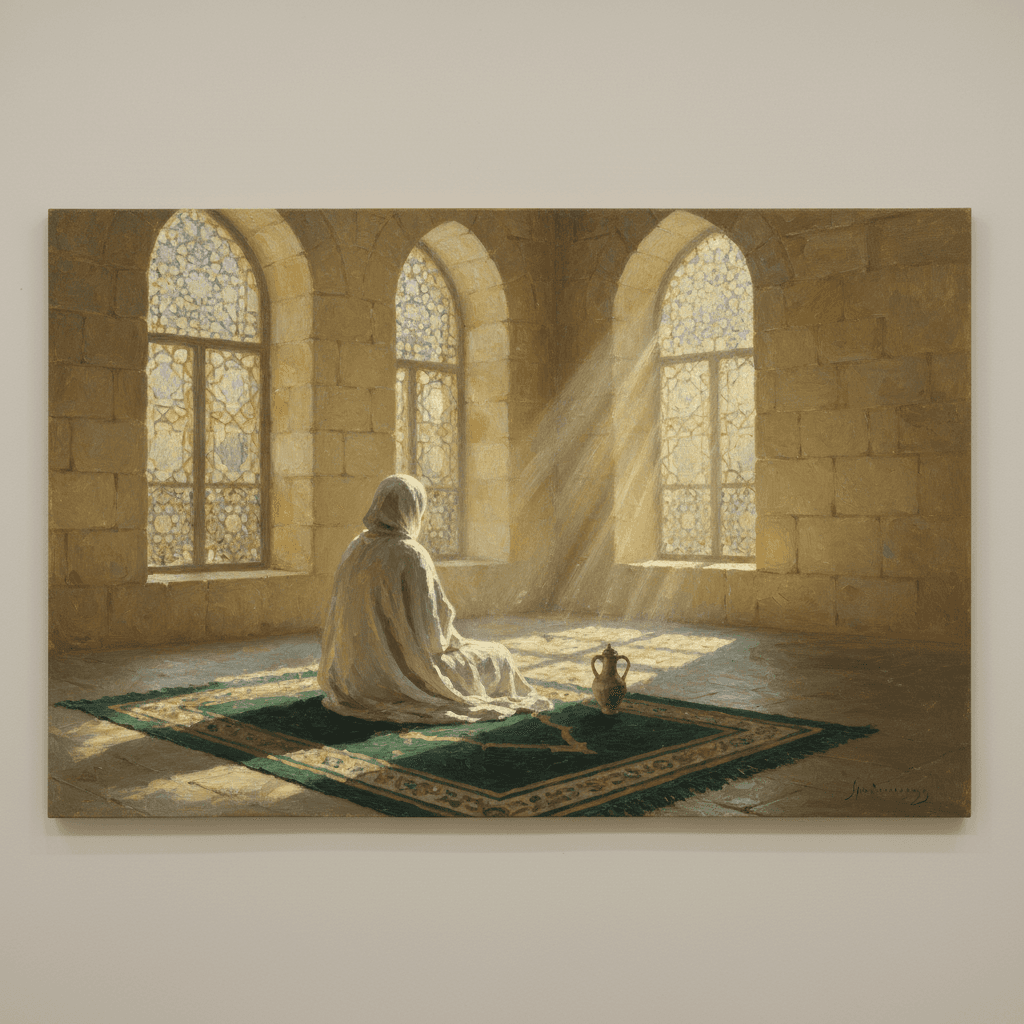
You are stressed. Your mind races at night. Maybe you struggle to focus during salah. Someone — a friend, a therapist, a wellness app — told you to try meditation. And then the doubt crept in: is this even allowed in Islam?
It is a fair question. Meditation has roots in Eastern religions like Buddhism and Hinduism, and much of the modern wellness industry packages it with spiritual concepts that feel foreign to a Muslim. But before you dismiss it entirely, you should know something important — Islam already has its own powerful tradition of contemplation, mindfulness, and inner stillness. You may have been practicing Islamic meditation your entire life without calling it that.
The Quick Answer
Meditation is not haram as a general concept. The ruling depends entirely on the type of meditation you are doing. Generic mindfulness techniques — deep breathing, calming your thoughts, being present — are permissible. Islamic contemplation is not just allowed but actively encouraged in the Quran:
إِنَّ فِي خَلْقِ السَّمَاوَاتِ وَالْأَرْضِ وَاخْتِلَافِ اللَّيْلِ وَالنَّهَارِ لَآيَاتٍ لِّأُولِي الْأَلْبَابِ الَّذِينَ يَذْكُرُونَ اللَّهَ قِيَامًا وَقُعُودًا وَعَلَىٰ جُنُوبِهِمْ وَيَتَفَكَّرُونَ فِي خَلْقِ السَّمَاوَاتِ وَالْأَرْضِ
"Indeed, in the creation of the heavens and the earth and the alternation of the night and the day are signs for those of understanding — who remember Allah standing, sitting, and lying on their sides, and reflect on the creation of the heavens and the earth." — (Surah Ali 'Imran, 3:190-191)
What is problematic: meditation that involves chanting mantras from other religions, invoking spiritual entities outside of Islamic belief, or practices built on concepts that contradict tawhid (the oneness of Allah).
What the Quran and Sunnah Say
Islam does not use the word "meditation," but the practices it describes are unmistakably meditative. Three core concepts stand out.
Tafakkur — Deep Reflection
Tafakkur (تفكّر) means deep, purposeful contemplation — reflecting on Allah's creation, on your own life, on the signs around you. The verse above (3:190-191) is the clearest endorsement. The Prophet ﷺ himself would spend long periods in solitary reflection in the Cave of Hira before revelation began. That was tafakkur in its purest form.
Abu al-Darda رضي الله عنه said:
"An hour of tafakkur is better than a year of worship."
This is widely quoted among scholars as a statement of the Companions, emphasizing that quality of spiritual presence outweighs quantity of empty ritual.
Muraqabah — Self-Watchfulness
Muraqabah (مراقبة) is the practice of being constantly aware that Allah is watching you. It is directly tied to the hadith of Jibril, where the Prophet ﷺ defined ihsan:
"أَنْ تَعْبُدَ اللَّهَ كَأَنَّكَ تَرَاهُ فَإِنْ لَمْ تَكُنْ تَرَاهُ فَإِنَّهُ يَرَاكَ"
"To worship Allah as though you see Him, and if you cannot see Him, then know that He sees you." — (Sahih Muslim 8a)
This is not passive awareness. It is an active, conscious state of being present with Allah — which is exactly what modern mindfulness aims to achieve, but directed toward the Creator.
Dhikr — Remembrance of Allah
Dhikr (ذِكر) is the most accessible form of Islamic meditation. Repeating SubhanAllah, Alhamdulillah, Allahu Akbar, or La ilaha illallah with focus and presence calms the heart, reduces anxiety, and connects you to Allah. The Quran explicitly ties dhikr to inner peace:
أَلَا بِذِكْرِ اللَّهِ تَطْمَئِنُّ الْقُلُوبُ
"Verily, in the remembrance of Allah do hearts find rest." — (Surah Ar-Ra'd, 13:28)
This is not metaphorical. Clinical research consistently shows that repetitive devotional practices — including dhikr — activate the parasympathetic nervous system and reduce cortisol levels. Islam prescribed this 1400 years ago.
Why This Is Actually Hard
The confusion is understandable. The modern meditation industry borrows heavily from Buddhist and Hindu traditions. When you open a meditation app, you might encounter references to chakras, "universal consciousness," karma in a non-Islamic sense, or instructions to "connect with the universe." These concepts are not neutral — they come from religious frameworks that contradict Islamic theology.
The challenge for Muslims is separating the technique from the theology. Deep breathing is not Buddhist. Sitting quietly is not Hindu. Focusing your mind is not shirk. But chanting "Om," visualizing energy centers tied to Hindu cosmology, or seeking spiritual guidance from non-Islamic sources — these cross boundaries that matter.
Your nafs may also complicate things. Sometimes the desire for "meditation" is really a desire to avoid the discipline of actual ibadah. If you find yourself drawn to a 20-minute guided meditation app but cannot sit for 10 minutes of dhikr after Fajr, that is worth examining honestly. The Islamic practices are harder because they demand accountability to Allah, not just to your own wellbeing.
What to Do About It — Practical Steps
You do not need to look outside Islam for inner peace. Here is how to build a meditation practice that is both spiritually sound and practically effective.
1. Start with Post-Salah Dhikr
After every salah, sit for 2-3 minutes. Recite the prescribed adhkar: 33 times SubhanAllah, 33 times Alhamdulillah, 33 times Allahu Akbar. Do this slowly. Do not rush through it as a checklist. Focus on each word. Feel the meaning. This is meditation — and it is sunnah.
2. Practice Tafakkur Before Bed
Spend 5-10 minutes before sleep in quiet reflection. No phone. No screen. Think about your day — where did you obey Allah? Where did you fall short? Reflect on His creation. Look at the night sky if you can. The Prophet ﷺ would recite the last ten ayat of Surah Ali 'Imran upon waking at night and reflect on creation. You can build this habit too.
3. Try Breathing with Dhikr
Combine deep breathing with remembrance. Inhale slowly while thinking "La ilaha" (there is no god), exhale while thinking "illallah" (except Allah). This is a technique used by scholars of tasawwuf for centuries. It calms your body and focuses your heart on tawhid simultaneously.
4. Use the Early Morning Window
The time between Fajr and sunrise is uniquely blessed. The Prophet ﷺ said:
"Whoever prays Fajr in congregation, then sits remembering Allah until the sun rises, then prays two rak'ahs, will have a reward like that of Hajj and Umrah." — (Tirmidhi 586)
This is the ultimate Islamic meditation session — salah, dhikr, and tafakkur in the quietest part of the day.
5. Replace, Do Not Just Remove
If you currently use a secular meditation app, you do not necessarily need to delete it — but you should supplement it. Add Islamic content to your routine. Track your dhikr. Build the habit of daily reflection rooted in your deen.
Build Your Daily Dhikr Habit
DeenBack helps you track your daily adhkar, build consistent worship habits, and grow spiritually — one day at a time.


Free download. Premium features available in-app.
Dua for Strength
When you feel overwhelmed and need calm, turn to this dua:
اللَّهُمَّ إِنِّي أَعُوذُ بِكَ مِنَ الْهَمِّ وَالْحَزَنِ وَالْعَجْزِ وَالْكَسَلِ
"O Allah, I seek refuge in You from worry and grief, from helplessness and laziness." — (Sahih al-Bukhari 6369)
The Prophet ﷺ used to make this dua regularly. It is a reminder that seeking mental peace is not a modern invention — it is deeply prophetic.
Common Questions
Is listening to Quran a form of meditation?
Yes. Listening to Quran recitation with focus and reflection is a powerful meditative practice. The Quran itself commands: "When the Quran is recited, listen to it and be silent, so that you may receive mercy" (Surah Al-A'raf, 7:204). Many people find that listening to a skilled reciter in a quiet space produces the same calming effects as any meditation technique — with the added benefit of connecting to Allah's words.
Can I use apps like Headspace or Calm?
You can use the breathing exercises and general mindfulness techniques from these apps. What you should skip: any guided sessions that involve non-Islamic spiritual content, visualization of "energy," or references to spiritual frameworks outside of Islam. Consider pairing them with Islamic apps that offer guided dhikr and Quran reflection. If you are interested in what Islam says about other modern practices, we cover those too.
Is transcendental meditation (TM) allowed?
Transcendental meditation involves receiving a personal mantra — often a Sanskrit word — from a TM teacher. Because these mantras are rooted in Hindu tradition and the practice involves spiritual initiation outside of Islam, most scholars would advise against it. The technique of silent repetition itself is fine — just replace the mantra with dhikr.
Does salah count as meditation?
Absolutely. Salah performed with khushu (خشوع — humility and focus) is the most complete form of meditation available to a Muslim. It combines physical stillness, breath awareness, verbal recitation, and spiritual presence. The challenge is that many of us rush through salah without presence. Working on your khushu is, in itself, a meditation practice. Related topics like the role of music and physical expression in worship also touch on how we engage our bodies and minds in faith.
Your Inner Peace Already Has a Source
You do not need to borrow from Buddhism or Hinduism to find calm. Islam gave you tafakkur, muraqabah, dhikr, dua, and salah — a complete system for inner peace that also connects you to your Creator. The modern wellness industry discovered what Muslims have practiced for fourteen centuries.
The real question is not whether meditation is haram. The real question is whether you are using the meditation tools Islam already gave you. If your dhikr feels empty, work on presence. If your salah feels rushed, slow down. If your mind races at night, try tafakkur before bed. These are not just spiritual exercises — they are practical tools for a calmer, more focused life.
Start small. Pick one practice from this article and commit to it for seven days. Track it. Build from there. The path to inner peace is not a single leap — it is a series of small, consistent steps.
Start Your Journey to Inner Peace
DeenBack helps you build daily dhikr, track your worship habits, and stay consistent on your spiritual journey. Download free today.
Free download. Premium features available in-app.
Frequently Asked Questions
Is meditation haram in Islam?
Meditation itself is not haram. Islam actually encourages contemplation (tafakkur), self-watchfulness (muraqabah), and remembrance of Allah (dhikr) — all of which are forms of meditation. What is problematic is meditation tied to other religious rituals, such as chanting Hindu or Buddhist mantras, invoking non-Islamic spiritual entities, or practices rooted in beliefs that contradict tawhid.
Is mindfulness meditation permissible for Muslims?
Yes, basic mindfulness — being present, focusing on your breathing, calming your mind — is permissible. These are neutral techniques with no inherent religious content. Many scholars point out that khushu (focus and humility) in salah is itself a form of mindfulness. The concern arises only when mindfulness is packaged with non-Islamic spiritual beliefs.
What is the Islamic alternative to meditation?
Islam has its own rich tradition of contemplative practices: tafakkur (deep reflection on Allah's creation), muraqabah (self-watchfulness and awareness of Allah's presence), dhikr (remembrance of Allah through phrases like SubhanAllah, Alhamdulillah, Allahu Akbar), and dua (supplication). Salah itself, performed with khushu, is the most complete form of Islamic meditation.
Can I do yoga and meditation together as a Muslim?
The physical exercises of yoga (stretching, breathing) are generally permissible when separated from Hindu spiritual elements. The same applies to meditation paired with yoga — keep the physical benefits, avoid the spiritual rituals that contradict Islamic belief. See our detailed guide on [is yoga haram](/blog/is-yoga-haram) for more.
Is it haram to empty your mind during meditation?
The concept of 'emptying your mind' is not inherently haram — it depends on the intention and framework. If the goal is to clear mental clutter so you can focus on dhikr or reflection, that is beneficial. If the practice involves opening yourself to 'cosmic energy' or spiritual entities outside of Islamic theology, that crosses a line. Islam encourages filling your mind with remembrance of Allah, not leaving it vacant.