
- Published on
Is It Haram to Dye Your Hair in Islam?
- Authors

- Name
- Ahmad
- Role
- Senior Marketing Manager, Islamic education • Deen Back
بِسْمِ اللهِ الرَّحْمٰنِ الرَّحِيْمِ
In the name of God, the Most Gracious, the Most Merciful.
The Quick Answer
Dyeing your hair is generally permitted in Islam. The hadith about changing grey hair says to avoid black dye. This article explains that evidence, other colors such as henna, and the cases on which scholars differ.
What the Quran and Sunnah Say
The primary evidence for hair dyeing comes directly from the Prophet ﷺ. When Abu Quhafa, Abu Bakr's father, came to the Prophet ﷺ with white hair and beard, the Prophet ﷺ said:
"Change it with something but avoid black." — (Sahih Muslim 2102b)
The Prophet ﷺ affirmed changing grey hair as a practice and cautioned against black. Scholars differ on the precise legal status of pure black dye; IslamWeb summarizes both the forbidden and disliked views.
Another report warns about black dye:
"At the end of time there will be people who dye their hair black like the crop of pigeons. They will not even smell the fragrance of Paradise." — (Sunan Abu Dawud 4212)
This is a strong warning. Scholars discuss how it applies to dyeing grey or white hair, naturally black hair, and differing shades. The report does not itself identify a single motive that determines every ruling.
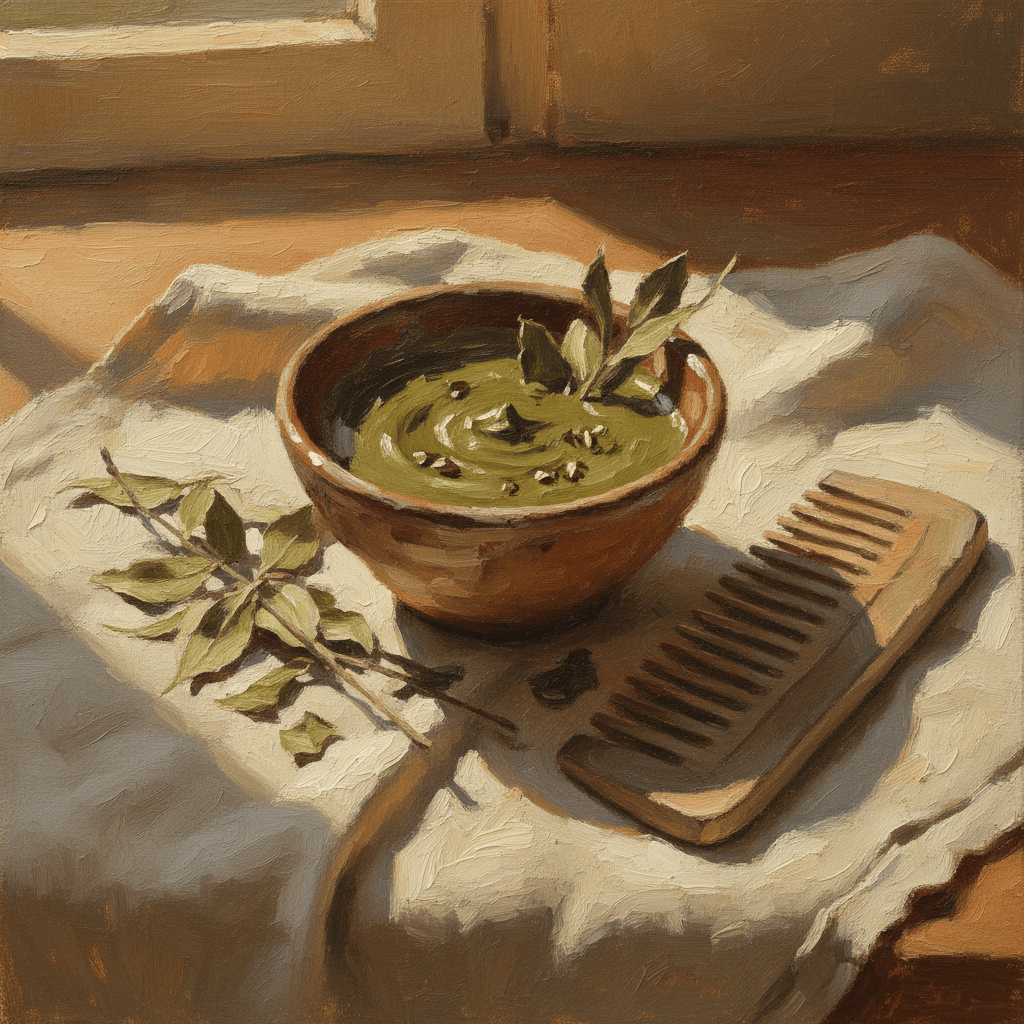
The Prophet ﷺ also specifically praised two plants used for dyeing: henna and katam (a plant yielding dark reddish-brown color). He said:
"The best things with which you can change grey hair are henna and katam." — (Sunan al-Tirmidhi 1753)
الحِنَّاء وَالكَتَمُ (al-hinna' wal-katam) — henna and katam. These were praised by name, making them among the most clearly permitted options.
The Quran does not specifically address hair dyeing, but the broader principles apply. Allah tells us in Surah Al-A'raf:
"O children of Adam, take your adornment at every place of worship." — (Quran 7:31)
Beautification is generally permitted. The warning about black dye is a specific issue within that broader permission, and scholars differ on its legal status.
Why This Is Actually Hard
The ruling sounds straightforward on paper. But when you are standing in the hair dye aisle, or talking to a colorist, or scrolling through shades on a website, the practical questions multiply fast.
What counts as "black"? Is a very dark brown prohibited? What about black dye on hair that was already dark brown to begin with — does that count as "covering grey"? What about semi-permanent dyes that fade? What about fashion colors that are unconventional but not black?
These are real questions that scholars have debated, and there is not a single unanimous answer to all of them.
Scholars discuss whether the warning about black dye applies only to covering grey or white hair, and how to distinguish pure black from very dark brown. They also differ on whether pure black is forbidden or disliked. Intention and context can matter, but neither replaces the hadith or a qualified opinion on a specific case.
There is also the question of context and modesty. For women, bright or unconventional fashion colors may attract attention in public settings in ways that conflict with haya' — the Islamic principle of modesty that runs through discussions of grooming and adornment, much like it does in questions about whether makeup is haram.
The difficulty here is real. Sit with the uncertainty, seek a qualified scholar if your specific situation is unclear, and make your decision with your niyyah (intention) clear.
What to Do About It
Step 1: Know your baseline ruling clearly
The broad guidance is that non-black dye is generally permitted, while the hadith warns against black when changing grey hair. Scholars differ on the exact ruling for pure black. Start with that distinction before asking about an edge case.
If you are considering a color that is auburn, brown, burgundy, copper, henna red, or any shade that is not pure black, you are in permitted territory according to the majority of scholars.
Step 2: Address the black dye question honestly
If you have been using black dye, or were planning to, ask how the shade and your circumstances fit the scholarly guidance. Intention is worth examining, but a good intention alone does not settle a question about a color the hadith tells us to avoid.
If the label says "black" but the result looks brown, or you are unsure whether the dye is pure black, take the product and your question to a qualified scholar rather than guessing from a marketing name.
This kind of honest self-examination is the same work required in questions about cosmetic procedures or permanent body modification — the surface question is about an act, but the deeper question is about your nafs and what it is chasing.
Step 3: Reconnect dyeing to sunnah, not vanity
One of the most underappreciated facts about this topic is that covering grey hair is a sunnah practice. The Companions did it. The Prophet ﷺ encouraged it. When you use henna or a permitted color to care for your appearance, you are not just making a cosmetic choice — you are following a prophetic example.
Reframe the act. This is not you chasing a beauty trend. This is you caring for your appearance in a way that has been explicitly recommended.
Step 4: Make grooming an act of gratitude
Say بِسْمِ اللَّهِ (Bismillah — "In the name of Allah") before you begin. Thank Allah for your hair, for your health, for the ability to care for yourself. This turns a routine act into one connected to your deen.
The Prophet ﷺ was known for cleanliness and caring for his appearance. Modesty and self-care are not in conflict in Islam — they are companions. The grooming practices of the sunnah — trimming, cleaning, adorning within limits — are all acts of gratitude for what Allah gave you.
Build a grooming routine grounded in sunnah
Deen Back helps you build daily habits of dhikr, reflection, and sunnah practice — including the small acts of worship woven into everyday life.


Free download. Premium features available in-app.
Step 5: Consult a scholar for your specific case
If you have a specific situation — a profession that has appearance requirements, a unique medical situation affecting your hair, questions about your specific dye product — take it to a qualified Islamic scholar. Islamqa.info has detailed discussions on hair dyeing rulings that you can use as a starting point.
The ruling on hair dyeing is one of the more evidence-grounded areas of Islamic grooming guidance. You do not need to navigate it by guessing.
A Dua for Strength
When you want to care for yourself while staying within what Allah permitted, this dua from the Sunnah is one to carry:
اللَّهُمَّ كَمَا حَسَّنْتَ خَلْقِي فَحَسِّنْ خُلُقِي
Allahumma kama hassanta khalqi fa-hassin khuluqi.
"O Allah, just as You have made my outward form beautiful, make my character beautiful too." — (Musnad Ahmad / Mishkat al-Masabih 2387)
Say this before or after caring for your appearance. It orients the act of grooming toward what actually matters: the inner character that outlasts every outward change.
Common Questions
Is dyeing your hair haram for men specifically?
The hadith warning about black dye is relevant to men too. The report in Sahih Muslim describes Abu Quhafa, whose hair and beard had gone white. Men covering grey hair with non-black dye — henna, brown, auburn — is generally permitted and in line with sunnah practice.
What about women who dye their hair for their husbands?
Adorning yourself for your husband is discussed positively in many Islamic teachings. The same hadith warning about black dye is relevant. Non-black dye is generally permitted, while scholars differ on the precise ruling for pure black. The intention of pleasing your spouse does not remove the need to consider that guidance.
Can I dye my hair if I am in ihram?
Cutting or shaving hair during ihram has its own restriction, but dyeing is a separate question. IslamWeb explains that dyeing with an unscented product that does not form a thick head covering is not itself an ihram prohibition and does not invalidate Hajj. Avoid perfume after entering ihram, and ask a qualified scholar if a particular product forms a thick covering or raises another concern.
What about synthetic dyes versus natural dyes — does it matter?
The hadith warning about black relates to the resulting color, whether the product is natural or synthetic. Henna and katam are specifically praised, and other non-black colors are generally permitted. Ingredients and texture can still matter in particular circumstances, such as perfume during ihram or a layer that blocks water during purification.
Does hair dye affect wudu or ghusl?
Ordinary color that leaves no physical barrier does not by itself invalidate purification. IslamQA says wiping over dyed hair is sufficient for wudu, and IslamWeb explains that dye without a material layer does not invalidate ghusl. If a particular product leaves a substantial waterproof layer, check its instructions and ask a qualified scholar about removing that barrier before a future wudu or ghusl. Performing ghusl before dyeing does not resolve a barrier that remains for later purification.
Moving Forward
Is dyeing your hair haram? For most colors, no — and the hadith encourages changing grey hair while warning against black. Scholars differ on the precise ruling for pure black, so treat that color with care.
The practical takeaway is to choose henna, auburn, brown, or another generally permitted non-black color, and to ask a qualified scholar about a black shade or another edge case. If you are in ihram or are concerned that a product leaves a waterproof layer, check those specific conditions rather than assuming all dye is prohibited.
Caring for your appearance is part of the sunnah. The same fitrah — the innate natural disposition — that Islam recognizes includes caring for your body and grooming it well. These are not concessions to vanity. They are recognized practices in a religion that knows human beings have a physical existence worth tending to with care and gratitude.
For related questions about where Islamic guidance draws the line on appearance and the body, see is makeup haram, are tattoos haram, is a BBL haram, and is gold haram for guidance on adornment and personal beautification more broadly.
Daily sunnah habits, including the ones easy to overlook
Deen Back helps you build a consistent daily practice — dhikr, salah tracking, and reflection — so the small sunnah acts stay present in your life.
Free download. Premium features available in-app.
Frequently Asked Questions
Is dyeing your hair haram in Islam?
Dyeing your hair is generally permitted in Islam. A hadith about changing grey hair says to avoid black; scholars differ on whether using pure black is forbidden or disliked. Non-black colors such as henna and brown are generally allowed.
Is black hair dye haram for women?
The hadith warning against black dye does not distinguish between men and women. Many scholars advise avoiding pure black when covering grey hair, although they differ on the precise ruling. Ask a qualified scholar about an unusual shade or circumstance.
Can I dye my hair a fashion color like blue or pink?
Scholars differ on this. Fashion colors that attract unnecessary attention in public may conflict with Islamic principles of modesty. The dye color itself is not haram, but the intent and context matter — wearing it in private or for a spouse may be permissible while wearing it specifically to attract non-mahram attention is problematic.
Is henna considered dyeing your hair?
Yes, and henna is actually explicitly encouraged in the Sunnah for covering grey hair. The Prophet ﷺ commended the Companions who used henna and katam (an indigo-based plant dye) to change grey hair. Henna is both permissible and recommended.
What if I already dyed my hair black? Do I need to remove it?
You do not need to take drastic action to remove the dye. The hadith warns against black dye, and scholars differ on its precise ruling. If you think you acted against the guidance you follow, seek forgiveness and ask a qualified scholar about your specific case.