
- Published on
Is Coffee Haram? What Islam Actually Says About Your Daily Cup
- Authors

- Name
- Ahmad
- Role
- Senior Marketing Manager, Islamic education • Deen Back
بِسْمِ اللهِ الرَّحْمٰنِ الرَّحِيْمِ
In the name of God, the Most Gracious, the Most Merciful.
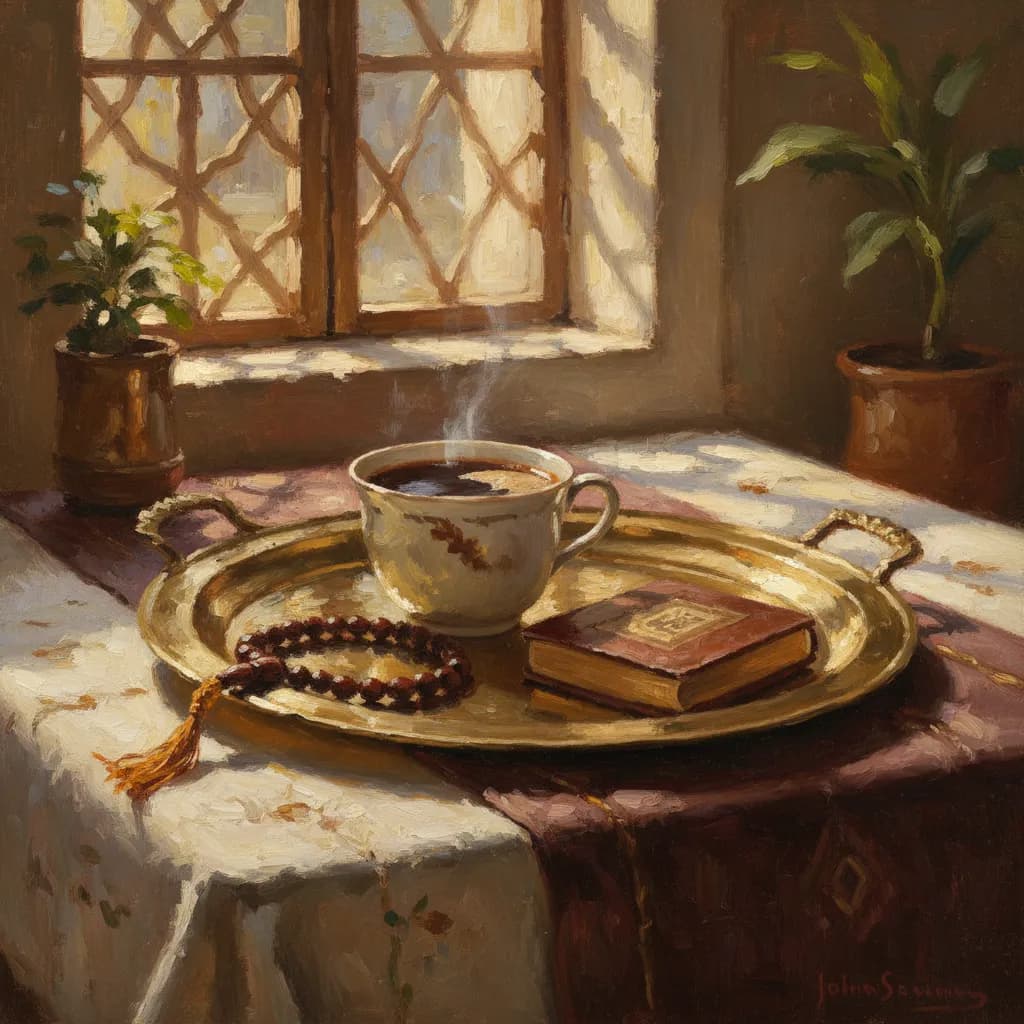
You are probably reading this mid-sip. Or maybe you are feeling guilty about the three cups you had before Dhuhr. Or perhaps someone in your community told you coffee is haram and you are not sure what to believe. Whatever brought you here, this is a question worth answering properly — not just the ruling, but what Islam actually teaches about your relationship with the things you consume daily.
Coffee is one of those topics where the fiqh is straightforward, but the self-improvement angle is where it gets interesting. Because the real question is not just "is it halal?" — it is "am I in control of this habit, or is it in control of me?"
The Quick Answer
Coffee is halal. The overwhelming consensus of Islamic scholars, past and present, is that coffee is permissible. It does not intoxicate, it does not impair the mind, and it does not fall under any category of prohibition.
كُلُوا وَاشْرَبُوا وَلَا تُسْرِفُوا إِنَّهُ لَا يُحِبُّ الْمُسْرِفِينَ
"Eat and drink, but do not be excessive. Indeed, He does not like those who are excessive." — (Surah Al-A'raf, 7:31)
The ruling is clear. But that verse also contains something important: the command against excess. We will come back to that.
What the Quran and Sunnah Say
Coffee did not exist in the Arabian Peninsula during the time of the Prophet ﷺ, so there is no direct hadith about it. When scholars evaluate something new, they apply a foundational principle in Islamic jurisprudence: the default ruling on food and drink is permissibility unless there is clear evidence of harm or intoxication.
The Prophet ﷺ said:
كُلُّ مُسْكِرٍ حَرَامٌ
"Every intoxicant is haram." — (Sahih al-Bukhari 5585)
Coffee does not intoxicate. It does not impair reasoning, cloud judgment, or alter consciousness the way alcohol does. For a deeper look at how scholars distinguish halal from haram, see our detailed guide.
The scholars also apply the principle of harm:
لَا ضَرَرَ وَلَا ضِرَارَ
"There shall be no harm inflicted or reciprocated." — (Ibn Majah 2341)
Moderate coffee consumption is not considered harmful by medical consensus. In fact, research suggests potential health benefits in moderation. This is categorically different from substances like alcohol, smoking, or shisha, where the harm is documented and severe.
The historical context is fascinating. Coffee originated in Yemen and Ethiopia — the heart of the Muslim world. In the 15th century, Sufi scholars in Yemen used coffee to stay awake for nighttime dhikr and worship. Coffeehouses spread across the Ottoman Empire and became centres of intellectual life, poetry, and community. In the early 1500s, some governors briefly banned coffee, arguing it was an intoxicant or that coffeehouses bred sedition. These bans were short-lived. The scholarly consensus settled firmly on permissibility, and coffee became one of the Muslim world's greatest cultural exports. IslamQA discusses the permissibility of coffee in detail.
Why This Is Actually Hard
If coffee is halal, why are you still reading? Because the ruling is not really the issue.
The issue is what happens when coffee becomes a dependency. When you cannot start your day, focus on your work, or even feel normal without caffeine. When missing your morning cup gives you headaches, irritability, and brain fog. When you are drinking four, five, six cups a day and your sleep — the sleep you need for Fajr — is suffering.
Your nafs will tell you this is fine because "it is halal." But Islam's standard is not just "is this technically permitted?" Islam's standard is: are you in control of yourself? The concept of wasatiyyah — the middle path, moderation — runs through everything. A halal thing consumed without restraint can still be a problem for your spiritual growth. This is the same principle that applies to understanding what makes something halal versus haram — it is not always black and white.
What to Do About It — Practical Steps
This is not about quitting coffee. It is about making sure coffee serves you, not the other way around.
1. Audit your actual intake. For one week, count every cup, every energy drink, every caffeinated tea. Most people underestimate their consumption by 30-40%. You cannot improve what you do not measure.
2. Set a daily limit and a cutoff time. Two to three cups before Dhuhr is a reasonable guideline. Caffeine after Asr will likely disrupt your sleep — and disrupted sleep makes Fajr harder. If Fajr is suffering because of your caffeine habits, that is a sign something needs to change.
3. Replace one cup with something better. Swap your afternoon coffee with herbal tea, water, or — better yet — a moment of dhikr. The afternoon slump is often dehydration or mental fatigue, not a caffeine deficit. Use that moment to reset spiritually instead of reaching for another cup.
Build habits that serve your deen, not just your energy levels
Deen Back helps you track your daily Islamic habits — from Fajr consistency to dhikr streaks. Replace autopilot routines with intentional worship.


Free download. Premium features available in-app.
4. Test your dependency. Try one weekend without caffeine. Not as punishment, but as information. If you get severe headaches and cannot function, that tells you something important about how much control this substance has over you. A Muslim should be able to go without any halal thing for a day without falling apart.
5. Reframe coffee as a blessing, not a need. Before your first cup, say Bismillah. After it, say Alhamdulillah. This small act of consciousness transforms an unconscious habit into a moment of gratitude. You will naturally drink less when you are actually paying attention to each cup.
6. Protect your sleep for worship. The Prophet ﷺ encouraged sleeping early and waking for the last third of the night. If caffeine is keeping you up until midnight, it is indirectly competing with your qiyam al-layl. Adjust accordingly. Unlike substances that are inherently harmful like nicotine, coffee just requires mindful boundaries.
Dua for Moderation and Self-Control
اللَّهُمَّ إِنِّي أَعُوذُ بِكَ مِنْ شَرِّ نَفْسِي وَمِنْ شَرِّ كُلِّ دَابَّةٍ أَنْتَ آخِذٌ بِنَاصِيَتِهَا
"O Allah, I seek refuge in You from the evil of my own self and from the evil of every creature that You hold by its forelock." — (Abu Dawud 5074)
Ask Allah to give you mastery over your habits, not just permission to have them. Tawbah is not only for haram things — it is for any pattern that distances you from your best self.
Common Questions
Is it okay to drink coffee before Fajr prayer?
Yes. There is nothing wrong with having coffee before Fajr. In fact, many Muslims drink coffee at suhoor during Ramadan to help with energy during the fasting day. Just make sure it does not replace a proper meal or adequate hydration.
Are coffee-flavoured desserts and drinks halal?
Coffee-flavoured foods are halal as long as the other ingredients are halal. Watch out for alcohol-based flavourings (like some tiramisu recipes that use rum or liqueur) and non-halal gelatin. The coffee itself is not the issue — check the full ingredient list. For more on ingredients to watch, see our post on what makes something halal vs haram.
Is it haram to spend a lot of money on coffee?
Spending money on coffee is permissible, but israf (extravagance) is discouraged in Islam. If your daily coffee shop habit is costing you money you need for obligations — family, zakat, savings — that is a problem of priorities, not a problem with coffee itself. The verse from Surah Al-A'raf (7:31) about not being excessive applies to spending as much as to consumption.
Your Journey Starts Now
Coffee is halal. That is settled. But the deeper question — whether your daily habits are serving your deen or quietly working against it — is one only you can answer.
Islam does not ask you to give up every good thing. It asks you to be intentional. To consume with gratitude, not compulsion. To build a life where you are in control of your habits, not the other way around.
Start small. Audit your intake this week. Replace one unconscious cup with a conscious moment of dhikr. Protect your sleep for Fajr. These are not dramatic changes — they are the kind of steady, consistent improvements that the Prophet ﷺ said are most beloved to Allah.
Take control of your daily habits with Deen Back
Track your worship, build streaks, and replace autopilot routines with intentional spiritual growth. Your best habits start with one day.
Free download. Premium features available in-app.
Frequently Asked Questions
Is coffee haram in Islam?
No. Coffee is halal (permissible) according to the consensus of Islamic scholars. Coffee does not intoxicate, does not impair the mind, and does not cause the kind of harm that would make it prohibited. The default ruling on food and drink in Islam is permissibility unless there is clear evidence of prohibition, and no such evidence exists for coffee.
Was coffee ever banned in the Muslim world?
Yes, briefly. In the early 1500s, some Ottoman-era governors and scholars attempted to ban coffee, arguing that it was an intoxicant or that coffeehouses encouraged immoral behaviour. These bans were short-lived and reversed. The overwhelming scholarly consensus settled on permissibility, and coffee became deeply embedded in Muslim culture.
Is caffeine addiction a sin in Islam?
Caffeine dependency itself is not classified as a sin. However, Islam teaches moderation in all things and warns against letting any substance or habit control you. If your coffee consumption is excessive, harms your health, disrupts your sleep and worship, or you feel you genuinely cannot function without it, that dependency is worth addressing from a spiritual self-improvement perspective.
Is decaf coffee halal?
Yes. Decaf coffee is halal. The decaffeination process does not introduce any haram substances. Both regular and decaffeinated coffee are permissible.
Can I drink coffee while fasting in Ramadan?
You cannot consume any food or drink, including coffee, during fasting hours (from Fajr to Maghrib). However, coffee is perfectly permissible during non-fasting hours — before Fajr (suhoor) and after Maghrib (iftar). Many Muslims enjoy coffee at suhoor to help with the day ahead.