
- Published on
How to Stop Feeling Spiritually Empty as a Muslim
- Authors

- Name
- Ahmad
- Role
- Senior Marketing Manager, Islamic education • Deen Back
بِسْمِ اللهِ الرَّحْمٰنِ الرَّحِيْمِ
In the name of God, the Most Gracious, the Most Merciful.
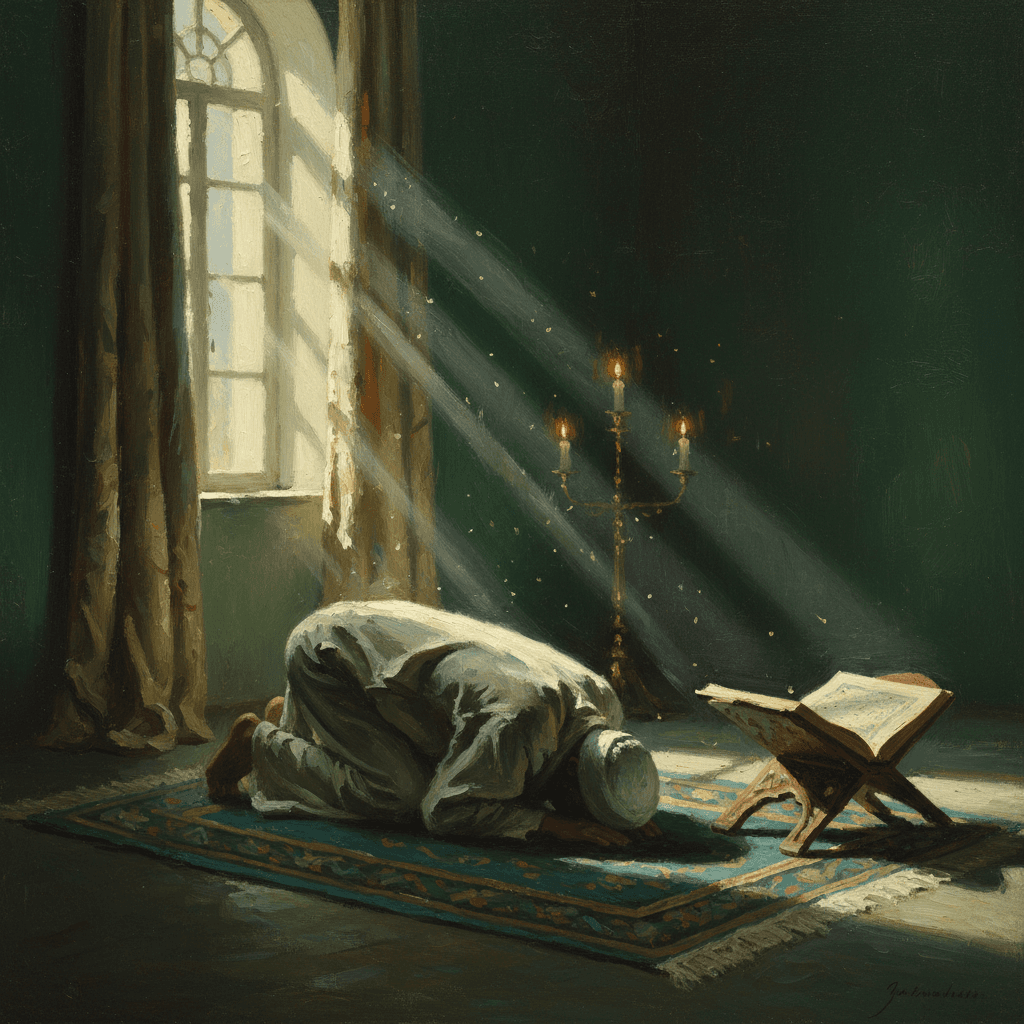
You pray, but it feels mechanical. You read Quran, but the words slide off the heart. You do the right things on the outside while feeling hollow on the inside.
Spiritual emptiness might be the most widespread and least discussed struggle in Muslim communities. People talk about quitting sin, building habits, and increasing worship — but almost no one talks honestly about what it feels like when the connection to Allah seems to have gone quiet.
If you are there right now, this is for you.
Why This Happens — and Why It Is Not What You Think
The nafs has a particular trick it plays on people in this state. It whispers: "You have drifted too far. You prayed without presence for too long. You sinned too often. You are too far gone to come back."
That voice is the nafs protecting its own comfort. Emptiness is what it wants — because emptiness is passive, and the nafs thrives on inertia.
The truth is different. The Quran says that Allah is closer to you than your jugular vein (Surah Qaf, 50:16). That closeness does not disappear when you drift. What drifts is your awareness of it.
Spiritual emptiness is almost always a symptom of one or more of the following:
The heart has become covered. The Prophet ﷺ said: "When the servant commits a sin, a black dot appears on his heart. If he repents, the dot is erased. If he continues sinning, the dots multiply until the heart is completely covered." (Ibn Majah 4244) Persistent minor sin — careless backbiting, habitual screen use without dhikr, ignoring salah — creates this covering gradually.
The spiritual diet has become unbalanced. Hours of entertainment, social media, and dunya consumption versus minutes of Quran and dhikr. The heart feeds on what it is given. If it is given nothing nourishing for long enough, it becomes numb.
Unresolved grief, guilt, or wounds. Spiritual emptiness sometimes sits on top of unprocessed pain. The person who lost someone, failed publicly, or carries deep shame often finds that the pain creates a wall between them and Allah — not because Allah withdrew, but because the pain has not been brought to Him honestly.
The Gap Between Knowing and Doing
Here is the pattern that keeps people stuck: they know what to do. They have been told to pray tahajjud, read Quran, do dhikr, make tawbah. And they have tried. And it felt forced and hollow.
So they conclude the methods do not work for them, or that they are beyond recovery.
What is actually happening is that consistency is needed before the feeling returns. The feeling of connection does not initiate the practice — the practice initiates the feeling. This is the most important thing to understand.
The Prophet ﷺ loved consistent small deeds above large but sporadic ones (Sahih Bukhari 6465). This was not just an ethical preference — it was an insight into how the heart works. Small consistent acts of worship chip away at the covering, gradually.
Step-by-Step: Rebuilding from Emptiness
Step 1: Make one sincere tawbah
Not a list of everything you have ever done wrong. One honest moment of turning back.
"Ya Allah, I have been distant. I do not even know exactly where it started. But I am here now, asking You to take me back."
The Prophet ﷺ said: "Allah, the Almighty, said: 'I am as My servant thinks I am. I am with him when he remembers Me.'" (Sahih Bukhari 7405)
Turn back. He is waiting.
Step 2: Protect your one prayer
If you are praying all five, choose the one that feels most meaningful and protect it with full presence. If you have been missing prayers, start with Fajr — it anchors the day.
Do not try to fix everything at once. One salah, prayed with genuine attention to the words, does more for spiritual emptiness than ten rushed ones.
Step 3: Add five minutes of Quran daily
Not an hour. Five minutes. Choose a surah you love or a passage you understand. Read it slowly. The barakah of Quran on the heart is unlike anything else — but the nafs will resist it, precisely because it works.
Step 4: Cut the thing that is feeding the emptiness
There is almost always one behavior that is actively deepening the disconnect — an excessive time sink, a habitual sin, a relationship that pulls you away from Allah. You do not have to cut everything at once. Identify the one thing doing the most damage and make a decision.
Rebuild Your Spiritual Connection One Day at a Time
DeenBack helps you track your salah, dhikr, and Quran habits with gentle accountability — the daily consistency that rebuilds a connection that feels gone.


Free download. Premium features available in-app.
Step 5: Talk to Allah as if He can hear you — because He can
One of the most underused tools for spiritual emptiness is informal dua. Not the formal Arabic — just your own words, in whatever language, telling Allah exactly what you are feeling.
"I feel empty and I do not know why. I feel distant from You. I am doing the actions but I cannot feel them. Help me feel something again."
Allah hears this. And responding to it is in His nature — He says in the Quran: "And when My servants ask about Me — indeed I am near. I respond to the call of the caller when he calls upon Me." (Surah Al-Baqarah, 2:186)
Step 6: Be patient with the timeline
The Prophet ﷺ described iman like rain — it falls on the earth, and different hearts respond like different soil. Some bloom immediately. Some take longer. But the rain does not fall for nothing.
You are not going to feel the warmth of connection on day 3 of a new habit. But by day 30, if you have been consistent, the heart begins to soften.
For more on reconnecting specifically, see how to feel close to Allah again and how to repent for major sins in Islam. If depression is part of what you are experiencing, dua for depression gives specific supplications used in these moments. Building the tawbah practice is covered in how to make sincere tawbah.
Common Mistakes That Keep People Stuck
Waiting to feel motivated before starting. Motivation follows action in spiritual matters — it does not precede it. Show up for salah without the feeling. The feeling will come later.
Trying to return to peak spirituality immediately. You are not going from zero to tahajjud every night in week one. You are going from zero to one consistent action. That is the goal.
Confusing spiritual emptiness with being a bad Muslim. Spiritual emptiness is a condition of the heart in a specific season. It is not a verdict on your worth or your relationship with Allah. Many of the greatest Muslims experienced dark periods of spiritual dryness.
Isolating yourself from community. The nafs thrives in isolation. Even sitting in a masjid without praying has an effect. Being around other Muslims, attending a halaqa, or simply being in a space of dhikr begins to shift the environment the heart is living in.
The Practice That Rebuilds Everything
There is a dua the Prophet ﷺ taught that addresses this state directly:
اللَّهُمَّ أَعِنِّي عَلَى ذِكْرِكَ وَشُكْرِكَ وَحُسْنِ عِبَادَتِكَ
Allahumma a'inni 'ala dhikrika wa shukrika wa husni 'ibadatik
"O Allah, help me to remember You, to thank You, and to worship You in the best manner." — (Abu Dawud 1522)
This dua asks Allah for the very things the empty heart cannot produce on its own — remembrance, gratitude, and proper worship. Say it every day after Fajr. It is an acknowledgment that the rebuilding is not something you do alone.
Start Your Spiritual Rebuilding Today
DeenBack gives you simple daily tools — salah tracking, dhikr reminders, and morning adhkar — to build the consistent spiritual practice that turns emptiness into presence.
Free download. Premium features available in-app.
Frequently Asked Questions
Why do I feel spiritually empty as a Muslim?
Spiritual emptiness in Islam is often caused by one or more of: neglecting dhikr and salah, persistent sin that hardens the heart, excessive dunya attachment, lack of Quran connection, and emotional wounds that have not been brought to Allah. It is not a sign you are beyond hope — it is a sign the heart is starving for what feeds it.
Is feeling spiritually empty a sign of weak iman?
Iman rises and falls — the Companions themselves confirmed this. Spiritual emptiness can indicate a period of low iman, but it is not the same as kufr or hypocrisy. The fact that you feel the emptiness and want to fill it is itself a sign of iman. The nafs that is completely satisfied with its emptiness is far more dangerous.
What is the fastest way to reconnect with Allah?
Scholars consistently point to three immediate actions: sincere tawbah (repentance) for whatever may have caused the disconnect, returning to consistent salah with presence, and making heartfelt dua in a moment of vulnerability — especially in the last third of the night. These do not guarantee instant results, but they open the door.
Can therapy help with spiritual emptiness?
Yes. Spiritual emptiness and clinical depression or anxiety often overlap. If the emptiness is accompanied by hopelessness, inability to function, or thoughts of self-harm, seeking professional help is an Islamic obligation — the Prophet ﷺ said to seek treatment. Spiritual and psychological tools work together, not against each other.
How long does it take to rebuild a spiritual connection?
There is no fixed timeline. Some people experience a shift within days of sincere effort. Others rebuild slowly over weeks and months. What matters is consistency over perfection — showing up for salah and dhikr even when you feel nothing is the act of faith that eventually produces the feeling.