
- Published on
What Is the Ummah? How the Muslim Community Can Transform Your Deen
- Authors

- Name
- Ahmad
- Role
- Senior Marketing Manager, Islamic education • Deen Back
بِسْمِ اللهِ الرَّحْمٰنِ الرَّحِيْمِ
In the name of God, the Most Gracious, the Most Merciful.
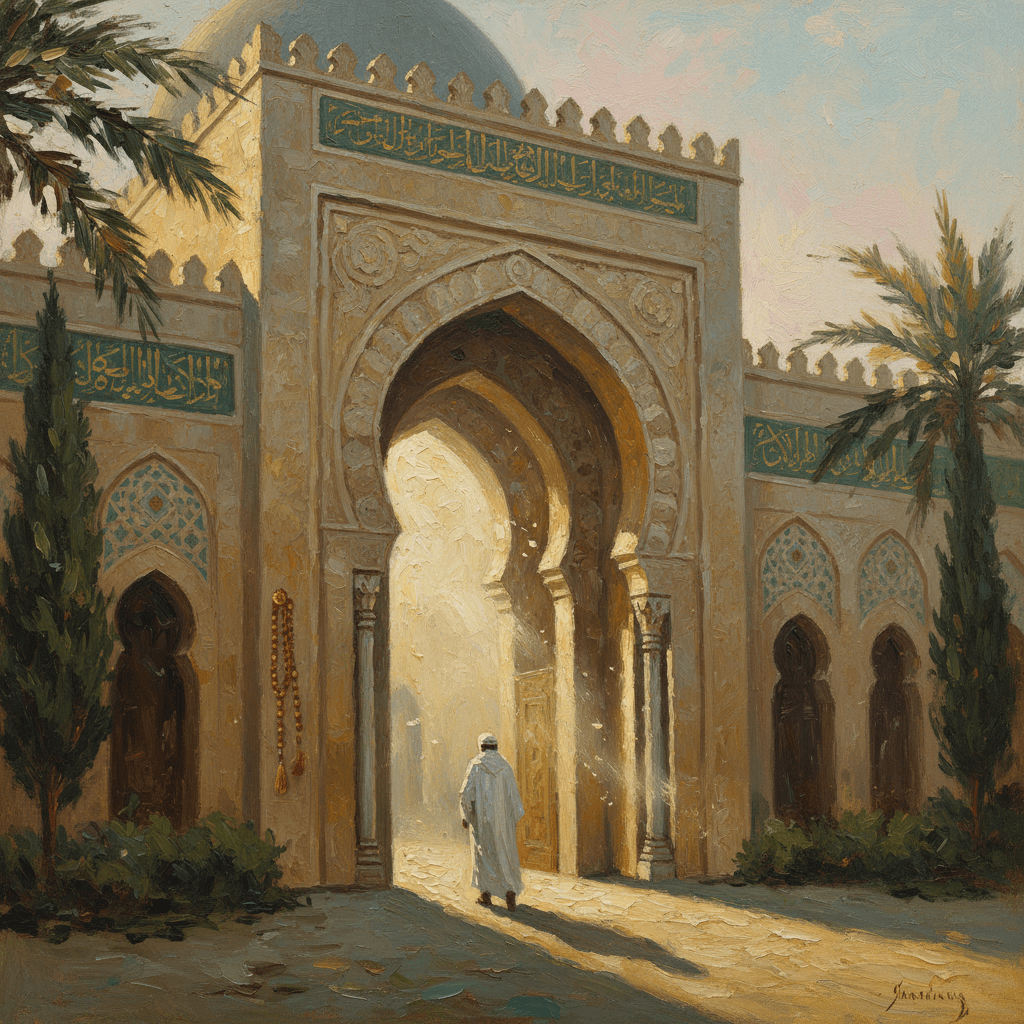
Have you ever felt that odd sense of kinship with a complete stranger — someone you have never met, in a country you have never visited — simply because they are Muslim?
That feeling has a name. It is the Ummah making itself known.
The Ummah is not a political slogan or a historical concept that ended with the early Islamic caliphate. It is a living, active reality — a bond the Prophet ﷺ described and that Muslims experience every day, even when they cannot articulate what they are feeling.
What the Ummah Actually Is
The word Ummah (أمة) in Arabic carries the sense of a group united by a shared thing — a shared belief, a shared leader, a shared time. In the Quran, it is used for different communities: the Ummah of Abraham, the Ummah of previous prophets, and — most centrally — the Ummah of Muhammad ﷺ.
The Prophet ﷺ described the Ummah in the most visceral terms possible: "The believers, in their mutual mercy, love, and compassion for one another, are like one body. When one part of it suffers, the whole body responds with sleeplessness and fever." (Sahih Bukhari 6011)
This is not a metaphor about organizational unity. It is a description of a felt bond — real, organic, embodied. When one Muslim suffers anywhere in the world, every Muslim is meant to feel it. When one Muslim succeeds, the community is strengthened. The Ummah operates more like a family than a nationality.
The Quran names this Ummah explicitly:
كُنتُمْ خَيْرَ أُمَّةٍ أُخْرِجَتْ لِلنَّاسِ تَأْمُرُونَ بِالْمَعْرُوفِ وَتَنْهَوْنَ عَنِ الْمُنكَرِ وَتُؤْمِنُونَ بِاللَّهِ
"You are the best community raised up for humanity: you command what is right, forbid what is wrong, and believe in Allah." — (Surah Ali 'Imran, 3:110)
This verse carries both honor and obligation. The Ummah is not praised for being a passive collective — it is praised for what it actively does: commanding right, forbidding wrong, and believing in Allah. Identity comes with responsibility.
One Ummah, Every Background
The Ummah crosses every human boundary that would otherwise divide people: ethnicity, language, nationality, social class, tribe. The Prophet's final sermon at Hajj made this explicit: "There is no superiority of an Arab over a non-Arab, nor of a non-Arab over an Arab, nor of a white man over a black man, nor of a black man over a white man, except by taqwa" (Musnad Ahmad 23489).
This was revolutionary in the 7th century and remains radical today. The Ummah's unity is not a nice sentiment — it is a structural challenge to every hierarchy based on birth, blood, or border.
Why Modern Muslims Struggle to Feel the Ummah
The irony of the digital age is that Muslims have more access to information about other Muslims than any generation in history — and yet many feel more isolated and disconnected than ever. You can see news about the Ummah suffering globally 24 hours a day, and the result is often numbness rather than connection.
Part of this is the nature of online community — it provides the sensation of connection without the substance of it. You can follow Muslim scholars on social media, read about Islamic events, and feel vaguely connected to the Ummah while being completely isolated from actual Muslim community in your physical life.
The nafs also plays a role. It prefers isolation, because isolation makes consistent worship and accountability harder. A Muslim surrounded by a genuine community has built-in structures that challenge the nafs — the Friday prayers, the accountability of being known, the mirror of other people's practice. The nafs prefers to minimize these.
There is also the sectarian damage — the way Muslims in some communities are taught to view other Muslims with suspicion based on theological or political differences. These divisions are real but they should not overwhelm the fundamental bond of the Ummah.
How to Make the Ummah Real in Your Life
The Ummah becomes real through specific, consistent practices — not through abstract loyalty declarations.
Make Jummah non-negotiable. The weekly Friday prayer is the Ummah at its most immediate and physical. When you stand in rows with other Muslims and make the same sujood, the concept becomes embodied. If attending Jummah is difficult for logistical reasons, address those reasons as a priority.
Make dua for the Ummah consistently. The Prophet ﷺ made dua for the entire community regularly. Dua for Muslims you will never meet — in Gaza, in Myanmar, in your own city — is an active expression of Ummah membership. It is also transformative: it is hard to feel isolated from people you are regularly praying for.
Give sadaqah to serve the Ummah. Money given to organizations serving Muslim communities — medical care, education, refugees, orphans — is one of the most direct ways to act on Ummah solidarity. The sense of connection that comes from actually contributing is qualitatively different from reading about need.
Find real Muslim community. Local masjid circles, Islamic study groups, Muslim professional networks — whatever is available in your area. Online community is supplementary; in-person community is foundational. The Prophet ﷺ said: "A Muslim is a brother to another Muslim" (Sahih Bukhari 2442). Brotherhood is a relationship, not a feeling — it requires contact.
Learn Muslim history and scholarship. Knowing the Sahabah, reading the Seerah, understanding the scholars who built Islamic civilization — this deepens your felt connection to the Ummah across time, not just geography. You are not just connected to the Muslims alive today; you are part of a 1400-year continuum.
Practice the Prophet's habits of community care. The Sunnah includes specific practices that build community: greeting with salam, visiting the sick, attending funerals, accepting invitations. Each of these is not just an individual act of worship — it is an act of Ummah building.
Build Daily Habits That Connect You to Something Bigger
DeenBack helps you track the daily practices — dhikr, dua for the Ummah, consistency in worship — that root you in something bigger than yourself.


Free download. Premium features available in-app.
Signs That You Are Living the Ummah
You begin to feel news about Muslim communities worldwide not as abstract information but as something that touches you. You make dua without being prompted. You find yourself giving sadaqah more regularly because the need feels personal.
In local community, you start to show up not just when it is convenient but because you recognize the obligation of presence. You greet Muslims warmly, including strangers. You feel a slight rightness when you see another Muslim across a crowded non-Muslim space — that moment of mutual recognition is the Ummah, in miniature.
You feel accountable to the community in your private behavior — not from surveillance, but from genuinely not wanting to be the Muslim who makes the Ummah look worse or weakens its position in your context.
Common Questions About the Ummah
Is there one Islamic leader of the Ummah?
The Caliphate — a unified political leadership of the Muslim world — ended historically with the dissolution of the Ottoman Caliphate in 1924. Today there is no single political leader of the Ummah. Leadership is distributed across scholars, community leaders, and national contexts. The spiritual and ethical unity of the Ummah does not require a single political authority.
Can non-Muslims be part of the Ummah?
The Ummah in its primary sense refers specifically to the Muslim community. However, the Prophet ﷺ used the term in the Constitution of Madinah to refer to the broader community of Madinah, including Jews and Muslims, suggesting that "Ummah" can have a broader social sense in some contexts. The specifically Islamic Ummah is defined by shared faith.
Should I prioritize my national identity or my Ummah identity?
These are not necessarily in conflict. Islam permits patriotism and community belonging at multiple levels. The issue arises when national or ethnic loyalty is used to justify treating other Muslims unjustly, dismissing their suffering, or dividing what Allah united. Islam does not erase nationality — it prevents it from becoming the primary moral framework.
Is the Ummah in a crisis today?
Many scholars and commentators describe the Ummah as being in a challenging period — facing both internal weaknesses (division, corruption, distance from Islamic values) and external pressures. But the Ummah has faced crises throughout history — the Mongol invasions, the Crusades, colonial occupation — and has always recovered. The question is what your contribution to that recovery will be.
You Are Already In It
You did not choose to be born into the Ummah. But you can choose how seriously you take your membership in it.
The Ummah is not an idea you opt into when it is convenient. It is a bond that comes with your shahada — an obligation of care, prayer, contribution, and solidarity that runs in every direction across the globe and across history.
The Prophet ﷺ is part of your Ummah. The Companions are part of your Ummah. The scholars who preserved this deen across fourteen centuries are part of your Ummah. And the Muslims alive today — in your city, in your country, across the world — are your brothers and sisters in the most real sense that word carries.
Show up for it.
Connect to the Ummah Through Daily Practice
The strongest contribution you make to the Ummah starts with your own daily worship. DeenBack helps you build consistent dhikr, dua, and Quran habits that make you stronger — and therefore better for everyone around you.
Free download. Premium features available in-app.
Frequently Asked Questions
What does Ummah mean in Islam?
Ummah (أمة) means 'community' or 'nation.' In Islamic theology, it refers to the global community of Muslims — approximately 1.8 billion people — who are united by their shared belief in Allah and the prophethood of Muhammad ﷺ, regardless of ethnicity, nationality, or language.
Is the Ummah a political concept or a spiritual one?
Both, but primarily spiritual. The Ummah is fundamentally a community of shared faith and shared obligations. Throughout history, it has had political expressions — the early Islamic state, the Caliphate — but the core concept is spiritual: believers are one body, and what affects one affects all.
Why do Muslims say 'the Ummah is suffering'?
The Prophet ﷺ described the Muslim community as one body — what affects one part affects the whole. When Muslims in one part of the world face persecution, poverty, or oppression, every Muslim is meant to feel that. Saying 'the Ummah is suffering' is an expression of that solidarity — and a call to response.
How can I feel connected to the Ummah when I feel isolated?
Practical connection includes: attending Jummah regularly, joining an Islamic study group or community, making dua for Muslims worldwide, giving to charities that serve Muslim communities, and learning about Muslim history and scholarship. Connection requires intentional acts, not just feeling.
Does belonging to the Ummah mean I agree with all Muslims?
No. The Ummah is not a monolith. Muslims disagree on fiqh rulings, political positions, cultural practices, and many other matters. Unity is in the fundamentals — the Five Pillars, the Six Articles of Faith — not in uniformity of thought on every issue.