
- Published on
Bismillah Meaning — What You Say Before Everything Matters
- Authors

- Name
- Ahmad
- Role
- Senior Marketing Manager, Islamic education • Deen Back
بِسْمِ اللهِ الرَّحْمٰنِ الرَّحِيْمِ
In the name of God, the Most Gracious, the Most Merciful.
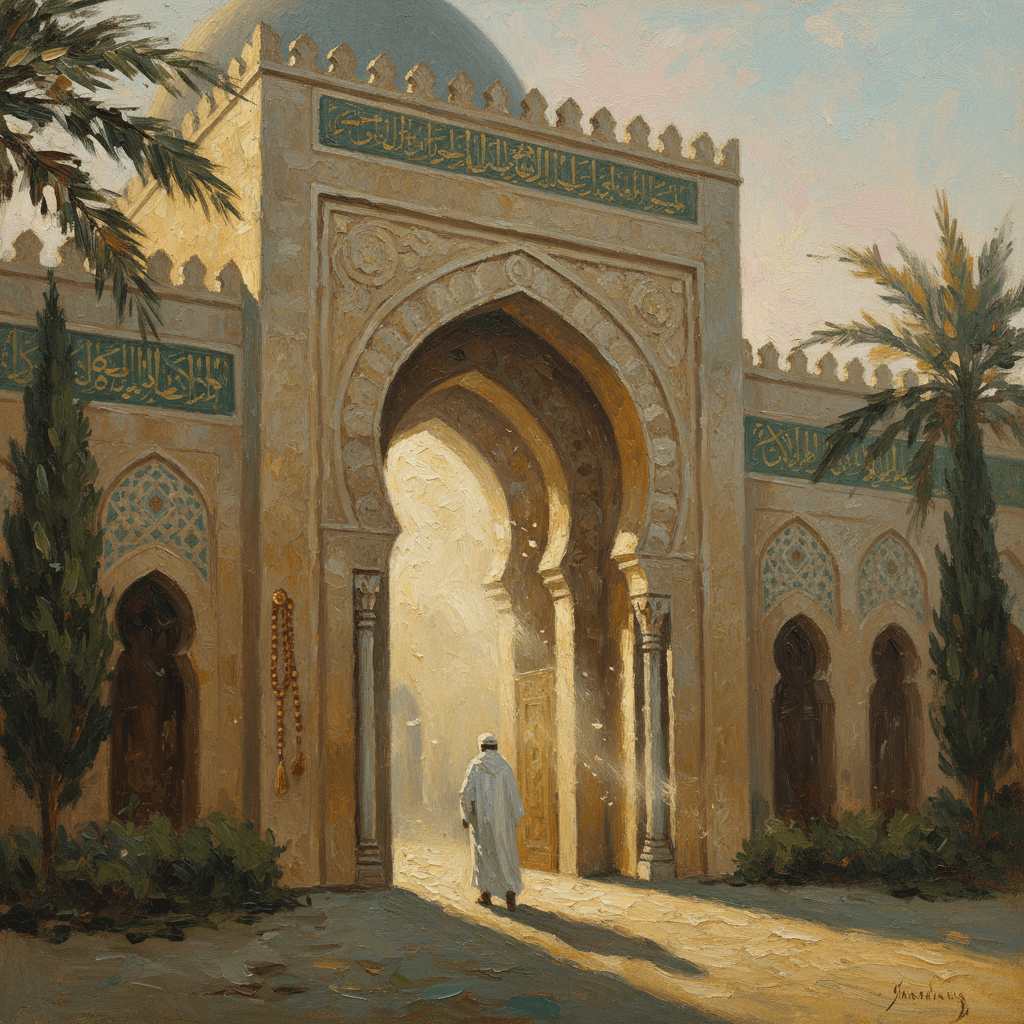
Every surah of the Quran begins with it — except one. The entire universe was created through divine command that begins with His name. The Prophet ﷺ said that any important matter not begun with it is cut off from blessing.
Three words. Fourteen Arabic letters. And yet most Muslims say Bismillah ir-Rahman ir-Rahim dozens of times a day without having ever unpacked what those words actually mean.
This matters. Because the difference between a habit and a living practice is understanding. When you know what you are saying, saying it changes you.
The Full Meaning — Breaking It Down
بِسْمِ اللَّهِ الرَّحْمَٰنِ الرَّحِيمِ
Bismillahi ir-Rahmani ir-Rahim
"In the name of Allah, the Most Gracious, the Most Merciful."
Three components:
بِسْمِ (Bi-ismi) — "In the name of." The Arabic preposition bi here carries the meaning of invoking, seeking assistance through, and beginning by. When you say bismillah before an action, you are declaring: "I do this through the power of His name and the blessing that comes from it." You are not acting on your own strength. You are connecting your action to the Source of all action.
اللَّهِ (Allah) — The proper name of God in Islam. Not a title, not a description — a name. It is the name that encompasses all other names and attributes. Ibn al-Qayyim wrote that this name is the greatest name of Allah, the one that all other names and attributes return to. When you say Allah, you are addressing the One who is deserving of all worship, the One on whom everything depends.
الرَّحْمَٰنِ (Ar-Rahman) — The Most Gracious. From the root r-h-m, meaning womb-like closeness and mercy. Rahman describes Allah's mercy as all-encompassing, present for every created being in this world — believer and disbeliever, human and animal, seen and unseen. The rain falls on everyone. The sun rises for everyone. This is Rahman — mercy so vast it cannot exclude anything.
الرَّحِيمِ (Ar-Rahim) — The Most Merciful. Also from r-h-m, but describing a specific, ongoing, intimate mercy. This is the mercy reserved especially for the believers — the mercy that forgives sins, accepts repentance, answers prayers, and will be most fully experienced in the hereafter. Rahim is personal in a way that Rahman is cosmic.
Together: Rahman is the ocean of mercy that everything swims in. Rahim is the current that specifically carries the believer home.
Why the Prophet Said It Before Everything
The Prophet ﷺ taught:
كُلُّ أَمْرٍ ذِي بَالٍ لَا يُبْدَأُ فِيهِ بِبِسْمِ اللَّهِ فَهُوَ أَبْتَرُ
"Every important matter that does not begin with 'In the name of Allah' is cut off [from blessing]."
— (Abu Dawud 4840, Ibn Majah 1894)
The word abtar (cut off) means something that is severed from its root — fruitless, incomplete, without barakah. An action begun without Bismillah may still succeed technically, but it is disconnected from the divine blessing that could have multiplied its impact.
The Sunnah records Bismillah before eating, drinking, entering the house, beginning the salah, putting on clothes, entering the bathroom (a variation: Bismillah before), beginning wudu, leaving the house, beginning a journey, and slaughtering an animal. In each case, the logic is the same: connect the action to Allah before beginning it.
And practically: saying Bismillah transforms the act. Eating becomes an act of gratitude. Putting on clothes becomes a recognition of Allah's provision. Leaving the house becomes a trust in His protection. The same physical action becomes spiritually different depending on whether you say those three words.
Bismillah and the Quran — An Inseparable Bond
The Quran opens with Bismillah. It begins 113 of its 114 surahs with Bismillah. The only surah that does not begin with it — Surah At-Tawbah — is considered by many scholars to have no Bismillah because of its nature (it is a declaration that ends the peace treaty with those who broke it). And notably, Surah An-Naml (27:30) includes a Bismillah within its verses — making some scholars count this as the 114th Bismillah in the Quran.
The significance is this: the very word of Allah that Muslims are commanded to read and memorize begins with this invocation. You cannot recite Quran without beginning with Bismillah. You cannot pray without it. It is woven into the fabric of Islamic practice at the most fundamental level.
If you want to explore the opening surah of the Quran in depth, read about the benefits of Surah Fatiha — a surah that contains another Bismillah and opens with the praise of Allah, the Most Gracious, the Most Merciful.
Turn Bismillah Into a Real Daily Habit
DeenBack tracks your daily dhikr and helps you build the intentional habits — like saying Bismillah before every action — that transform ordinary moments into acts of worship.


Free download. Premium features available in-app.
How to Make Bismillah More Than a Reflex
Most practicing Muslims say Bismillah before eating. That is a start. But the Sunnah envisions something more comprehensive.
The full list of times to say Bismillah:
- Before eating and drinking (Tirmidhi 1858)
- Before beginning wudu (Abu Dawud 101)
- Before entering the bathroom (in a modified form)
- When leaving the house: Bismillah, tawakkaltu alallah, wa la hawla wa la quwwata illa billah (Tirmidhi 3426)
- Before starting any important work or task
- Before reciting Quran or beginning salah
- Before slaughtering an animal (this is required for the meat to be halal)
- Before intimacy between spouses (Bukhari 141) — this protects the child from Shaytan's influence
The habit of saying Bismillah before every action is, in essence, the habit of constant dhikr — constant remembrance of Allah throughout the ordinary moments of life.
A practical technique: anchor Bismillah to transitions. Every time you move from one activity to another — sitting down to work, picking up your phone, starting to cook — say Bismillah first. You do not need to make it dramatic. A quiet, intentional "Bismillah" before unlocking your phone changes the relationship you have with that phone.
This connects to the broader practice of how to do morning adhkar — beginning the day with intentional remembrance of Allah sets the context for everything that follows, including every Bismillah you say throughout the day.
Signs the Practice Is Becoming Real
You know Bismillah has become more than a reflex when:
- You notice when you forgot it before doing something and feel a genuine pull to correct it
- You pause before actions — even small ones — creating a micro-moment of Allah-consciousness
- You begin to experience what the Companions described as feeling the blessing (barakah) differently in things you begin with it versus things you rush into
- You naturally say alhamdulillah at the end of actions, creating a full arc: begin with Allah's name, end with His praise
These signs are not about performance. They are internal. The nafs wants every religious act to be visible and acknowledged. Bismillah is often the opposite — private, constant, and accumulating silently into a life characterized by divine connection.
Common Questions
"Is saying Bismillah once before a meal sufficient, or do I need to say it before each dish?" One Bismillah at the beginning of a meal covers the entire meal according to the majority of scholars. If you are eating in courses or a very extended meal with breaks, renewing it between breaks is recommended. The intention at the start covers what follows immediately.
"What if I forget to say Bismillah before eating — is my food haram?" No. The food is not haram because of forgetting Bismillah (unless it was intrinsically haram for another reason). The Prophet ﷺ specifically gave the remedy: say Bismillahi awwalahu wa akhirahu when you remember — covering both the beginning and end of the meal.
"Is there a difference between saying Bismillah and Bismillah ir-Rahman ir-Rahim?" The full form is more complete and carries the full invocation. For most daily acts (eating, drinking, leaving the house), Bismillah (abbreviated) is what the Sunnah narrations record. For beginning Quran recitation and formal prayers, the full form Bismillahi ir-Rahmani ir-Rahim is used. Both are valid invocations.
"Why don't we say Bismillah when making wudu for prayer?" Actually, the Prophet ﷺ said:
لَا وُضُوءَ لِمَنْ لَمْ يَذْكُرِ اسْمَ اللَّهِ عَلَيْهِ
"There is no wudu for the one who does not mention the name of Allah over it."
— (Abu Dawud 101, Ibn Majah 397)
Many scholars hold saying Bismillah before wudu as obligatory or strongly recommended. Start your wudu with Bismillah — it is prophetic practice. Explore how to perform wudu step by step for a complete guide.
Closing — Three Words That Change Everything
Bismillah ir-Rahman ir-Rahim.
Allah, whose mercy is so vast it encompasses all creation. Allah, whose mercy is so specific it holds you personally. All named before every act of a Muslim's life.
You say these words multiple times every day. The question is whether you say them consciously or by habit alone. The Sunnah envisions both — a habit so deep it becomes reflex, and a consciousness so alive that even the reflex carries meaning.
Start today. Before the next thing you do — before you stand up from where you are reading this — say Bismillah. Intentionally. Knowing what you are saying.
That is the beginning of everything.
Build Intentional Islamic Habits — One Bismillah at a Time
DeenBack helps you track your dhikr streaks and build the consistent daily habits that transform ordinary acts into worship. Start with Bismillah. Build from there.
Free download. Premium features available in-app.
Frequently Asked Questions
What does Bismillah mean in English?
Bismillah ir-Rahman ir-Rahim means 'In the name of Allah, the Most Gracious, the Most Merciful.' The full phrase acknowledges that every action is undertaken by invoking the name of Allah, who is characterized by two aspects of His mercy: Rahman (encompassing, all-embracing mercy) and Rahim (specific mercy toward the believers in this world and the hereafter).
What is the difference between Rahman and Rahim?
Both names come from the root r-h-m (mercy). Rahman refers to Allah's vast, all-encompassing mercy that extends to every creation — believers, disbelievers, animals, and all of existence. Rahim is the specific, ongoing mercy reserved especially for the believers. Rahman is wider; Rahim is more specific and intimate. Together they describe a mercy so vast and so personal that no human analogy fully captures it.
Why do Muslims say Bismillah before everything?
The Prophet ﷺ said 'Every important matter that does not begin with the mention of Allah is cut off (from blessing).' (Abu Dawud 4840, Ibn Majah 1894). Beginning with Bismillah connects the action to Allah, invites His blessing (barakah), and reminds the person that they act not by their own power alone. It transforms ordinary acts into potential acts of worship.
Is Bismillah part of Surah Fatiha?
There is scholarly difference on this. The Shafi'i school holds that Bismillah is the first verse of Surah Fatiha and must be recited aloud in prayer. The Hanafi school considers it a separate verse placed at the beginning of each surah but not part of the surah itself — it is recited silently in prayer. Both positions have strong evidence. The Quran begins with it, and it opens 113 of the 114 surahs.
What should I do if I forget to say Bismillah before eating?
The Prophet ﷺ gave a remedy for this: if you forget to say Bismillah before eating, say 'Bismillahi awwalahu wa akhirahu' (In the name of Allah at its beginning and its end) when you remember. (Abu Dawud 3767, Tirmidhi 1858) This covers the oversight and restores the intention of the meal.