
- Published on
Al-Majeed: Meaning, Benefits, and How to Connect With This Name
- Authors

- Name
- Ahmad
- Role
- Senior Marketing Manager, Islamic education • Deen Back
بِسْمِ اللهِ الرَّحْمٰنِ الرَّحِيْمِ
In the name of God, the Most Gracious, the Most Merciful.
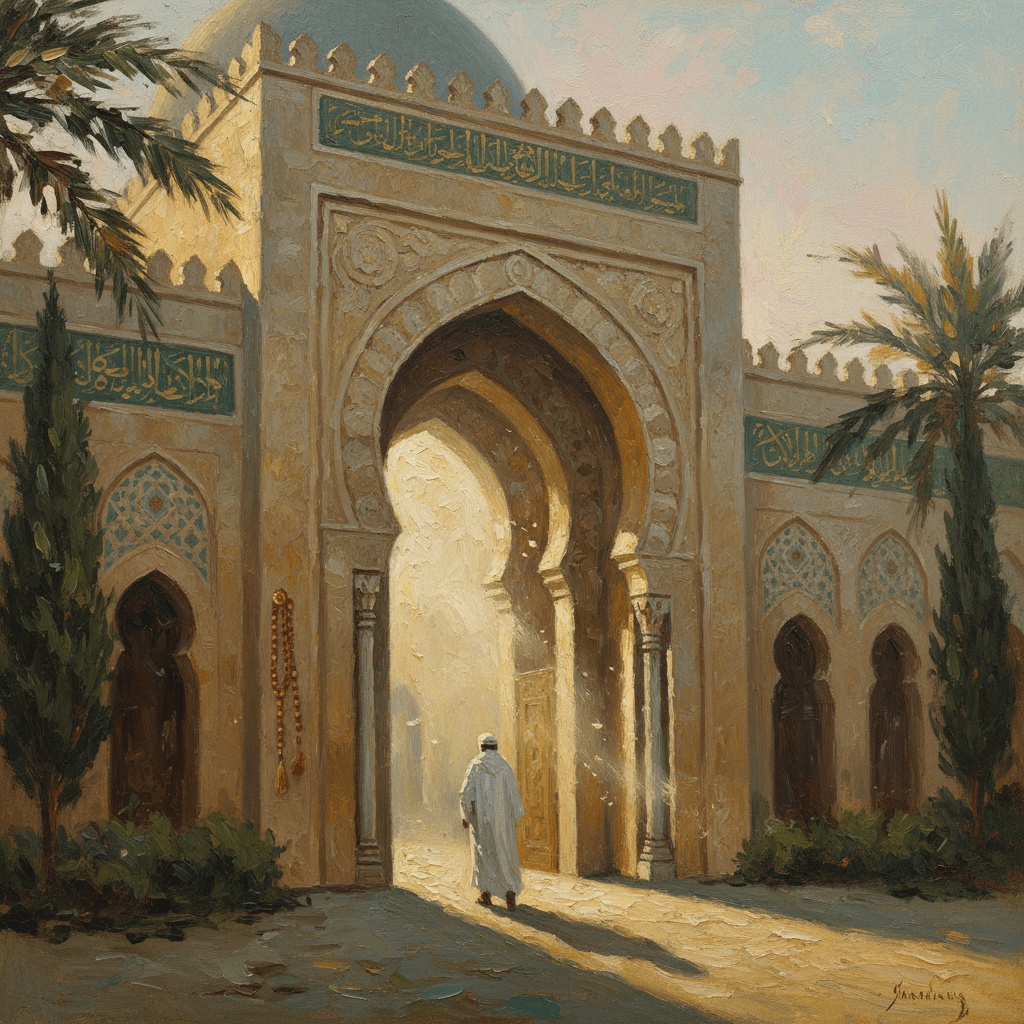
You say it at least seventeen times every day. In every prayer, in the Tashahud, your tongue forms the words: innaka Hameedun Majeed — "Indeed You are the Praiseworthy, the Most Glorious."
But do you pause on what you are saying?
Al-Majeed (الْمَجِيدُ) is one of the 99 Names of Allah. It is not one of the most commonly known, but it is one of the most frequently invoked — embedded directly into the prayer structure that anchors every Muslim's day.
What Al-Majeed Means
The Arabic root m-j-d (م-ج-د) carries meanings of nobility, elevation, honor, and boundless glory. In classical Arabic, majd describes honor that is both high in status and expansive in generosity — not a closed-off greatness but a greatness that reaches outward.
Al-Majeed combines two dimensions:
- Elevation of status — above all comparisons, beyond any limitation
- Nobility in action — a glory that expresses itself through giving, mercy, and generosity
Ibn Al-Qayyim (rahimahullah) explained that al-Majeed contains the qualities of grandeur ('azhamah), beauty (jamal), and magnanimity (karam). It is not just that Allah is great — it is that His greatness overflows into generosity. Truly great kings and leaders historically were called majeed not merely for power but for the way that power benefited those around them.
Applied to Allah: His glory is not self-contained. It is the source from which all goodness, mercy, and blessing flow to creation.
Where This Name Appears in the Quran
Al-Majeed appears twice.
First: In Surah Hud, when the angels visit Ibrahim ﷺ with glad tidings of a son:
رَحْمَتُ اللَّهِ وَبَرَكَاتُهُ عَلَيْكُمْ أَهْلَ الْبَيْتِ إِنَّهُ حَمِيدٌ مَجِيدٌ
"The mercy of Allah and His blessings be upon you, O people of the house. Indeed, He is Praiseworthy and Most Glorious." (Surah Hud, 11:73)
The context is a moment of extraordinary divine gift — the gift of a child to Ibrahim and Sarah ﷺ after they had grown old and Sarah herself expressed wonder at the news. The angels close with this name: Hameedun Majeed. His greatness is precisely the source of His capacity to give the impossible.
Second: In Surah Al-Buruj, after describing the persecution of believers who were burned alive for their faith:
ذُو الْعَرْشِ الْمَجِيدُ
"Lord of the Throne, the Most Glorious." (Surah Al-Buruj, 85:15)
Notice: this comes after one of the most difficult passages in the Quran — the burning of believers. The response is not an explanation of why it was permitted, but an affirmation of who is in control: the Lord of the Throne, the Majeed. His majesty encompasses even the most painful chapters of human history.
Al-Majeed in Your Daily Prayer
Every Muslim who prays Salah calls upon this name. The Durood Ibrahim — which scholars hold to be obligatory in the final Tashahud — contains the phrase:
إِنَّكَ حَمِيدٌ مَجِيدٌ
"Innaka Hameedun Majeed" — "Indeed You are the Praiseworthy, the Most Glorious."
This appears in both the salah upon Ibrahim and upon Muhammad ﷺ. You are saying, in every single rakat's Tashahud: "The one I am asking to bless Your Prophet is the Most Glorious One — the One whose greatness gives."
When you slow down on these words — not rushing through the Tashahud but actually pausing on Majeed — you are encountering this name of Allah in the most intimate context of Islamic worship. You are standing before Al-Majeed. Let that land.
What This Name Teaches About How to Approach Allah
Al-Majeed reshapes your approach to dua in a specific way. When you stand before someone of supreme status, two things can happen: you either freeze with unworthiness, or you lean into the nobility of the one before you — knowing that true greatness gives generously.
The Islamic teaching leans firmly toward the second. Allah says in Surah Al-Zumar (39:53):
قُلْ يَا عِبَادِيَ الَّذِينَ أَسْرَفُوا عَلَى أَنفُسِهِمْ لَا تَقْنَطُوا مِن رَّحْمَةِ اللَّهِ
"Say: O My servants who have transgressed against themselves — do not despair of the mercy of Allah."
The One saying this is Al-Majeed. His glory is not the kind that turns away the ordinary or the broken. His nobility, like the best of human nobility, reaches down.
When you make dua and feel unworthy — remember that Al-Majeed's greatness is specifically the kind that gives despite the smallness of the one asking.
Connecting Al-Majeed to Your Worship Practice
In Salah: The next time you reach the Tashahud, slow down on Hameedun Majeed. Pause for two seconds. You are invoking this name — standing before the Most Glorious. Let the awareness of that change your posture slightly, internal and external.
In personal dua: Open with Ya Majeed when you are asking for something that feels impossibly large. His majesty is the answer to what feels beyond reach. The One who gave Ibrahim ﷺ a child in old age is the same Al-Majeed you are addressing.
In dhikr: Alternate between Ya Hameed and Ya Majeed — they are frequently paired in the Quran for a reason. Together they capture a God who is worthy of praise and whose praise is the foundation of His generous greatness.
When facing injustice or hardship: Recall Surah Al-Buruj's context. The believers who were burned lost everything in this dunya. The Quran's response to their story is: Dhu al-Arsh al-Majeed — the Lord of the Throne, the Most Glorious, is aware, is sovereign, and His majesty encompasses this too.
Reflect on the 99 Names Every Day
DeenBack includes daily reflections on the 99 Names of Allah — including Al-Majeed — helping you pray with awareness rather than habit. Start your streak today.


Free download. Premium features available in-app.
Al-Majeed Alongside Other Names
Al-Majeed is best understood in connection with other names that describe Allah's greatness and giving:
- Al-Hameed (الحميد) — the Praiseworthy. Always paired with Al-Majeed in the Quran. Together: the Most Glorious One who is worthy of all praise.
- Al-Kareem (الكريم) — the Most Generous. Shares the element of majesty expressed through giving.
- Dhu al-Arsh — Lord of the Throne. The pairing in Al-Buruj (85:15) connects Al-Majeed directly to sovereignty over all creation.
- Al-'Azim — the Magnificient. Majesty of a different kind — enormity and weight.
For broader exploration: 99 Names of Allah, How to Memorize 99 Names of Allah, and Asma Ul Husna Benefits.
Common Questions
Is Al-Majeed mentioned in authentic hadith? Yes — in the hadith of Durood Ibrahim that appears in multiple collections, most notably in Bukhari (3370) and Muslim (406). The Prophet ﷺ taught the companions this specific salah upon himself which ends with innaka Hameedun Majeed.
Can I say Subhan Allah al-Majeed? The phrase Subhan Allah al-Azim is established from hadith. Subhan Allah al-Majeed is not specifically narrated, but praising Allah using His names in appropriate forms is permissible and recommended. Scholars encourage reflection and dhikr using all of Allah's beautiful names.
How does Al-Majeed relate to tawbah (repentance)? Al-Majeed's character of generous giving includes forgiving. When you turn to Allah in tawbah, you turn to the Most Glorious — whose noble character is to accept, to purify, to restore. This is why dua and tawbah should be made with confidence, not timidity.
Why do scholars say the Tashahud is where Al-Majeed is most present in practice? Because the Tashahud is said in every rakat, before and after prostration, by every Muslim in every prayer. It is the most frequently repeated dhikr in Muslim life. Having Al-Majeed embedded there means every practicing Muslim invokes this name minimally 17 times per day — and with it, implicitly acknowledges the nature of the One they are praying to.
Closing
Al-Majeed is the name you say every single day in prayer — whether you have thought about it or not. Today you can change that.
In your next salah, when you reach the Tashahud and say Hameedun Majeed, pause. Just for a moment. You are standing before the Most Glorious — the One whose greatness overflows as generosity, whose sovereignty encompasses all, whose nobility is the reason nothing you ask is truly too large.
That awareness — maintained for even two seconds — is the beginning of a deeper prayer.
Pray With Awareness, Not Just Habit
DeenBack helps you build focus and intention in your salah through daily reflection on the 99 Names of Allah. Connect more deeply with every prayer — starting today.
Free download. Premium features available in-app.
Frequently Asked Questions
What does Al-Majeed mean in Islam?
Al-Majeed (الْمَجِيدُ) comes from the Arabic root m-j-d, meaning glory, honor, and nobility of the highest order. As a name of Allah, Al-Majeed means the Most Glorious, the Most Honorable, the Majestic One whose greatness is perfect and complete. Ibn Kathir described it as capturing both the elevation of Allah's status and the boundlessness of His generosity — glory that gives, not glory that withholds.
Where is Al-Majeed mentioned in the Quran?
Al-Majeed appears twice in the Quran: in Surah Hud (11:73) — when the angels give Sarat Ibrahim glad tidings of a child, they describe Allah as Hameed (Praiseworthy) and Majeed (Glorious). It also appears in Surah Al-Buruj (85:15): 'Dhu al-Arsh, al-Majeed' — 'Lord of the Throne, the Most Glorious.' The second context comes after describing the punishment of those who persecuted believers, followed immediately by this name — Allah's majesty and sovereignty encompass even the darkest moments.
How is Al-Majeed connected to Durood Ibrahim?
Al-Majeed appears in the Tashahud/Durood Ibrahim that Muslims recite in every prayer: 'Allahumma salli 'ala Muhammadin wa 'ala ali Muhammadin kama sallayta 'ala Ibrahima wa 'ala ali Ibrahim, innaka Hameedun Majeed.' The last words — 'innaka Hameedun Majeed' — invoke this name directly. Every Muslim who prays invokes Al-Majeed at least seventeen times a day, though many do not pause on what they are saying.
What is the difference between Al-Majeed and Al-Jaleel?
Both describe grandeur and magnificence, but with a slight distinction. Al-Jaleel (the Majestic) tends to emphasize awe and reverence — the distance of greatness. Al-Majeed combines supreme greatness with active generosity and nobility — the giving nature of greatness. A king can be majestic without being generous; Allah's majid is a glory that extends outward through gifts, mercy, and grace.
Can I use Al-Majeed in dua?
Yes. Beginning dua with praise using Allah's names is recommended. 'Ya Majeed' (O Most Glorious) can open supplications, especially when asking for things that require recognition of Allah's absolute greatness — intercession, transformation, the lifting of difficulty that seems impossible. His majesty is the reason nothing is beyond His ability.